
Will Salm's palace become a palace of commerce?
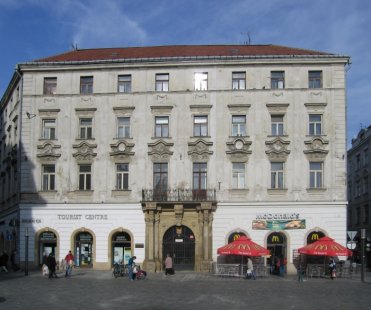
The Salm Palace is a monumental palace building in the center of the city of Olomouc - just a few steps from the UNESCO monument, the Holy Trinity Column. It is an irregular four-winged building on the site of several old burgher houses, of which the basements of Gothic origin and partially the ground floor masonry have been preserved. The Baroque eight-axial facade facing the Upper Square with its elaborate stucco decoration was created during an extensive reconstruction in 1728. At that time, the owner was Count Julius Salm, who was the president of the Moravian Diet in 1637. In the years 1791 - 1792, the two-story building was raised by one floor and topped with a mansard roof, which was removed by 1906. The interior spaces have been continuously adapted, particularly noticeable are the modifications from the interwar period and subsequently after World War II (internal partitions). Due to its historical value, the building was declared a cultural monument.
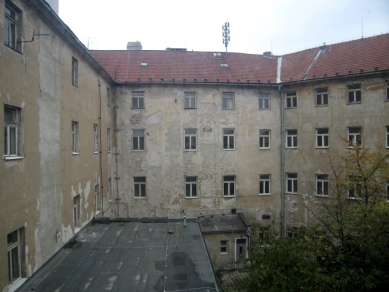
After the war, the palace belonged to the city of Olomouc; however, recently the city sold the property, and the new owner is now taking steps that should hopefully lead to a complete reconstruction and profitable use of the building. So far, only partial construction modifications of the ground floor and clearance of the premises have taken place (including insensitively removing heating units during winter). A significant proposal has now been presented that considers roofing the inner courtyard. It is a relatively large space that could accommodate the entire Primavesi villa without its garden for comparison. The roofing is being considered at the level of the first floor with the necessary support from a central column.
Is it appropriate for such a monumentally significant building in the center of a city reserve to reflect the recent trend - that is, the roofing of courtyards and yards? Undoubtedly, this represents an example of a commercially-utilitarian approach. The purpose of such a modification is not to make the cultural values of the building accessible to the public, but to financially exploit every possible area. How unaesthetic and monumentally destructive the effect of such a modification can be is visible in Brno at Freedom Square in the House of Lords of Lipá. The castle in Hranice also cannot be unequivocally considered a positive example. Moreover, the methodology of monument care does not recommend this solution. The roofing of the courtyard of this cultural monument does not represent an appropriate use, nor does it correspond to "its cultural and political significance, monument value, and technical condition," according to the Act on State Monument Care. The National Heritage Institute, as an expert organization, has therefore expressed a negative opinion on the possibility of roofing the courtyard of the Salm Palace. However, the Heritage Department of the Olomouc City Hall did not accept this approach from the expert organization and allowed the possibility of roofing. One of the reasons was the potential to hold cultural events in such a covered space. Can we really trust such an idealistic intention, especially after visiting the Palladium department store in Republic Square in Prague?
Furthermore, the current owner has still not submitted a project for the complete reconstruction of the building.
Because the NPÚ Olomouc still holds the opinion that roofing the courtyard would lead to the cultural devaluation of the building and a negative monument precedent in the city of Olomouc and the region, it has submitted a request for a review of the decision made by the Olomouc City Hall to the superior authority - the Regional Office of the Olomouc Region. We can now wait to see which approach will prevail for such a significant building in the heart of the city. What will "that heart" be like?
After the war, the palace belonged to the city of Olomouc; however, recently the city sold the property, and the new owner is now taking steps that should hopefully lead to a complete reconstruction and profitable use of the building. So far, only partial construction modifications of the ground floor and clearance of the premises have taken place (including insensitively removing heating units during winter). A significant proposal has now been presented that considers roofing the inner courtyard. It is a relatively large space that could accommodate the entire Primavesi villa without its garden for comparison. The roofing is being considered at the level of the first floor with the necessary support from a central column.
Is it appropriate for such a monumentally significant building in the center of a city reserve to reflect the recent trend - that is, the roofing of courtyards and yards? Undoubtedly, this represents an example of a commercially-utilitarian approach. The purpose of such a modification is not to make the cultural values of the building accessible to the public, but to financially exploit every possible area. How unaesthetic and monumentally destructive the effect of such a modification can be is visible in Brno at Freedom Square in the House of Lords of Lipá. The castle in Hranice also cannot be unequivocally considered a positive example. Moreover, the methodology of monument care does not recommend this solution. The roofing of the courtyard of this cultural monument does not represent an appropriate use, nor does it correspond to "its cultural and political significance, monument value, and technical condition," according to the Act on State Monument Care. The National Heritage Institute, as an expert organization, has therefore expressed a negative opinion on the possibility of roofing the courtyard of the Salm Palace. However, the Heritage Department of the Olomouc City Hall did not accept this approach from the expert organization and allowed the possibility of roofing. One of the reasons was the potential to hold cultural events in such a covered space. Can we really trust such an idealistic intention, especially after visiting the Palladium department store in Republic Square in Prague?
Furthermore, the current owner has still not submitted a project for the complete reconstruction of the building.
Because the NPÚ Olomouc still holds the opinion that roofing the courtyard would lead to the cultural devaluation of the building and a negative monument precedent in the city of Olomouc and the region, it has submitted a request for a review of the decision made by the Olomouc City Hall to the superior authority - the Regional Office of the Olomouc Region. We can now wait to see which approach will prevail for such a significant building in the heart of the city. What will "that heart" be like?
The English translation is powered by AI tool. Switch to Czech to view the original text source.

5 comments
add comment
Subject
Author
Date
největší ničitelé památek jsou památkáři a archeologové
Vladimír
26.01.08 05:06
Olomouc - quo vadis ?
26.01.08 06:09
Salmuv palac
raptor
27.01.08 07:20
To Vladimír Antipamátkář
Mgr. Jan Kubeš
28.01.08 08:08
zastresovani dvoru
palmexman
28.01.08 01:35
show all comments