
The state does not want to squat, but it cannot compel the owner to make repairs
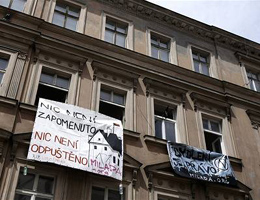 |
Authorities can fine homeowners under the building code, but also under the heritage protection law if the property is declared a cultural monument. In Prague, this has happened several times; owners may even pay the fines, but the houses continue to deteriorate. Often, it also happens that the property owner cannot be located, or does not collect official correspondence. What the company will do with its property, where squatters attempted to move in this weekend in a long-empty house in Prague 2, is unclear.
Prague squatters launched a website in April, highlighting decaying and supposedly abandoned houses and calling for them to be inhabited. Unlike some other European cities, squatting is not widespread in the Czech Republic. Homeowners are primarily concerned, supported by the media, which portray squatters as unruly elements who disregard established social norms. Squatters argue that it is better for a house to be inhabited than to be completely abandoned and fall apart. However, for the owners of at least Prague's abandoned houses, the intention is often precisely for the house to fall down and convert into a lucrative plot of land.
Not all houses that squatters list as abandoned are actually abandoned. For example, a building on Liliová Street owned by the National Heritage Institute is reportedly in use except for one part. “We applied for funding in 2007 and 2008, and this year we submitted another investment proposal. We hope that funds will be found,” the spokesperson Zdeňka Kalová told ČTK. According to her, the building is in good condition, with only the old facade contrasting with the surrounding houses. It houses a detached office of the National Heritage Institute, which would like to establish an educational center there.
The building U Voříkovských on Liliová Street is also listed on the Prague City Hall website under the section Heritage Sins, just like the Church of St. Michael, which has a private owner, or the complex of houses near Old Town Square, which was abandoned by the municipality, though according to this website, the houses still belong to it. The city hall's server lists abandoned monuments in Prague 1, 2, 6, 7, and 8.
The National Heritage Institute also manages a list of the most endangered immovable monuments, but by law, it cannot disclose their owners. It records 44 such properties in Prague, including some owned by the state.
The first district decided to fight against the houses that mar the center of Prague. It identified dilapidated houses in its territory and contacted their owners to find out what they plan to do with the properties. However, only a small number of owners responded.
Therefore, the building office is now preparing a concept based on proposals from councilor Filip Dvořák, which would dictate how to proceed in dealings with those who neglect their properties. “The solution is an active approach and not letting the owner rest,” Dvořák told ČTK.
However, he notes that officials are overwhelmed with other tasks and do not have the resources for a thorough approach. As part of the concept, he suggests that the building office should outsource the preparation of documentation and various assessments to external firms.
The English translation is powered by AI tool. Switch to Czech to view the original text source.
0 comments
add comment