
110 years ago, the Jerusalem Synagogue was opened in Prague.
 |
| source: www.praha.eu |
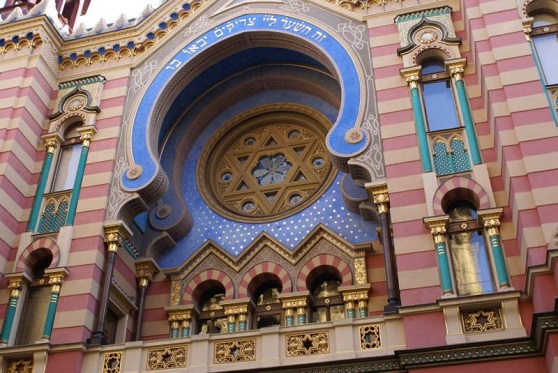
Prague - 110 years ago, on September 16, 1906, the Jubilee (or Jerusalem) synagogue in Prague was solemnly opened, the youngest synagogue in the capital. The synagogue was built as a replacement for the synagogues demolished during the sanitation process, which claimed a large part of the former Jewish town. The synagogue is still used for worship and cultural events are also held here. It is also a sought-after tourist monument because it combines Art Nouveau forms with Moorish style.
When the sanitation reconstruction of the Jewish quarter Josefov began, an Association for the construction of a new temple was established in 1898. The new building was to serve as a replacement for the Cikánkov, Velkodvorská, and New synagogues. In January 1899, the association purchased an old house on Jerusalem Street in New Town as a site for the new building. Of the three projects, the design by the Viennese architect Wilhelm Stiassny won, and Alois Richter was commissioned by the association to build it. During World War II, it was used as a warehouse for confiscated Jewish property, which partially spared it from devastation.
The synagogue is known by two names, Jubilee and Jerusalem. The first and original designation, Jubilee Synagogue of Emperor Franz Joseph I, was given in honor of the anniversary of Franz Joseph I's ascension to the throne. The second name, which has become more popular, derives from the name of the street where the synagogue is located. In the past, it was also referred to as the Great Synagogue.
The English translation is powered by AI tool. Switch to Czech to view the original text source.
0 comments
add comment