
High-tech buildings by architect Kaplický have, in many ways, preceded their time
 |
His studio Future Systems aims to change the traditional concept of architecture, using unusual materials, considering ecology, the use of natural energy, and natural light. He draws inspiration from organic forms in nature (spider webs, flowers, butterfly wings, or fish scales), as well as the aerodynamic beauty of ships, airplanes, and cars. Kaplický's team applies knowledge from research in space and the aviation and shipbuilding industries, where new materials have been developed - strong, lightweight, durable, and seamless.
In the Czech Republic, Future Systems has participated in several competitions, but no building has been realized yet. Before his emigration in 1968, the native of Prague's Ořechovka left his mark in the Czech Republic. His name is associated with a private family house in Braník and the ramp to the villa of screenwriter Jaroslav Dietl.
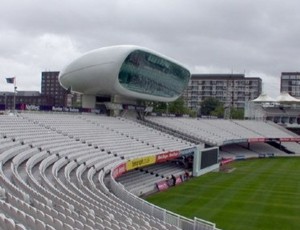
It is known about Kaplický that he does not make compromises and does not back down from his principles. Two of his buildings were recently listed by The Independent among the most significant modern constructions. Besides Selfridges, there is also the press box at London's Lord’s cricket stadium, for which the studio was awarded the prestigious Stirling Prize in 1999. It is an all-aluminum shell building that resembles the head of a periscope. It rises above the field and provides a perfect view of the area. The enormous glass facade is sloped to avoid reflecting the sun.
"You cannot stop time and create artificial museums, endlessly defend horse-drawn carriages or buses that pollute the air," asserts the famous architect. Among his other projects are a floating bridge in London’s Canary Wharf, a kindergarten reminiscent of a shell, a tourist center at Stonehenge, and an "invisible" house in Wales. This one is embedded in a cliff above the sea and only presents a glass facade. At Future Systems, they are also working on designs for lamps, furniture, glass, and cutlery.
After establishing himself in London, Kaplický founded the design office Future Systems in 1979, which became the only British company to work for the American National Aeronautics and Space Administration (NASA). This "space" experience is clearly evident in the studio's designs. Kaplický has collaborated for many years with his wife, 18 years younger architect Amanda Levetová, with whom he has a son named Josef. The Future Systems studio has worked for clients from more than 30 countries across Europe, America, and Asia.
"Architecture is a 24-hour profession. When someone doesn’t do it that way, it shows," claims Kaplický, who was born on April 18, 1937, into an artistic family. He also studied at the Academy of Art, Architecture and Design in Prague and then briefly worked as a freelancer. Before making a name for himself in Britain, he collaborated with renowned architects such as Norman Foster, Richard Rogers, and Renzo Piano.
Several books have been published about Kaplický in the Czech Republic (his confession about life and views titled Album, a collection of sketches from 1941 called Sketches, or Czech Inspiration, where he summarizes significant works by Czech inventors and intellectuals as a co-author). A documentary film titled Profile has also been made about him. At the turn of 1998 and 1999, the architect had a significant exhibition in Prague.
The English translation is powered by AI tool. Switch to Czech to view the original text source.
4 comments
add comment
Subject
Author
Date
sleoš Janáček
sidonie
03.03.07 12:42
Ano, ale Janáček
Jazzy
03.03.07 02:47
Arogantně?
Daniel John
03.03.07 02:49
Sláva vítězi !
Bart
03.03.07 03:35
show all comments