
The work of Jakub Krčín is today the pride of the South Bohemian landscape
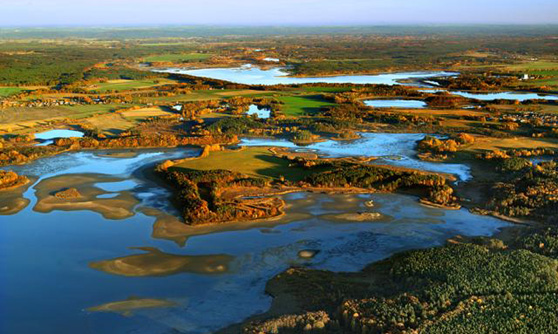 |
| Třeboňsko - ponds Rožmberk, Velký Tisý, Malý Tisý, and Kaňov; source: visittrebon.cz |
Prague - A significant, yet controversial figure was the famous Rožmberk regent and fishpond manager Jakub Krčín of Jelčany and Sedlčany, whose birth anniversary falls on July 18, marking 480 years. Krčín left behind a grand heritage in the form of the fishpond landscape in Třeboň, which remains a decoration and pride of this once marshy corner of the country to this day.
Fishponds were originally established primarily on fertile ground to foster fish farming. In the early 16th century, Štěpánek Netolický embarked on the systematic construction of a fishpond system in the marshy area around Třeboň. He designed the Golden Canal (Zlatá stoka) on the estate of the Rožmberks and created several ponds such as Opatovický and Horusický. On the adjacent estate of the Krajíř family from Krajku, Mikuláš Ruthard from Malešov worked on constructing the local system, founding Staňkovský pond and Hejtmana.
However, the appearance and life of the region were most significantly influenced by Krčín's successor, Jakub Krčín. As a long-standing regent of the Rožmberk estates, he diligently and skillfully managed the already efficiently organized fishpond economy and continued to expand it. For instance, he built the largest Czech pond and, at the time, the largest in Europe, Rožmberk, and also Svět (then Nevděk), as well as many others, along with the nearly 14 km long relief canal Nová řeka, which diverted water from the Lužnice River to the Nežárka River.
As the estate manager, Krčín primarily aimed to increase the yields of the Rožmberk economy. Just like with fish farming, he paid attention to brewing, sheep farming, courtyards, and mills. In 1578, he established a financial office that monitored the economy throughout the entire Rožmberk domain. He gained the favor and wealth of Vilém of Rožmberk. He also received acknowledgment from Emperor Rudolf II, who entrusted him with the oversight of his fishponds in the Poděbrady region.
Subordinate officials and, especially, laborers found significantly less enthusiasm for the energetic, unyielding, and ambitious man. Historical sources often depict him as a hard-hearted person, whose only concerns were his own career and economic goals. He was not only strict with his workers but also reportedly punished things like poaching very harshly (with hanging). It is no wonder that many unflattering rumors circulated about him among the people, mostly accusing him of collusion with the devil.
From today's perspective, Krčín was primarily a capable manager. His timelessness in this regard was highlighted by the writer and historian of fish farming, Miroslav Hule. In an extensive book, he washes away the tyrant’s image cultivated over the centuries and explains in period contexts that he was no feudal monster. Krčín supposedly guided his life by two maxims: "Do not disturb old revenues and seek new ones" and "Whatever you do, do it wisely and consider the outcome".
Allegedly, he only miscalculated horribly once, in his personal life. For financial reasons, he married the wealthy widow Dorota Slepičková, who was 30 years older than him. Reportedly, she was not a pleasant person, and thus he preferred spending time traveling across the estate and overseeing his constructions. Krčín allegedly expected to soon be a widower, but it took 21 years before that came true.
Krčín came from a poor gentry family from Polepy near Kolín (the surname from Jelčany is derived from the nearby village where his family originated). He studied in Kolín and at Charles University in Prague. After completing his studies, he entered the service of Vilém Trčka of Lípa and later managed the economy of the monastery in Borovany near České Budějovice. In 1561, he began serving the most powerful noble in the land, Vilém of Rožmberk, and a year later became the burgrave of Český Krumlov. In 1569, he was appointed regent of all Rožmberk estates.
After leaving Třeboň, he settled in Křepenice in the Sedlčany region. He improved Křepenice and Sedlčany, which he acquired from Vilém of Rožmberk in 1580, building, among other things, a brewery, a mill, and fish ponds in Sedlčany, while in Křepenice he built the fortress Nový Hrádek. Besides traditional activities (he was the administrator of the Rožmberk estate until 1589), he also devoted himself to his great passion: alchemy. He married for the second time to the daughter of the fish farmer Jan Zelendar, who bore him six daughters.
He wished to be buried in nearby Obděnice. A year before his death, he had the local church repaired and his tombstone placed in its wall. However, it is not known where Jakub Krčín is buried and when exactly he died. It is certain that it was sometime at the turn of January and February 1604.
The English translation is powered by AI tool. Switch to Czech to view the original text source.
0 comments
add comment