Czech Republic is threatened by radon in buildings, the standards are said to be too lenient
 |
Radon in buildings is the most significant source of ionizing radiation for Czechs. Its concentration in the air is relatively low, around 10 Bq/m³ (Becquerels per cubic meter). However, it significantly increases in buildings, with levels exceeding 1000 Bq/m³ not being uncommon. According to statistics, radon exceeds this threshold in approximately 7,500 apartments where around 20,000 people live.
This can already cause serious health problems. "If the concentration of radon is higher than the average, which is 118 Bq/m³ that about 30% of the Czech population is exposed to, the relative risk of developing a malignant disease is higher than 16%," warns the State Health Institute (SZU) on its website, which states that due to high radon concentrations in the Czech Republic, around 900 people die annually from malignant lung diseases. "This accounts for about 16% of all deaths from lung tumors," calculated the SZU.
According to Evžen Korec, chairman of the board and CEO of the development company Ekospol, this is due to overly lenient standards that allow 200 Bq/m³ in new buildings and even 400 Bq/m³ in renovated old houses. "The recommended values of radon concentration in the Czech Republic are too high compared to Germany and the value recommended by the World Health Organization (100 Bq/m³). Given the negative health consequences, it is essential that the recommended value in the Czech Republic be reduced to this level. There are also necessary health measures in all buildings where this value is exceeded," Korec stated, emphasizing that the greatest focus should be on kindergartens and schools.
A similar opinion is shared by expert witness in the field of building physics and radon protection, Martin Jiránek, associate professor at the Faculty of Civil Engineering at CTU. "In new buildings, such a reduction is certainly realistic. The question then is existing buildings, as some materials can also emit radon. Personally, I would support a limit of 100 Bq/m³ and for existing buildings, go for 200 Bq/m³," Jiránek, an expert on radon issues in buildings, told ČTK.
The State Office for Nuclear Safety (SÚJB), which is responsible for this issue, is not currently planning any changes in the limits. "We are preparing a completely new atomic law. However, nothing changes in terms of construction," said Eva Pravdová from SÚJB at a professional seminar of the Czech Chamber of Authorized Engineers and Technicians in Construction (ČKAIT).
According to Korec, the state should, in addition to tightening standards, also ensure the removal of radon from all public buildings. Owners of private buildings can apply for state subsidies for radon protection measures in certain cases.
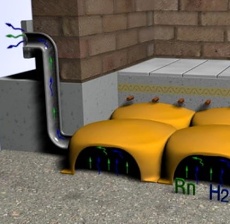
The most effective way to eliminate high radon concentrations is a mechanically controlled ventilation system with heat recovery. During construction, so-called radon barriers can also be used to prevent the dangerous gas from entering the building. However, this measure is difficult to implement in previously built buildings.
The Czech Republic is located on a substrate with a high proportion of uranium in many areas. Due to its soil composition, the Czech Republic has among the highest radon concentrations in buildings compared to other countries. Radon can enter homes from the ground through leaks in building structures, from underground water, and from unsuitable building materials. The amount of radon emanating from the ground in a given location can be found on the radon map of the Czech Republic, available online.
The English translation is powered by AI tool. Switch to Czech to view the original text source.

0 comments
add comment