
The area of the pilgrimage site in Horní Police is awaiting renovation for 107 million CZK
 |
| photo: www.jizerky.cz |
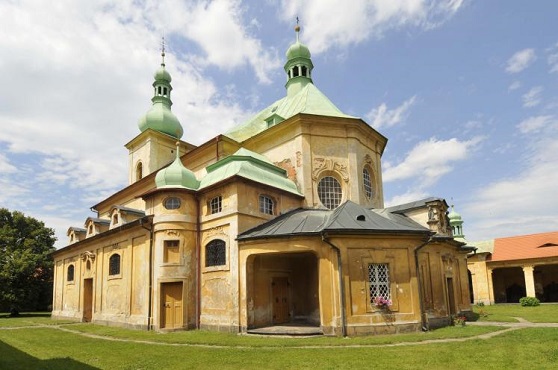
Horní Police - A restoration costing nearly 107 million crowns awaits the area of the pilgrimage church of the Visitation of the Virgin Mary in Horní Police in the Czech-Liberation region. It is in a state of emergency. The Roman Catholic parish has managed to obtain European funding for the reconstruction, which, along with a state contribution, will cover 95 percent of the costs. Work is expected to begin this fall and should be completed by the end of 2019, the administrator of the parish and general secretary of the Czech Bishops' Conference, Stanislav Přibyl, said today.
"The work will start with the repair of the roof and rafters of the church. The entire interior furniture will also be removed for restoration," said Přibyl. The area is a cultural monument, but it underwent its last major repair 105 years ago, in 1912. It also suffered because an aerial bomb exploded nearby at the end of World War II, and for about ten years it rained inside through the damaged roofs until the previous administrator of the archdeaconry managed to cover them. "80 to 90 percent of the rafters have reached the end of their lifespan," the administrator stated.
The pilgrimage site originated at the location of a Gothic church burned by the Hussites. According to legend, in 1523 a statue of the Virgin Mary was found on the bank of the Ploučnice River, which pious hands pulled from the water and donated to the local chapel. The statue was regarded as a heavenly gift, and people came to pay homage to it. Today, it is part of the main altar, and a Marian column commemorates the spot where it was retrieved from the river.
The pilgrimage site consists of a belfry with a main gate, a three-nave church, a three-winged cloister with chapels, a cemetery, and a three-winged presbytery building with agricultural facilities. There is also a Stations of the Cross. The European funding will mainly be used for the restoration of the church, belfry, and partially for the presbytery. "We are already preparing the second phase," added Přibyl. This phase will mainly concern the cloisters. "They are semi-open corridors around the church. It is something beautiful that frames the pilgrimage site, but it is very demanding to maintain," said Přibyl.
The current form in the Baroque style was acquired during a reconstruction at the turn of the 17th and 18th centuries. The then-owners of the estate, Julius Francis and his daughter Anna Marie Francis, had a significant role in this. The work was carried out in two phases. The middle part of the main church was created under the direction of the Italian builder Giulio Broggia, and the second phase was overseen by Václav Špaček. However, the estate owner wanted a quick result, which is why, according to Přibyl, many of the constructions are quite peculiar. "For example, there are wooden structures surrounded by stucco, some kind of Baroque drywall," he noted. This complicates the planned repairs as well. "The health of the wooden load-bearing elements must be assessed," he added.
Once the work is completed, the church will resemble its appearance during the Baroque period. Today, the façade is yellow-gray, but it will be newly painted white and red. As part of the reconstruction, an exhibition about the history of this pilgrimage site, associated with the title of the archdeaconry, should be created inside the church. It was most visited in the first half of the 18th century, when 30,000 to 40,000 pilgrims came for the pilgrimages. "Interesting things happened here. For example, when pilgrims entered through the main tower, there was a cross, and blood flowed from the hands and feet of Christ," said Přibyl. According to him, the accounts for red paint used for these purposes document this.
The English translation is powered by AI tool. Switch to Czech to view the original text source.
0 comments
add comment