
The world-renowned sculptor Kenneth Snelson has died.
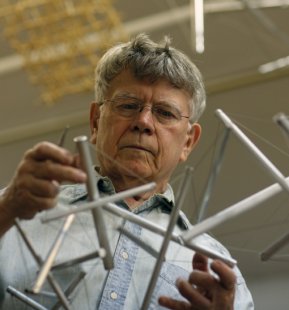
New York – The world-renowned American sculptor and photographer Kenneth Snelson passed away on Thursday, December 22, at the age of 89 in his home in Manhattan. He used knowledge and elements from engineering aesthetics in his work. The cause of death was cancer.
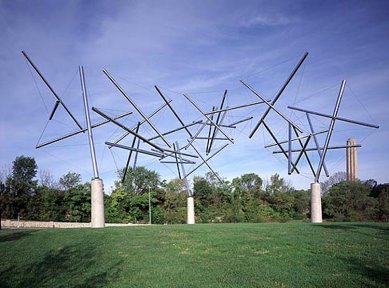
Kenneth Snelson (1927-2016) was captivated in the 1940s during his painting studies at Black Mountain College in North Carolina by the lectures of one of his teachers, Buckminster Fuller. Fuller taught students geometry and introduced them to his futuristic inventions such as geodesic domes, etc. Young Snelson was fundamentally influenced by Fuller’s inventions and began to incorporate them into his own work. He composed spatial forms made of aluminum tubes and steel cables into tower and arch structures, often kinetic. The structures levitated in the air and achieved a powerful artistic expression.
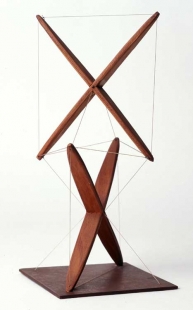
Snelson's and Fuller's collaboration culminated in an exhibition at New York's MoMA (1959), where Fuller displayed one of his former student's works - "Early X Piece." Snelson referred to the principles of his work as "floating compression" and "floating mobility"; however, in art history, Fuller’s term "tensegrity" - derived from the words "tension" and "structural integrity" - became more prominent.
Kenneth Snelson Duane was born on June 29, 1927, in the town of Pendleton, Oregon. When Kenneth was 6 years old, his father opened a camera shop. Cameras became his lifelong passion, and after finishing college, he worked for several years in New York as a cameraman for various television news reports.
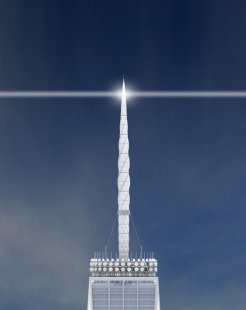
Snelson's sculptures adorn many public spaces and architecture. In Europe, his most famous work is the 27.5-meter tall "Needle Tower II," created in 1968 at the Kröller-Müller Museum in the Netherlands. The symbolic peak of his career was to be a 120-meter tall mast on top of the One World Trade Center skyscraper, which he collaborated on with architects from the Skidmore Owings & Merrill firm; however, the investor abandoned the realization of this masterpiece due to concerns about overly demanding maintenance and repairs.
> kennethsnelson.net
Kenneth Snelson (1927-2016) was captivated in the 1940s during his painting studies at Black Mountain College in North Carolina by the lectures of one of his teachers, Buckminster Fuller. Fuller taught students geometry and introduced them to his futuristic inventions such as geodesic domes, etc. Young Snelson was fundamentally influenced by Fuller’s inventions and began to incorporate them into his own work. He composed spatial forms made of aluminum tubes and steel cables into tower and arch structures, often kinetic. The structures levitated in the air and achieved a powerful artistic expression.
Snelson's and Fuller's collaboration culminated in an exhibition at New York's MoMA (1959), where Fuller displayed one of his former student's works - "Early X Piece." Snelson referred to the principles of his work as "floating compression" and "floating mobility"; however, in art history, Fuller’s term "tensegrity" - derived from the words "tension" and "structural integrity" - became more prominent.
Kenneth Snelson Duane was born on June 29, 1927, in the town of Pendleton, Oregon. When Kenneth was 6 years old, his father opened a camera shop. Cameras became his lifelong passion, and after finishing college, he worked for several years in New York as a cameraman for various television news reports.
Snelson's sculptures adorn many public spaces and architecture. In Europe, his most famous work is the 27.5-meter tall "Needle Tower II," created in 1968 at the Kröller-Müller Museum in the Netherlands. The symbolic peak of his career was to be a 120-meter tall mast on top of the One World Trade Center skyscraper, which he collaborated on with architects from the Skidmore Owings & Merrill firm; however, the investor abandoned the realization of this masterpiece due to concerns about overly demanding maintenance and repairs.
> kennethsnelson.net
The English translation is powered by AI tool. Switch to Czech to view the original text source.

0 comments
add comment