
Will wooden skyscrapers become the new trend in construction?
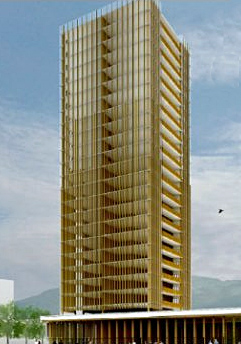 |
| Michael Green: Tallwood |
"We think we can go higher than 30 stories," said Green. "We stopped working with wood a hundred years ago (with the advent of concrete and steel). Now we are exploring a whole new system that uses a large amount of wood."
According to him, modern wood materials have been available for about 20 years, but until recently, they were used marginally or in low-rise buildings. What has changed is the way architects and builders consider the use of wood.
"The real change occurred when we started thinking about climate change. Concrete and steel are great, but they are not friendly to the environment," he asserts.
Green's building "Tallwood" is designed from panels made by pressing and gluing wooden veneers (laminated strand lumber). Other solid wood materials use layers of wood connected at angles, making them exceptionally strong and usable in structural systems, walls, and floors.
Concerns that buildings might become fire hazards should be set aside for wooden structures, as large pieces of wood resist fire well, and the charred layer protects the wood beneath it, Green claims.
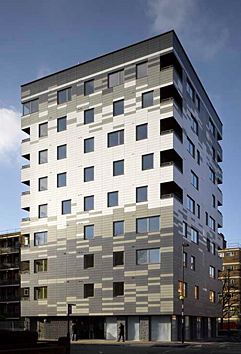 |
| Waugh Thistleton: Stadthaus |
"It is lower than 30 meters because for heights over 30 meters, British regulatory authorities said that an automatic fire suppression system would need to be installed and there would be other regulations at play," said Craig Liddell, business director of KLH UK, the company that designed the wood composite material for the building.
Components of cross-laminated timber used in Stadthaus are cited as airtight, making the building one of the most energy-efficient in London. Because it is prefabricated, construction took a shorter time and was cheaper than a typical concrete and steel building, Liddell asserts.
No matter what the environmental benefits of such buildings may be, they were built for one compelling reason.
"The idea is that for tall wooden buildings to be viable, they have to save costs,” says Green. "We can show that wooden buildings are cheaper compared to other buildings."
Moreover, he believes it is about pushing the boundaries of what is possible to consider.
"We are truly at a stage where we can start to show what is possible, almost like with the Eiffel Tower. It was built when no one understood tall buildings, but it showed what could be done and significantly expanded the boundaries of imagination,” said Green.
The English translation is powered by AI tool. Switch to Czech to view the original text source.
0 comments
add comment