
Ancient Rome will be on the internet thanks to Google Earth
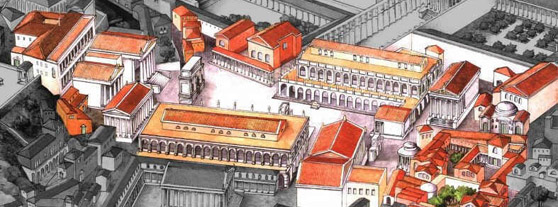 |
The program, which offers users access to maps and satellite images of the Earth's surface, now includes a new layer that allows users to see what Rome looked like around the year 320. It was a vibrant city with approximately one million inhabitants under the rule of Emperor Constantine the Great.
The emerging windows provide information about the monuments. Visitors can enter some significant sites, such as the Senate or the Colosseum, and admire the architecture and marble decorations, Italian Google branch and the Roman municipality stated in a joint announcement on Wednesday.
Google's project called "Ancient Rome 3-D" is based on a simulation of the city created by an international scientific team led by American universities in Virginia and California.
Using laser scanning of current ruins and with the guidance of archaeologists, scientists worked for about a decade on the reconstruction of ancient Rome within its 21-kilometer-long walls, said Bernard Frischer, who leads the Virginia Institute for Advanced Technology in the Humanities.
The simulation, which was completed in 2007, was originally intended for scientific and educational purposes in the study of ancient buildings. It also served as an environment for simulations, for example, to determine how many people could fit in certain squares.
Frischer stated that publishing the entire project on the Internet represents an expansion of its capabilities as an educational tool. Google has already launched a competition among American teachers and is offering prizes for the best ideas on how to utilize this new "ancient Rome."
In the future, other historical sites may also be available on the Internet. Frischer mentioned that his team is already working on the reconstruction of the colonial form of the city of Williamsburg in Virginia. "It is illogical for ancient Rome to remain the only place that Google Earth offers in this way,” he stated. “It's an ideal platform for publishing similar works, whether it’s Giza in ancient Egypt or Athens during the Age of Pericles."
The English translation is powered by AI tool. Switch to Czech to view the original text source.

2 comments
add comment
Subject
Author
Date
Antický Řím
Čeřovský
21.11.08 09:41
Řím
Martin Rosa
22.11.08 01:39
show all comments