Author: Ing. arch. Zbyněk Ryška, in collaboration with Ing. arch. Petr Baletka
The concept of making the Voršilek monastery grounds accessible is based on the history of this place, and its atmosphere plays a crucial role. Alongside the church and chapel, the most important space here is the courtyard surrounded by the cloister, which houses the paradise garden. The area is defined to the north and south by the library pavilions, and to the west and east by covered amphitheaters. The garden is set 1.5 m below the level of the existing terrain for greater intimacy and exclusiveness. Jury's Evaluation
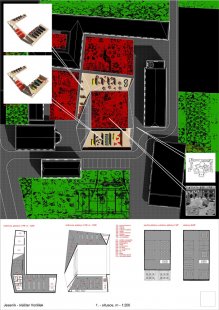
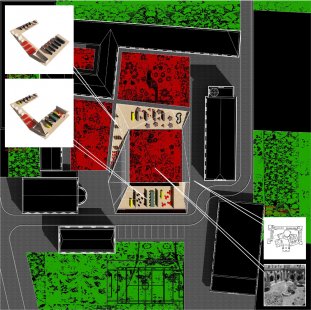
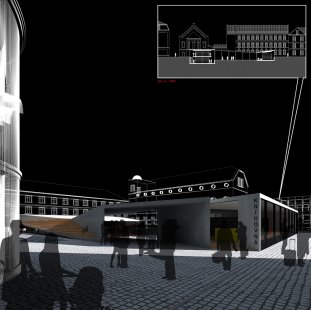
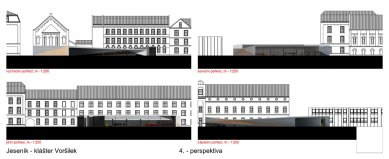
The central element of the proposal is the building of a new library. It is conceived as an analogy with the paradise courtyard surrounded by the cloister. The level of its courtyard is lowered by half a floor compared to the surroundings, and it can be entered (or traversed) through two elongated outdoor staircases. The low mass of the library with an approximately square footprint is inserted into the existing irregular monastery courtyard, thereby creating several new spaces. Unfortunately, it is not entirely clear from the project presentation what these spaces are. The evaluative council raised questions:
Does the building parasite on the given spatial framework or rather enrich it?
Does it bring a new order to the existing monastery complex, or does it resign and we only perceive the order upon entering the new building?
The building itself is architecturally quality. The inspiration from the paradise courtyard and L. Kahn's design convinces us that its placement is not accidental. There is no doubt that the proposed building would be beneficial to the place and would be used daily. The placement of other operations in the reconstructed KORD building is appropriate in this context.
Alena Hýblová
Author's Report
History When considering the concept of making the Voršilek monastery grounds in Jeseník accessible, we primarily relied on the history of this place. The monastery was founded in 1878. The Voršilek order took care of education and culture in the region. Over time, the monastery became an educational and upbringing institution of European format. Sisters and students from all over Europe used to come here. In 1944, the monastery was dissolved. After 1951, a House of Children and Youth and an Association of Young Naturalists were established here. It is one of the oldest in the republic. In 2006, the Free Time Center DUHA was created by merging DDM and SMP. Today, there is a school, a kindergarten, and concerts are held in the monastic chapel. The place has a rich tradition in the education and upbringing of youth. We want to build on this history with the library project.
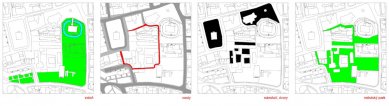
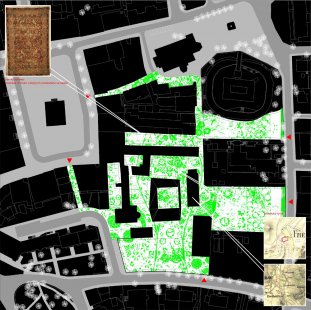
Genius loci Atmosphere plays a crucial role in the site's concept. It is a place behind a wall, a place often defined by the courtyard facades of houses. A place that is entered through gates and passages. A place hidden in the depths of the historical city center. The place is "enclosed" by a wall and the courtyard facades of houses that define the central square with their main facades. The main theme of the area is the garden. Whether the word garden originated from to enclose (define) or as a place beyond the walls (at the walls) is insignificant here. Moreover, the city of Jeseník never had walls. Here, it can be replaced by the monastery wall.
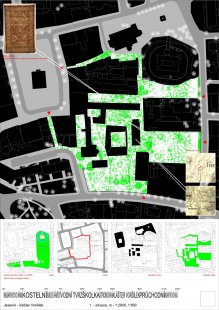
Urbanism We propose a path that runs throughout the area and becomes its axis. The main entrances are always from the square. One passage leads to Kostelní Street and the other again leads through a passage to Průchodní Street. Vehicle entries include parking on Průchodní Street and Kostelní Square. The profile of the path is 4 m one-way from Zámecké náměstí and has a paved surface, also serving for the supply of all operations in the area. The entire area is a pedestrian zone with the possibility of supply vehicle access. Other entrances are gates in the monastery wall. Each leads to a clearly defined and designated garden. We always pass through the garden to the main axis of the entire area. The principle of gardens connected by paths is adopted by the monastery area itself. The vaguely defined and overly extensive courtyard is divided by inserting the library building. The library surrounds another garden. This garden is a square of 25x25 m. It is a contemporary paradise garden. It should also be added that the garden does not have to be only "green" but can also be "stoned".
The Monastery What distinguishes the monastery from an ordinary urban block?
It is a closed operation of a group of people holding a certain (in our culture Christian) faith and system of life.
(Source: Wikipedia)
It suggests the name claustrum = enclosed place. The building has its clearly defined rules - church, paradise garden, chapel, refectory, dormitory, scriptorium, etc. All this can be found in the Jeseník monastery, with the missing operation of the scriptorium being supplemented. In our opinion, besides the church or chapel, the most important space is the paradise courtyard, around which all buildings and operations are located. Therefore, we insert such a paradise garden, set apart by the cloister, into the already defined courtyard space. The area is defined to the north and south by the library pavilions, and to the west and east by covered amphitheaters. The garden is set 1.5 m below the level of the existing terrain for greater intimacy and exclusiveness.
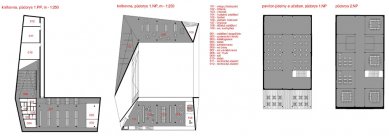
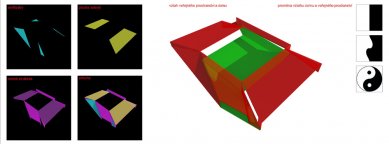
The Library How has the role of the library changed in the 21st century? From secret and hard-to-access storage of books in the Middle Ages through the palaces of the 19th century to an open public building intended for more media (internet, music carriers, video) and functions (exhibitions, lectures, concerts, celebrations). It has become a cultural center of the 21st century, primarily because media and information (thanks largely to the internet) signify a new age. We conceived the library building as pavilions for individual operations. The pavilions simultaneously define and separate the individual gardens. Between the pavilions are inserted amphitheaters that serve as auditoriums during social events. Everything is connected and covered by the roof structure. The public space runs through the building, and conversely, the building intertwines with the public space. The public space is the building, and the building is the public space. The interior becomes the exterior and vice versa.
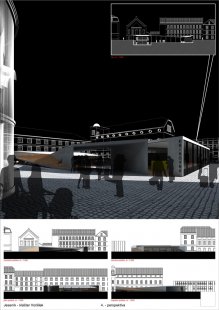
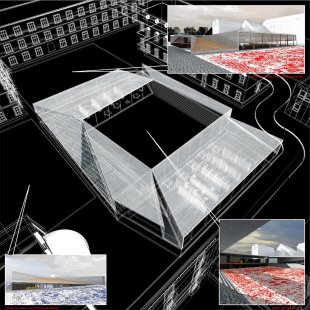
The Roof The roof is conceived as another garden. There are amphitheaters oriented towards the other gardens, and grassy areas above the pavilions. The roof creates and covers the cloister of the paradise garden. The roof unites and covers the library pavilions and defines the paradise garden. It is an intelligent platform that responds to the surroundings with its shape and function. The shape is generated by the facades of existing buildings, the amphitheaters opening up to newly delineated courtyards, and the operations of the library. The roof forms a self-supporting element through its modeling.
Roof (coverage) The term to cover, in architectural vocabulary, meant to conceal, protect, hide one thing from another. Today it rather means "to create by uniting or connecting." This way of thinking expresses the possibilities of connecting many energies and genres. It also signifies, in another sense, an understanding of the principle of covering. A covering not merely as a roof, but as the creation of new nature, landscape.
(Source: The Metapolis Dictionary of Advance Architecture)
Cafeteria and Classroom Pavilion How does a city come into being? Through the gradual building and layering of houses and surfaces upon one another. The city is a reflection of society. When a person is ill, we care for them until the last moment and do everything possible to save their life. We should treat buildings in the same way. Is a prefabricated building from the sixties any less valuable than a brick one from the 19th century? It is merely another layer in the urban fabric. We propose the KORD object for reconstruction. Due to its nature as a prefabricated steel structure, this building can be treated very freely. We demolish one module of the skeleton to free up space for the proposed path. The entire envelope is replaced with a glass structural façade. On the first floor, a cafeteria with a kitchen is placed, and on the second floor, the necessary classrooms and offices.
Ing. arch. Zbyněk Ryška - graduated from the Faculty of Architecture, VUT Brno (2005). He collaborated with the Kuba and Pilař Architects studio. He is currently studying in the Master’s studio of Roman Koucký at CTU in Prague.
The English translation is powered by AI tool. Switch to Czech to view the original text source.