
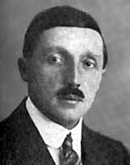
Bohumír Kozák
*4. 12. 1885 – Volfířov, Czech Republic
†1. 4. 1978 – Prague, Czech Republic
Biography
Božimír František Kozák was a Czech architect, a representative of Functionalism, an architectural theorist, and a heritage conservationist. He was born into the family of a Protestant pastor and preacher. After completing his elementary education, he studied at the technical university in Prague under Professors Josef Schulz and Jan Koula, and gained practical architectural experience under another outstanding architect, Osvald Polívka. He initially worked for Václav Nekvasil’s renowned construction company in Karlín, where his first designs were realized, and later became a partner in the Prague construction company Dušek – Kozák – Máca.
During his prolific career, he designed countless public and private buildings, including the Intercity Telephone and Telegraph Exchange in Žižkov, the Masaryk Homes in Krč (now Thomayer Hospital), the Avion office complex (now Luxor Palace), and Broadway Palace in central Prague. Numerous apartment buildings and villas throughout Prague were built to his designs, including luxurious residences in Vinohrady, Smíchov, and Holešovice. Many of Kozák’s projects were also realized outside the capital, particularly buildings for congregations of the Czechoslovak Church and the Evangelical Church of Czech Brethren in Poděbrady, Čáslav, Prostějov, Zruč nad Sázavou, and elsewhere. Professor Bohumír Kozák also concerned himself with urban planning in the city of a hundred spires on the Vltava, and some of his ideas were ahead of their time. He advocated a metro system as a solution to Prague’s transport needs, and in 1938–1939, as part of a project to bridge the Nusle Valley, he produced an architectural study for a metro station that was essentially identical in concept to today’s Vyšehrad station. It should also be mentioned that Professor Bohumír Kozák was one of the founding members of the Czechoslovak Socialist Party.
Travel was one of his great passions. An accomplished draftsman, he produced pencil drawings of astonishing authenticity during his journeys abroad and through the Czech countryside. As early as 1941, he published An Architect’s Travels. Most of his drawings, however, depicted his beloved Prague. From 1950 onward, these were gradually published in several thematic collections, including Prague’s Lesser Town, The Language of Prague Architecture, and Prague: A Dream in Stone. These publications are now treasured additions to the library of any lover of Prague’s history.
As he grew older, Professor Bohumír Kozák gave up architectural design and increasingly devoted himself to his interests, particularly pencil drawing and the preservation of historic buildings and sites. Among other activities, he became a member of the governing council of the Club for Old Prague and later its chairman.
Josef Hrubeš: Remembering the Architect Bohumír Kozák
The English translation is powered by AI tool. Switch to Czech to view the original text source.