
Big Hall of Silesian Ostrava Castle

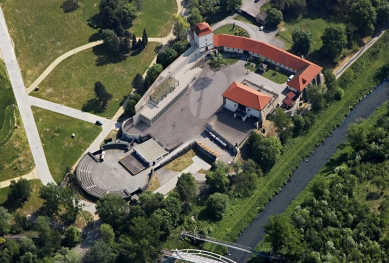
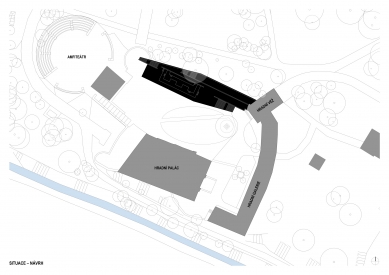
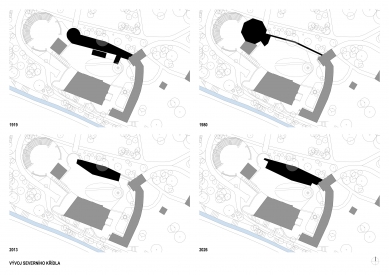
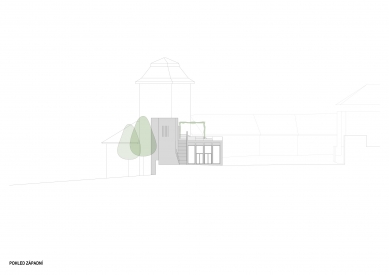
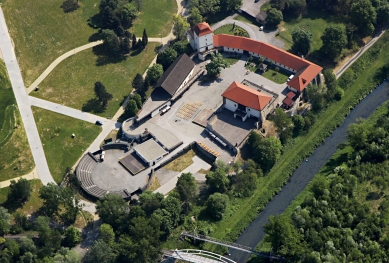
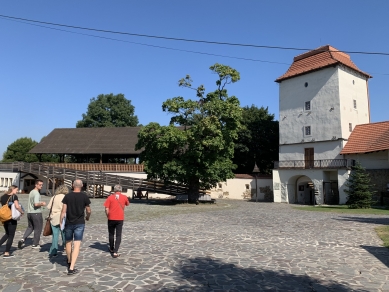
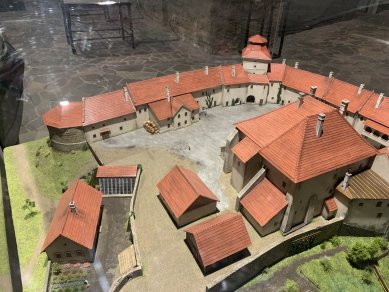
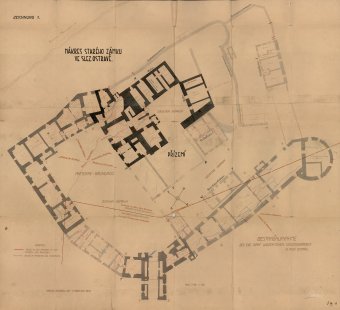
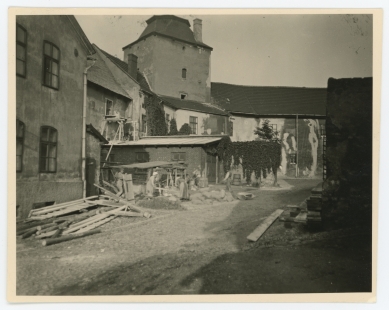
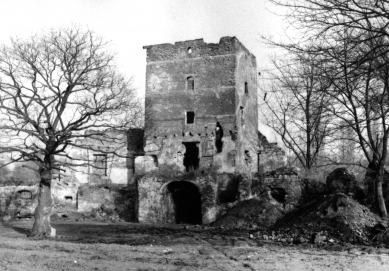
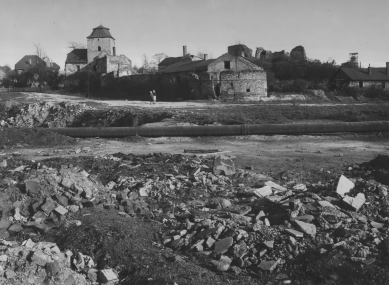
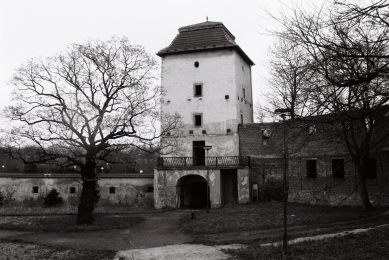
The design of the Great Hall forms the northern wing of the Silesian-Ostrava Castle complex, founded in the 13th century near the confluence of the rivers Lučina and Ostravice. The site has undergone significant changes over the centuries—due to subsidence, the area has dropped by more than 11 meters, and the original castle turned into a ruin during the 20th century. Only fragments of the Renaissance rampart have survived from the northern wing. The area was redeveloped only in 2013 with the existing Castle Terrace building, which is now slated for demolition.
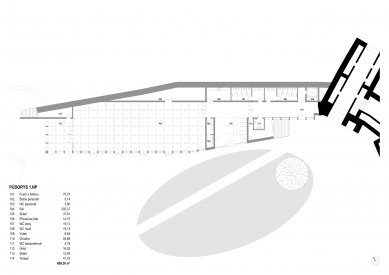
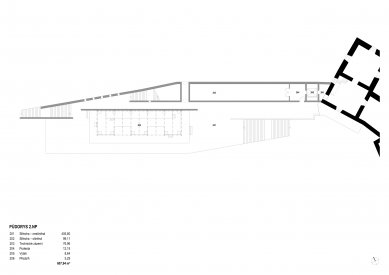
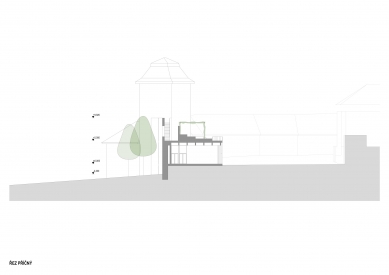
The task was to design a new Great Hall for social events with a capacity of approximately 150-200 people, extended sanitary facilities, and preserved access to the roof terrace, as well as barrier-free connectivity with the castle tower and the eastern wing.
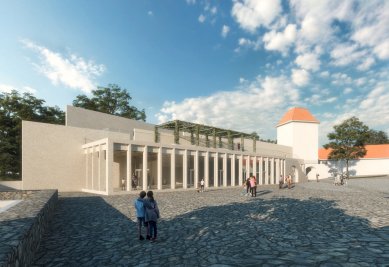
The proposed new building of the Great Hall does not emerge as a replica of the castle buildings but as a contemporary continuation of them. It does not imitate historical forms but interprets archetypes deeply rooted in our subconscious. It represents a cultural code that is understandable across generations.
The visit begins with a journey along the ramparts. The mass gradually approaches and compresses. The material is haptic and cold. The tension thickens. After a while, relaxation returns, a breath.
The project works with a free interpretation of four motifs of Central European castles and translates them into a contemporary architectural language.
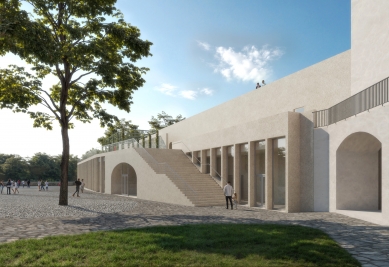
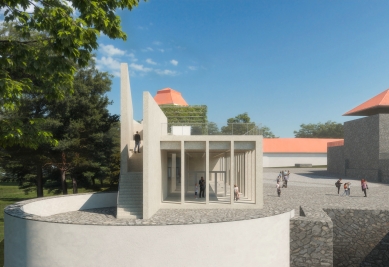
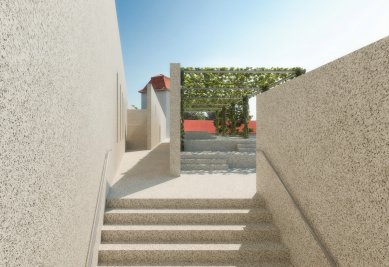
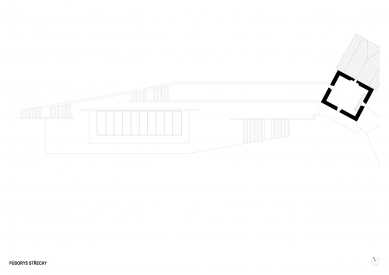
The motif of the rampart: The object from the north restores the solid line of the rampart based on the modern floor plan while projecting into the layout and opens up to the center of the castle complex. The rampart, which has already lost its defensive function, is deconstructed into individual slabs and crumbles towards the courtyard. The fortification transforms into a viewing path. It allows for a walk along the ramparts, the discovery of nooks, and new perspectives on the surroundings.
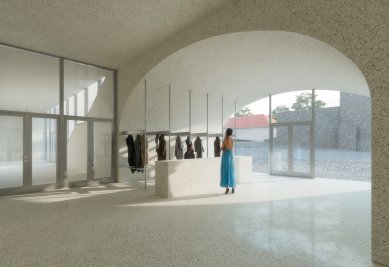
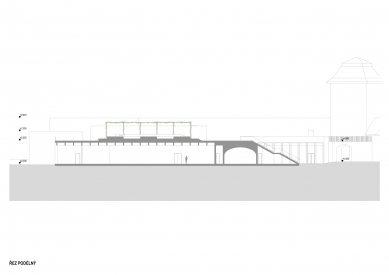
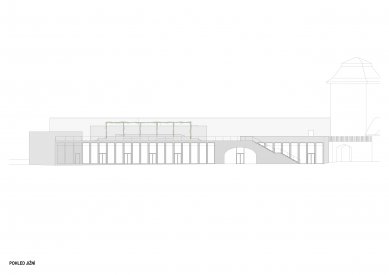
The motif of the vault: The entrance space is based on compression. The barrel vault inserted between the rhythm of the high order focuses attention, serving as a semantic sign of the entrance. It emphasizes the weight of the structure and intensifies the transition between the exterior and the interior. It is not decoration but a physical experience of the space.
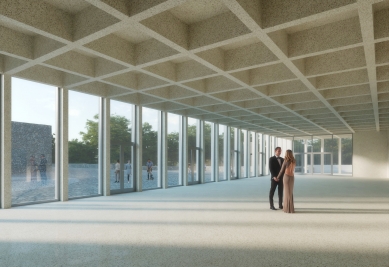
The motif of the coffered hall: The Great Hall opens optically and functionally to the courtyard. The square grid acknowledges the tectonics of the space, serving as an interpretation of Renaissance coffered ceilings. The representative character arises not from ornamentation but from the harmony of proportions and rhythm.
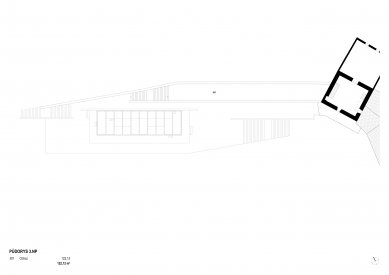
The motif of the vineyard: The southern exposure of the roof terrace connects to the tradition of vineyards on the slopes of castle fortifications. The plants create a natural seasonal filter of light and shadow. Nature is not separated from architecture but naturally intertwines with it.
The Great Hall works with memory without romantic nostalgia. It utilizes enduring principles—working with composition, spatial compression and decompression, the haptics of material, rhythm, semantic signs, and boundaries.
It is not a reconstruction of the castle, but a new layer within the historical structure.
The task was to design a new Great Hall for social events with a capacity of approximately 150-200 people, extended sanitary facilities, and preserved access to the roof terrace, as well as barrier-free connectivity with the castle tower and the eastern wing.
The proposed new building of the Great Hall does not emerge as a replica of the castle buildings but as a contemporary continuation of them. It does not imitate historical forms but interprets archetypes deeply rooted in our subconscious. It represents a cultural code that is understandable across generations.
The visit begins with a journey along the ramparts. The mass gradually approaches and compresses. The material is haptic and cold. The tension thickens. After a while, relaxation returns, a breath.
The project works with a free interpretation of four motifs of Central European castles and translates them into a contemporary architectural language.
The motif of the rampart: The object from the north restores the solid line of the rampart based on the modern floor plan while projecting into the layout and opens up to the center of the castle complex. The rampart, which has already lost its defensive function, is deconstructed into individual slabs and crumbles towards the courtyard. The fortification transforms into a viewing path. It allows for a walk along the ramparts, the discovery of nooks, and new perspectives on the surroundings.
The motif of the vault: The entrance space is based on compression. The barrel vault inserted between the rhythm of the high order focuses attention, serving as a semantic sign of the entrance. It emphasizes the weight of the structure and intensifies the transition between the exterior and the interior. It is not decoration but a physical experience of the space.
The motif of the coffered hall: The Great Hall opens optically and functionally to the courtyard. The square grid acknowledges the tectonics of the space, serving as an interpretation of Renaissance coffered ceilings. The representative character arises not from ornamentation but from the harmony of proportions and rhythm.
The motif of the vineyard: The southern exposure of the roof terrace connects to the tradition of vineyards on the slopes of castle fortifications. The plants create a natural seasonal filter of light and shadow. Nature is not separated from architecture but naturally intertwines with it.
The Great Hall works with memory without romantic nostalgia. It utilizes enduring principles—working with composition, spatial compression and decompression, the haptics of material, rhythm, semantic signs, and boundaries.
It is not a reconstruction of the castle, but a new layer within the historical structure.
The English translation is powered by AI tool. Switch to Czech to view the original text source.
0 comments
add comment