
House with a pond

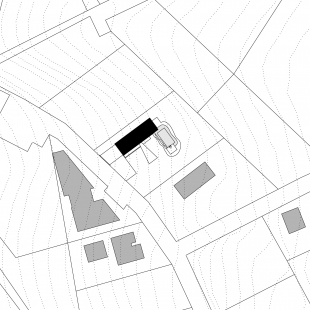
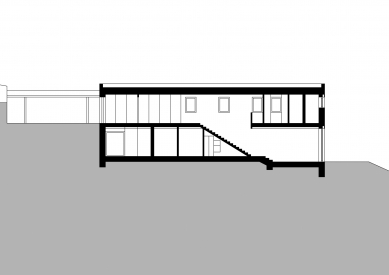
A sloped plot of land with access from the west and a view of the Berounka valley led us to an unconventional arrangement of the house. The terrain here did not allow for a classic layout with a living ground floor and a quiet area upstairs. Therefore, we chose an inverted principle: the main entrance is placed at the upper level, which serves as the bedroom floor. This approach allowed the house to naturally connect to the access road while smoothly following the terrain.
From the bedroom floor, one descends the staircase to the social area of the house, where we positioned the kitchen area with a dining room and a living room. This vertical division refers to a concept known, for example, from the Tugendhat Villa in Brno, where the living spaces open toward the best views and sink into the terrain. A similar logic allowed us to create smooth spatial gradations – from the compact upper floor down to the fully open living space with a view of the valley.
The slope of the terrain is also reflected in the interior itself. We placed the living room three steps lower than the dining room, giving it an exceptional ceiling height. The difference in levels creates a dynamic space that reacts to the terrain and naturally "grows" out of it. From both levels of the living area, one can directly access the garden. The higher part is connected to a covered terrace, while the lower level borders a natural pond and garden.
The choice of materials unifies the appearance of the façade and interior, ensuring their mutual continuity. The façade made of sand-colored bricks gives the building a solid, calm appearance. The same light tones were applied inside the house – especially on the bleached oak used for the floors, stair treads, and built-in furniture. A three-sided fireplace is the dominant element of the living space, which naturally defines the boundary between the dining and living areas, allowing the fire to be perceived from various spots and zoning the space without the need for physical barriers. It thus serves both an aesthetic and functional role and becomes a natural focal point of the house's social life.
Overall, we conceived the house as a structure that does not try to conquer the terrain but rather collaborates with it. All key operational and form principles of the house arise from a reaction to the location. The result is a house that is firmly anchored in its environment, framing the landscape and actively utilizing it through its layout.
From the bedroom floor, one descends the staircase to the social area of the house, where we positioned the kitchen area with a dining room and a living room. This vertical division refers to a concept known, for example, from the Tugendhat Villa in Brno, where the living spaces open toward the best views and sink into the terrain. A similar logic allowed us to create smooth spatial gradations – from the compact upper floor down to the fully open living space with a view of the valley.
The slope of the terrain is also reflected in the interior itself. We placed the living room three steps lower than the dining room, giving it an exceptional ceiling height. The difference in levels creates a dynamic space that reacts to the terrain and naturally "grows" out of it. From both levels of the living area, one can directly access the garden. The higher part is connected to a covered terrace, while the lower level borders a natural pond and garden.
The choice of materials unifies the appearance of the façade and interior, ensuring their mutual continuity. The façade made of sand-colored bricks gives the building a solid, calm appearance. The same light tones were applied inside the house – especially on the bleached oak used for the floors, stair treads, and built-in furniture. A three-sided fireplace is the dominant element of the living space, which naturally defines the boundary between the dining and living areas, allowing the fire to be perceived from various spots and zoning the space without the need for physical barriers. It thus serves both an aesthetic and functional role and becomes a natural focal point of the house's social life.
Overall, we conceived the house as a structure that does not try to conquer the terrain but rather collaborates with it. All key operational and form principles of the house arise from a reaction to the location. The result is a house that is firmly anchored in its environment, framing the landscape and actively utilizing it through its layout.
Stempel & Tesař architects
The English translation is powered by AI tool. Switch to Czech to view the original text source.




0 comments
add comment