
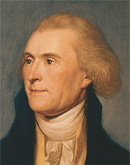
Thomas Jefferson
*13. 4. 1743 – Shadwell, USA
†4. 7. 1826 – Charlottesville, USA
Biography
Thomas Jefferson was the third president of the United States (1801-09) and the principal author of the American Declaration of Independence (1776).
He was also an avid student of architecture whose designs rank among the most influential in the early history of the United States. As a student at the College of William and Mary (1760-62), he purchased his first book on the subject and later amassed one of the largest architectural libraries in America. He was particularly influenced by the classical style of Andrea Palladio, which emphasized symmetry, proportion, and the use of columns. These principles went on to define the architecture of the early United States, first in Richmond with Jefferson's design for the State Capitol, and then in Washington, D.C., where he influenced decisions about the designs of the U.S. Capitol and the White House. Jefferson is probably best known for his homes—Monticello in Albemarle County (1769-74) and Poplar Forest in Bedford County (1806-09)—which became laboratories for Jefferson's design interests and his many influences. Monticello, in particular, combined Jefferson's obsession with classical forms and his admiration for contemporary France. During his retirement, Jefferson founded the University of Virginia (May 5, 1817) and created a distinctive U-shaped design with interconnected pavilions and a domed rotunda surrounding a long, narrow green space. Along with Monticello, the university is considered one of the pinnacles of American architecture and cemented Jefferson's legacy as an architect, landscape architect, and urban planner.
The English translation is powered by AI tool. Switch to Czech to view the original text source.