
In the Fant's building, paintings hidden under the symbolism of ROH were uncovered during renovation
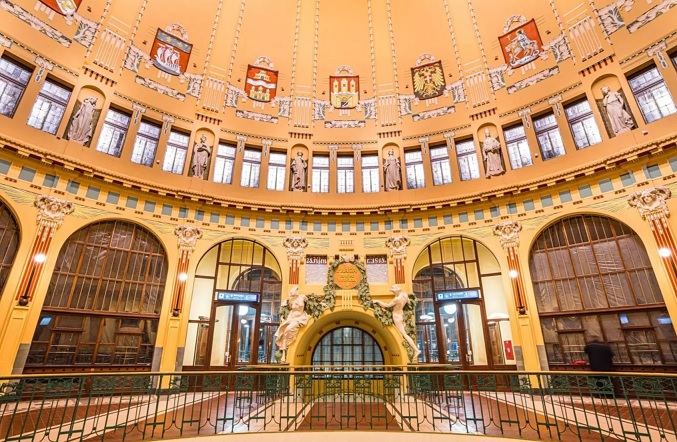 |
Prague – During the reconstruction of the Fantova building at Prague's main train station, original paintings of globes hidden under the symbolism of the Revolutionary Trade Union Movement (ROH) were uncovered in the cultural space. The reconstruction is proceeding according to schedule, having started last summer and expected to last until spring 2029. It will return the interiors of the historic building to their original appearance. For example, the ceiling of the check-in hall in the southern wing will disappear. Jana Dehner from the Czech Railways (SŽ) told journalists this during a tour of the building today.
The removal of the ceiling from the 1950s will also require the use of climbing techniques. This will create an open space with a decoratively adorned Art Nouveau ceiling. According to SŽ General Director Tomáš Tóth, it will serve passengers and will be accessible from the southern underpass via barrier-free elevators.
"Passengers will find not only the original check-in hall here but also other commercial spaces. There will be spaces for cafes, fast food, and lounges for individual carriers," Tóth told ČTK. Offices will be created on the upper floors of the building.
According to Dehner, demolition work has been completed in the building, and exploration is ongoing. Preparations are underway for the start of construction work and the refurbishment of the original spaces. The installation of new elevators will begin at the beginning of the summer holidays, which will limit passage through the southern underpass.
In connection with the reconstruction, SŽ regularly consults with heritage protection officials. "Basically, for every find at the construction site, we invite heritage protectors for their input," Dehner said. They are also participating in the reconstruction of the government lounge, where there are numerous paintings and carved decorations on the walls.
The government lounge is located in the southern tower and connects to the first platform. Above the corridor to the lounge is a stained glass window, above which fluorescent lights were placed in the past for illumination. These will disappear during the reconstruction, and the light from them will be replaced by natural light that will reach the stained glass from the glazed dome in the tower.
According to Jan Zikmund from the Avers company, restoration color studies are also ongoing, based on which the original wall colors will be determined. Investigations are also being conducted to find the gentlest ways to reinforce the stucco. A restoration workshop will be set up in the center of the building during the reconstruction, where paintings will be adjusted.
"We have found some additional photographs beyond what the designer was able to discover. Specifically, we found photographs in the magazines Český svět and Architektonický obzor. There we noticed certain nuances compared to the specifications that the designer had available," Zikmund told ČTK, noting that the photographs were from 1909. The appearance of the Fantova building, as it will be after the completion of the work, is also aimed towards that year.
Based on new findings, fragments or covered parts have been examined. Although the reconstruction is aimed at the appearance from 1909, valuable elements from later periods will also be preserved, according to Zikmund, such as the coat of arms with the lion or the furniture from the 1960s, which will be refurbished and reused.
In the current phase, which follows the already completed restoration of the Fantova and Sloupový halls and the exterior of the building, SŽ is reconstructing the southern wing, including the upper floors of the northern part and the central section. Total costs are 666 million crowns. The reconstruction of the historic building began in 2019.
Prague's main station was opened on December 14, 1871, then named Emperor Franz Joseph Station. The Art Nouveau Fantova building was built between 1901 and 1909 and replaced the original, no longer adequate train station building. The government lounge initially served as a waiting area for the imperial family while awaiting their train. Until 1977, the Fantova building served as the main check-in area of the main train station. It is named after the architect Josef Fant, who designed it.
The English translation is powered by AI tool. Switch to Czech to view the original text source.
0 comments
add comment
Related articles
0
20.03.2025 | In June, the repair of the last part of Fant's building at the main train station will begin
1
21.08.2020 | The state will renovate the Main Train Station in Prague, new pavilions will be built on the roof
0
27.09.2017 | The fantasy building at the main train station belongs to SŽDC, the court decided
0
27.09.2017 | The court will decide who owns the railway station's Fantova building
0
14.08.2017 | The railway workers selected a designer for the renovation of the facade of the main train station in Prague
0
20.01.2017 | The repair of Fantova building at the main station will be completed in 2022
0
16.03.2015 | Grandi Stazioni is requesting another two years for the restoration of the Fanta building
8
29.11.2010 | The hall of Prague's Main Station is finished