
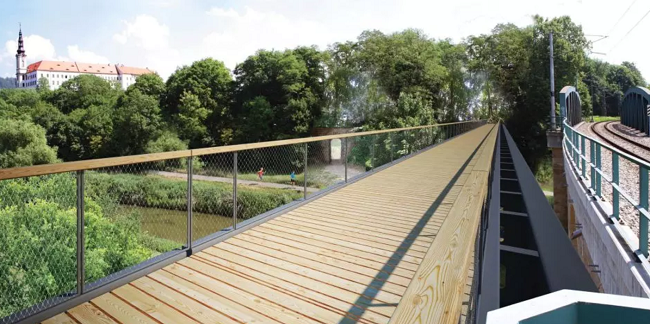
The footbridge and cycle path over the Elbe in Děčín is facing load tests
 |
| lavka |
Děčín - Experts are subjecting the foot and cyclist bridge over the Elbe and Ploučnice to load tests. The construction, costing more than 120 million crowns, is nearing completion. Builders are still working on connecting the bridge to the access roads. It should be finished by the end of April. This was reported by the city hall spokesperson Luděk Stínil in a press release.
A static load test is a method to verify whether the bridge is indeed as solid and stable as the designers anticipated during its design. "The principle is relatively simple – the structure is loaded with a certain weight and the reaction is monitored," Stínil stated.
In practice, it looks like about five multi-carts drive onto the bridge. The vehicles represent the test load. They stop at the locations specified by the static calculations. The designers know which places will experience the greatest stress on the structure. At each selected spot, the deflection of the bridge is monitored using measuring devices, i.e., how much the structure bends under load. Every construction slightly deforms when loaded, so the builders monitor the magnitude of the deflections.
The measured values are then compared with the values predicted by the calculations during the design phase. If the actual deflection falls within the expected range, it means that the bridge functions exactly as it was designed to be safe for regular use. The static load test thus serves as an important check that confirms both the correctness of the design and the quality of the construction work.
A dynamic test will follow the static test, during which oscillation will be simulated with the help of an electrodynamic shaker.
The construction of the bridge will create a new connection between both banks of the Elbe. Thanks to the bridge, the number of cyclists on the Tyrš Bridge and the Elbe waterfront should decrease, contributing to the calming of traffic. The city managed to secure a grant of 43 million crowns for the investment.
The English translation is powered by AI tool. Switch to Czech to view the original text source.
0 comments
add comment
Related articles
0
30.04.2018 | <Děčín> announced an architectural competition for a footbridge over the <Labe>
0
19.10.2017 | <Děčín> will announce an architectural competition for a pedestrian bridge for cyclists
0
08.09.2016 | Děčín is looking for a city architect
0
12.02.2013 | Děčín announces an architectural competition for the renewal of Podmokly