
Tahokov – modern design

Publisher
Tisková zpráva
05.11.2009 00:05
Tisková zpráva
05.11.2009 00:05
 |
Advantages of expanded metal
- Lower acquisition costs – it is produced using a zero-waste technology, which means you pay only for the product, not for waste generated during production.
- Long lifespan.
- Compact material (not welded, intertwined…).
- Wide variety of types and sizes.
- Simple finishing.
- A wide range of products allows for meeting all requirements – transparency, strength, permeability…).
- High load capacity (stairs, grates, ramps, walkways).
 |
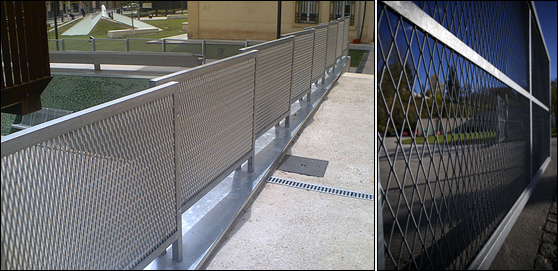
Fencing and infill for railings
- Long lifespan.
- Safety.
- Low maintenance.
- Good visibility through.
- Easy installation.
 |
 |
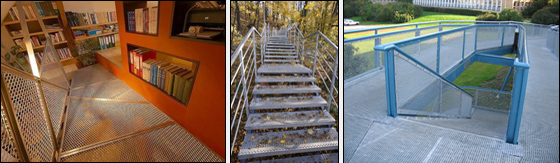
- High load capacity.
- Anti-slip properties (also for wheelchair users).
- Economic solution.
- Natural drainage of water.
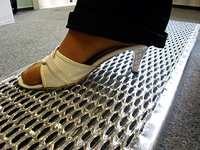
- Walkable for women's shoes with narrow heels.
 |
Ceiling panels
A significant advantage of ceiling panels is easy installation, interesting design, and breathability (extraction or ventilation can be installed above the panel).
 |
Ceilings in the city theater in Brno
Building cladding
A challenge for architects, who can play with colors, shapes, various types, and give buildings a new "more modern" look.
As seen in the image below, in Ostrava it was used for garages, where it covered the building, giving it a very interesting appearance while keeping it breathable. Another advantage is that in case of damage or vandalism, only the destroyed piece can be replaced, not the entire area.
 |
Cladding of a parking garage, Ostrava-Dubina
 |
Cladding of Netto Prague
What exactly is expanded metal
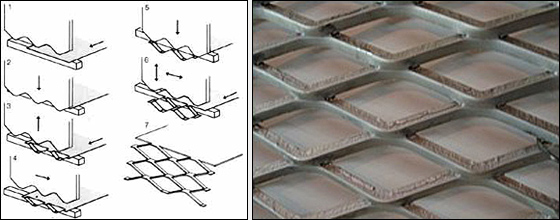
Expanded metal is a metal mesh made from various types of sheets by cutting and subsequent stretching, which, depending on the type of special blades, usually leaves openings in the shape of a diamond (image on the right) or hexagon.
 |
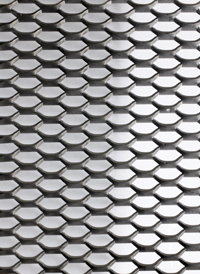 |
Material: expanded metal is most often made from ordinary steel, stainless steel, and aluminum (see image on the left). For standard steel, the product can also be treated with coloring, powder coating, or hot-dip galvanizing, which leads to longer material lifespan and improvement in appearance (stairs, grates, fences, etc.).
Thickness of material: standardly 0.5 to 4 mm. Thinner ones are mainly used as filters, ceilings, or meshes, while thicker ones are used as infill for railings, stairs, ramps, walkways, etc. (see illustrative photo above).
Contact:
ArcelorMittal Technotron s. r. o.
Křižíkova 1377, 738 05 Frýdek-Místek
Tel: +420 59 558 482 454; +420 59 558 483 656
Fax: +420 59 558 482 334
www.technotron.cz
prodej@technotron.cz
The English translation is powered by AI tool. Switch to Czech to view the original text source.