
Interview with TRANSAT architects
 |
 |
An architectural office based in Brno, established in 1997, since 2002 composed of: Petr and Alena Všetečkovi, Robert Václavík, and Karel Menšík. From 1998 to 2002, several architects worked there, with Jitka Ressová contributing authorship to some projects. Related professions are covered by a broader circle of external collaborators and consultants.
Authorization with ČKA in 1997, membership in DOCOMOMO - Czech Working Group for Documentation and Restoration of Buildings and Settlements of the Modern Movement at UNESCO - since 2002.
www.transat.cz
When did you start using Allplan support in architectural design?
Petr Všetečka: The need to use a computer in design arose soon after the establishment of our studio. Since both Robert Václavík and I belong to a generation that did not have much exposure to computers in college, our young collaborators, who brought their computer skills from school, became the main drivers of the transition from manual to computer processing.
Why did you choose Allplan?
PV: Before we purchased our first Allplan licenses for the studio, we considered which software to choose. Allplan appealed to us with its compactness and versatility. All necessary tools, including visualization, were part of one program. The individual approach from the Czech representation of Nemetschek played a significant role. Years later, it has proven that Allplan was a good choice. We are gradually purchasing additional modules according to our needs, which speed up and simplify our work.
 |
PV: From the beginning, we have mostly worked with four people in the studio - all architects, although there have been more of us temporarily. We have a circle of permanent external collaborators and specialists. We have three licenses available. We do not have Allplan network-connected yet, but we are starting to feel it as a limitation and will invest in a network solution in the near future.
What do you see as the greatest benefit of Allplan?
PV: The great feature, or rather property, of Allplan is the ability to monitor the development of the building during the design phase in spatial representation. This is invaluable assistance, allowing us to work on the house until the last moment before submission and to modify it in various ways. In the past, this was not possible. For instance, if we decide to change the shape of the roof three days before submission today, it is still feasible to submit the documentation on time. Personally, I find this flexibility of Allplan very satisfying.
 |
PV: We are a generation accustomed to sketching, and we cannot do without a pencil in the initial phase. Even during the design process, we make several hand drawings. However, I believe that the era is moving towards new techniques, and purely computer-based work is undoubtedly one of them.
Have you ever felt limitations or an inability to create the required structure or element while working in Allplan?
PV: I think the limitations in our projects do not stem from the CAD used. If we felt that Allplan was holding us back or preventing us from creating a part of the project, I or my colleagues would definitely use another tool, but that hasn’t happened so far. It is true that in our studio we design architecturally non-avant-garde building solutions, for which Allplan is perfectly suitable. In the 3D modeler, we have always found tools for atypical cases without issue.
 |
PV: I believe that the best way to design architecture is both by creating a 3D model on the computer and by utilizing a physical working model. The ability to touch the model with your hands is important. My dream is to create a large physical model for each assignment where the thicknesses of constructions and other essential aspects are visible.
What role do visualizations play in your design process?
PV: They play a very significant role because they allow us to demonstrate our proposal to the client. However, I must note that visualizations will never show a hundred percent representation of the proposed solution because there are too many factors that influence the final design, and not all of them can be predefined. An architect's experience is irreplaceable, including knowledge of material properties, their behavior, aging, and working with light. Visualizations never show space or the materiality of the house relevantly.
 |
PV: I would divide this topic into two parts. On one hand, the search for and definition of shape - in this respect, we are not inspired by information technology. Our buildings are still more about searching in the areas of construction and technology than purely shape experiments. On the other hand, I find the second aspect, which I would call “generating processes,” much more interesting. Here, we should not exclusively use architectural software but possibly programs from other fields - statistical, sociological, building-physics, climatological, or others aimed at collecting and accumulating data for subsequent evaluation. In this regard, I see a much more interesting application of information technology for architecture.
 |
PV: So far, we have not dealt with assignments where these techniques could apply, but a direct application can be seen in the work of the Dutch MVRDV. I have been thinking a lot about their models for transforming various input data into physical structures recently. I find it more promising than discovering and describing new forms in the computer because I do not yet see a connection to this kind of design in practical real building in the Czech environment. It seems misguided to try to realize some forms with conventional construction technology. Perhaps we will embrace this style someday, but for now, I am waiting primarily for a structural mass-material that would enable this "new building" on a larger scale. In this sense, no one has surpassed the progressivity of Ještěd in our country. However, I consider experiments based on wood material as characteristic and credible for our time. They may naturally bring unconventional architectural forms.
 |
PV: Definitely. In fact, I would say that it is happening on a massive scale. For example, one of our current projects - the restoration of the Minaret in Lednice - uses the latest methods for object surveying. The entire building is spatially scanned with a laser, and we obtain a very detailed relevant 3D model, which is the main aim of this method. The scanner also records colors. This precise measurement will serve as a crucial basis for our work. Reading and respecting such found architectural-historical anomalies is methodologically the way out of heritage purism.
 |
PV: Recently, great technologies have emerged around us. Both in terms of designing buildings on the computer, where you can work very accurately and in detail, and also in material possibilities. Especially in surveys and restoration of monuments, we have access to technologies that often allow for a new, truer perspective on things. However, I see a significant problem in the construction process, where the knowledge and skills of the people executing the buildings may not correspond to the sophistication of the project, often leading to issues. Perhaps that is why exhibition halls or airport terminals are collapsing. In our construction industry, there is a decline in professionals in conventional trades, which is a paradox in times of increasing specialization and certification. The smarter the technologies and software are, the more significant the gap sometimes becomes between theory and practice. This gives rise to frustration and an unfavorable feeling among architects regarding construction. Particularly in smaller buildings, ensuring a quality construction process is extraordinarily difficult. However, we also have good experiences.
 |
PV: Specifically for us, not really. The limitations we consciously impose while designing are more ecological or contextual in nature. For example, the selection of certain materials, their application, and so on. For us, the workability of the material and its logical use are essential. Its natural and not distant origin and a certain degree of sustainability in use are important. We do not let any potential problems or imperfections at the construction site limit us; we try to work with proven contractors.
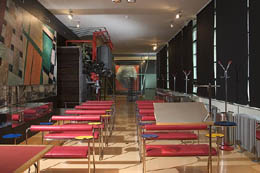 |
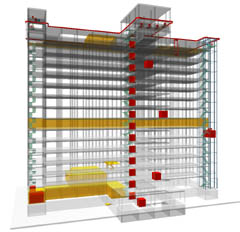
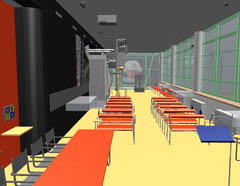
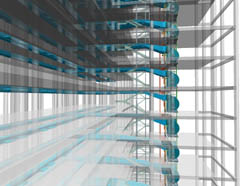
PV: Certainly. The largest project we have been involved in was the restoration of the Baťa skyscraper in Zlín, where we carried out specialized survey, design, and engineering work related to the historical parts of the building, its restoration, and interpretation (the general designer was Centroprojekt Zlín). In this specific case, we appreciated the 3D modeling tool in Allplan. We verified several atypical elements of the furnishings of the multifunctional space Expo 21 and refined their final appearance. For this design, we modeled all exhibits, including the multi-story air conditioning engine room, elevator speed limiter, and other elements, creating a visual representation of this representative space. Since the investor required various functional uses of the hall, we processed all possible variants of spatial arrangement in 3D and verified their functionality.
A few visualizations of the skyscraper's structure were used for promotional materials.
An interesting task was preparing the materials for the modeling company that produced both a model of the skyscraper and also Karfík's sample family house in Zlín for Expo 21. We fine-tuned the virtual model on the computer, which served as the basis for the modelers to create a physical model.
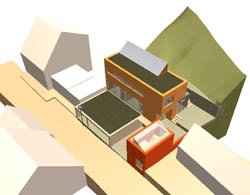 |
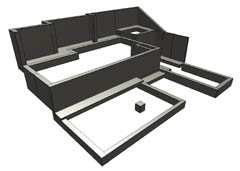
Karel Menšík: The terrain modeler is a very useful tool. For example, in the project of the company headquarters in Kuřim near Brno, after fine-tuning the placement of the building on the slope, we generated excavation drawings and calculated the volume of the excavated soil. We then calculated the volume of concrete for the foundations and retaining walls. However, the crucial aspect for us is the ability to place the house accurately into the terrain. We also utilized this in the project of a duplex in the Masaryk quarter of Brno, which is also on a slope.
 |
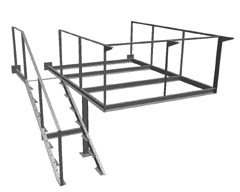
KM: The duplex was the first project we created completely in 3D. Therefore, all elements are worked out in detail, including the interiors. We created a model of the steel structure for the locksmiths.
In Allplan, library elements are predefined for steel elements.
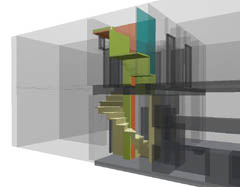
KM: Yes. We extensively utilize the elements in the library. We directly take the steel structures from the library. This simplified our work when designing the terrace for the renovated house in Žabovřesky. The output was a list of elements and a construction scheme for the contracting company. In this project, the interior and its solutions played a significant role. We created several visualizations in the working phase, rendering existing structures with transparency so that the new furnishing elements would stand out more.
 |
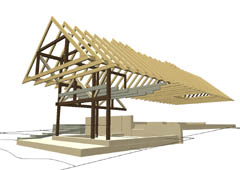
KM: Besides the terrain module, we also acquired a roof module. It is also an excellent helper. We first used it in the project of a holiday house in Sedliště near Jimramov. From the 3D model of the entire wooden construction, we generated a list of elements, and it became the basis for the carpenters to price it. We subsequently generated construction drawings for realization from the model. Until we acquired the roof design module, working with wooden constructions was more complex.
I see that Allplan is truly a creative tool in your hands. I wish you many interesting projects and thank you for the interview.
The English translation is powered by AI tool. Switch to Czech to view the original text source.