"His work is a clear force of his spirit, a driving lever of new development in architecture in his homeland, a fresh source of knowledge and a strong certainty amidst multifaceted free activity, for his art is not a whim, but a path."¹
Ernst Wiesner is one of the most prominent figures of the founding generation of modern architecture in Brno. Together with Bohuslav Fuchs, he is considered the most significant architect in Brno of the 20th century. He achieved his greatest successes in interwar Brno. Under his hands, the first puristic works in Czechoslovakia were created, striving primarily for purity of form, freeing the building from decoration with an emphasis on independent structure, color, and the texture of building material. Thus, Wiesner was paving the way for the famous Brno functionalism. His buildings were among the absolute top of their time and still surprise with their timelessness, a fact recognized by his contemporaries.
Wiesner's work had a considerable impact at the time it was created. He was one of the first architects to realize buildings with a modern spirit within the Brno environment without rejecting tradition. He approached historical inspirations in a distinctive and sensitive manner, which is characteristic of his creation. He excelled especially in spatial and functional arrangement of inner layouts and often combined modern elements with historical furniture in his interiors. This is evidenced by the words of his employee, architect Endre Steiner: "He always believed in the combination of modernity and old furniture."
Due to his Jewish heritage, Wiesner was forced to leave for abroad. However, he postponed his departure until the last moment, with the decisive events occurring on March 15, 1939. He left the republic in a hurry, recalling that he took only one coat, a suit, and a pair of shoes. Under very difficult conditions, he managed to reach Great Britain. During the journey, he had to hide for fourteen days in the attic of a house in Cologne. In England, due to his international architectural successes and personal contacts, he obtained political asylum and a work permit from the Royal Institute of British Architects (RIBA). Nevertheless, it was almost impossible to find employment, and his financial situation in the early years of exile was very critical.
Later, Wiesner began collaborating with the Czechoslovak government in exile in London. In the 1940s, he married the Hamburg actress Eva Marie, with whom he found his second home in England. In 1950, he won a competition for a teaching position in architecture at the University of Liverpool and moved with his wife to the northwest of the United Kingdom. He worked at the University of Liverpool until 1955 when he retired at the age of sixty-five. Even after that, he remained a member of the university council and examination boards. His work in Liverpool was primarily focused on teaching, yet he did have one significant realization – the construction of St. Nicholas High School near the Liverpool Cathedral. The university awarded him the highest academic honor, the title of Master of Architecture.
Conversely, Wiesner gradually became forgotten in Brno. In one publication, he was even incorrectly credited as the author of the Brno crematorium to Bohuslav Fuchs. The restoration of Wiesner's connections to Brno occurred only in the mid-1960s, primarily thanks to architect Bedřich Rozehnal. He was the one who passed Wiesner's address to the young Brno architect Mojmír Kyselka, who gained an extraordinary opportunity to travel to England in 1965. During his study trip, he visited Wiesner in Liverpool and was probably the first Czechoslovak with whom Wiesner met after nearly twenty years. According to Kyselka's words, Wiesner reacted to the meeting with great emotion and in broken Czech declared that it was the most beautiful moment of his life because the city of Brno, to which he had devoted the best of his work, had remembered him once again.
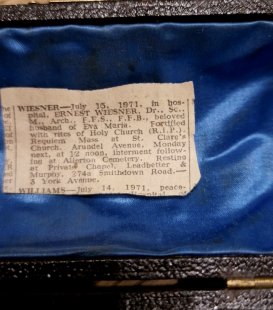
Bedřich Rozehnal subsequently contributed to the awarding of the silver medal of the University of J. E. Purkyně in Brno to Wiesner in 1966 and three years later also to the awarding of an honorary doctorate from the same university. The developing relationships between the University of Liverpool and Brno inspired Wiesner so much that he planned to annually donate a sum of a thousand pounds to Brno for scholarships and bequeath his house in Liverpool for the accommodation of Czech students after his death. However, these generous intentions were interrupted by the political situation in Czechoslovakia. Wiesner prepared several times to visit Brno, but due to the uncertain political developments and deteriorating health, he had to repeatedly postpone the trips. At the beginning of 1971, his health issues, particularly severe arthritis, worsened to the extent that he became confined to a wheelchair and was hospitalized. He passed away on January 21, 1971.
Until 2021, the commonly held belief was that Wiesner's tombstone in Liverpool did not exist, and the grave had been canceled. By coincidence, this assumption was disproved by the custodian of Villa Stiassni, who identified his tombstone at Allerton Cemetery.
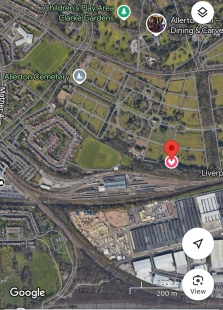
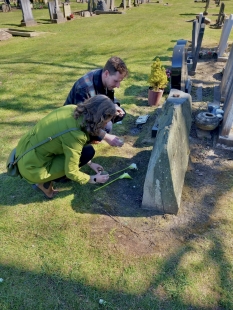
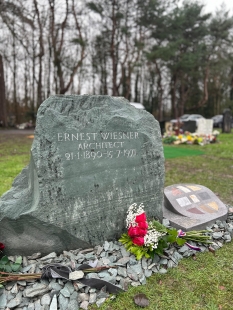
Following the identification of Ernst Wiesner's tombstone, the South Moravian Region organized a foreign working trip to British Liverpool from April 6-8, 2025. The aim was to document the tombstone and discuss possibilities for its restoration. The tombstone is located at Allerton Cemetery in the southeastern part of Liverpool, in group No. 14, under record number 483. It was most likely created immediately after Wiesner's death in 1971, with his wife as the likely commissioning party. However, this statement remains at the level of logical conjecture, as it has not been possible to find relevant archival sources in the Liverpool archives.
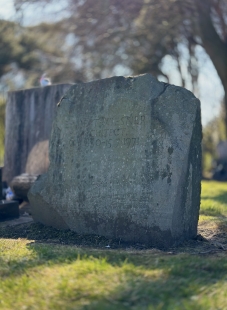
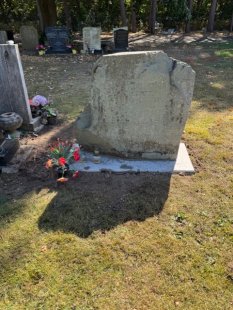
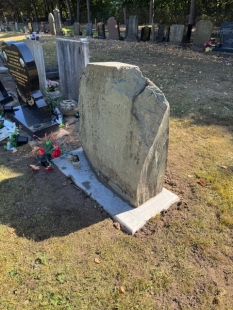
The tombstone is designed as a massive, irregularly processed stone block, whose form consciously avoids traditional funerary symbolism and ornamentation. The dominant feature is the rawness of the material and a thorough reduction of expression. The surface of the stone bears traces of rough processing, left in places in nearly natural condition, thus referring to the modernist emphasis on the truthfulness of material and authenticity of substance. The shape of the tombstone is asymmetrical and lacks axial composition; thus, it distances itself from the historicizing types of tombstones of the 20th century and leans towards a civic, even architectural logic of form.
The inscription is executed in a plain capital letter, engraved directly into the stone without any framing or decorative elements. The typography is factual and functional, fully subordinated to the overall concept: "ERNEST WIESNER; ARCHITECT; 21.1.1890 - 15.7.1971"
The overall impression of the tombstone is contemplative and introverted. Instead of representing or monumentalizing the personality, it offers a quiet, closed object that feels more like a silent architectural artifact set in the landscape of the cemetery. The tombstone can be understood as a personal manifesto of a modern architect – consistent in reduction, truthful in material, and restrained in expression.
During the foreign trip, an agreement was reached on the restoration of the existing tombstone, for which Ursula Sarsfield, owner of Sarsfield Memorials Liverpool, the oldest family stonemasonry firm specializing in memorials in Liverpool, was commissioned.
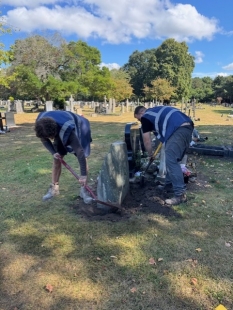
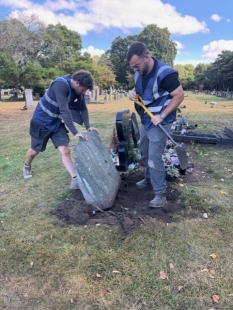
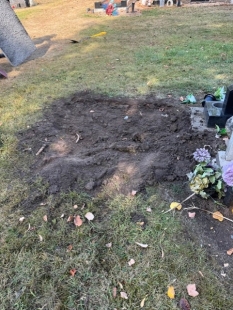
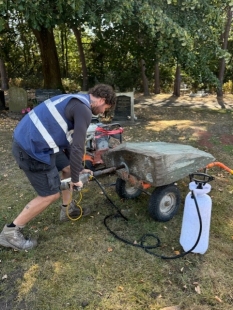
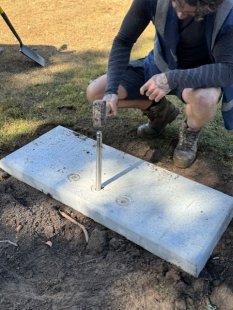
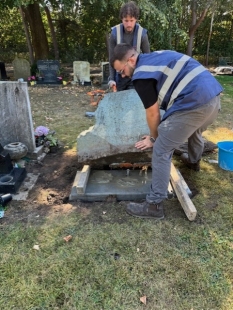
The restoration involved removing the tombstone, resetting it onto a new concrete base, and then professional cleaning and sealing of the stone. The restoration work was completed in June 2025 and financed from the budget of the South Moravian Region.
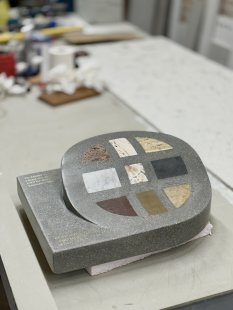
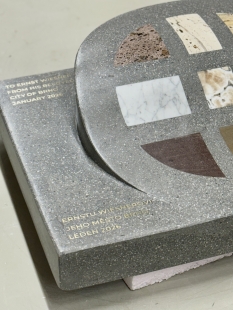
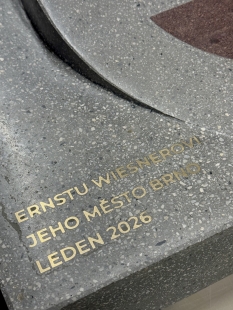
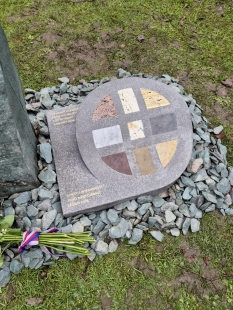
Concurrently with the ongoing restoration of the tombstone, the Brno architectural office RIVIERA architects was approached with the task of creating a new object that would commemorate the personality of Ernst Wiesner while also sensitively complementing the existing tombstone in the space of Liverpool Cemetery and materializing the idea of "bringing a piece of his beloved Brno to Wiesner in England." Tomáš Růžička and Igor Serenčko provided a design that, in the form of a precise and processed object, contrasts with the only partially processed Wiesner tombstone. The object was set into the surrounding terrain at a respectful distance so that it would not compete with or overshadow the visual impression of the tombstone. The object incorporates several compositional principles that Ernst Wiesner used. These include a grid, a curve, and basic geometric shapes. The division of solid and glazed surfaces of the facades into a grid with striking proportions can be seen on the façade of the Kapitol building. The curves refer to older architecture – Wiesner used them on the portals of the Czech Union Bank or Gutmann’s house. The effort to simplify to basic geometric shapes runs through the architect's entire work. The basic shape of the new commemorative object made of polished, fine concrete is dimensionally based on the concrete base added to the original tombstone and serves as its extension/closing. The circle itself, rising from the base, is a pure shape, the surface of which is covered by the aforementioned grid made up of various types of colored stones used by Wiesner, such as onyx, travertine, marble, and sandstone. These stone fragments were obtained from several buildings in Brno realized by Wiesner, such as the Moravia Palace, the Czech Radio building, or the Neumark and Stiassni villas. From the side view, the curved surface of the circle is prominent. The object bears the inscription ERNSTU WIESNEROVI JEHO MĚSTO BRNO, LEDEN 2026 / TO ERNST WIESNER FROM HIS BELOVED CITY OF BRNO, JANUARY 2026. An identification plaque is placed on the back side with the name of the donor institution - Renewed by the South Moravian Region. The flawless production of the monument during the Christmas season was ensured by Radim Skácel and Vladimír Vrána.
Everyone who values Wiesner's work had the opportunity to support the creation of the object. A public fundraising campaign was announced via the Donio portal, raising over 75 thousand through almost forty donors, for which we express our sincere thanks.
On the occasion of the 136th anniversary of Ernst Wiesner's birth, the second foreign trip of the South Moravian Region to British Liverpool took place from January 19-22, 2026, following the previous activities related to the identification and restoration of Wiesner's tombstone. The trip was also supported by the Czech ambassador to Great Britain Václav Bartuška and the Consul General of the Czech Republic in Manchester David Frous.
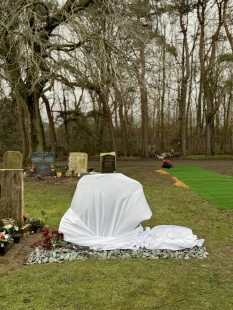
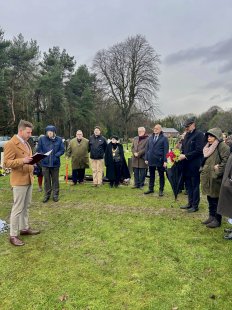
The main aim of the trip was the official unveiling of the restored Wiesner tombstone and the new commemorative object at Allerton Cemetery in Liverpool, with the ceremony itself taking place on January 21, 2026.
The commemorative event at the cemetery was conceived as a dignified reminder of Wiesner's life work and his significance for interwar architecture. Representatives of the city of Liverpool, led by the Lord Mayor of Liverpool Barbara Murray, representatives of memory institutions, and members of the Royal Institute of British Architects (RIBA) attended the event.
Kateřina Konečná Michal Doležel Tomáš Růžička
1] Max Eisler (1881-1937), art historian.
The English translation is powered by AI tool. Switch to Czech to view the original text source.