Autodesk presents its global vision for design software
The CEO of Autodesk outlined the company's strategic direction at a global press event.

Publisher
Tisková zpráva
02.03.2007 11:00
Tisková zpráva
02.03.2007 11:00
 |
In front of journalists and analysts from around the world, Bass elaborated on the main global factors driving design and outlined Autodesk's intention to help companies redefine their design processes to stimulate innovation and provide competitive advantage. Through state-of-the-art 2D and 3D design technologies, Autodesk aims to empower customers in diverse industries to practically test, change, and refine their ideas in the early stages of the design process. Its new products will help them save time and money, improve quality, and support innovation.
“In a world where globalization continuously expands the range of options available to customers, great design has become an opportunity to stand out from the crowd,” said Bass. “Fortunately for Autodesk, there has never been a better time to be a leader in design software. Autodesk's mission is to make immensely powerful options available for practically testing ideas before realization using 2D and 3D design tools that help companies of all sizes in various locations and industries fully leverage design innovations.”
Innovative designs require more than aesthetics
Bass identified five key global forces that are putting significant pressure on companies to innovate while addressing social and environmental challenges. Emerging economies, a global infrastructure boom, including highways and energy grids, the rise of the middle class in countries like China, the necessity for sustainable design, and the advent of the “digital lifestyle,” all raise the bar for success. For companies looking to maintain competitiveness and profitability, innovation is the only option.
Bass noted that as a result of these realities, Autodesk's customers are thinking differently about the design process to better understand the information expressed by the geometry of the drawing, particularly the function and likely user experience of a given design. Using examples from leading customers, Bass explained how early insights into the design's impression on the customer help companies get ahead when bringing successful concepts to market.
For designers to realistically envision the impressions of ideas before realization, they must not only know how the idea will look but also how it will actually function. Advanced 3D design technologies from Autodesk help customers with this, enabling them to create fully functional digital prototypes. With these, companies can visualize, simulate, and analyze the practical functioning of concepts. This integrated environment allows customers not just to see but also to “experience” their ideas before anything is actually constructed, proactively changing designs and adhering to principles of sustainable design.
Implementing changes in the early stages of development provides companies with all the advantages of design innovation – particularly cost-effectiveness, efficiency, faster time-to-market, better quality, and performance – all of which translate to a competitive edge in the rapidly changing global economy.
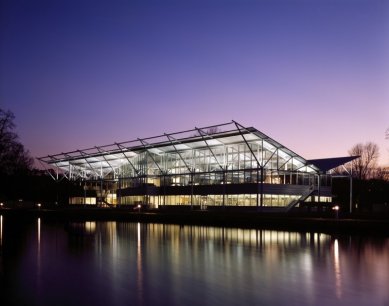
HOK, Palumbo Motorcar practically test ideas before realization
Global architecture and engineering firm HOK and the bold American company Palumbo Motorcar, which specializes in designing and manufacturing concept cars, were among the customers who together with Bass explained how they use digital prototyping to boost productivity and ensure competitive advantage.
 |
Jason and Joe Palumbo explained how Palumbo Motorcar aims to tap into the growing market for hybrid vehicles and high-performance sports cars, which is projected to represent a business opportunity valued at $3 billion. The company is working on the design of the groundbreaking Palumbo M-80 concept car with hybrid gas and electric propulsion. This vehicle aims to provide tremendous speed and acceleration with exceptionally favorable fuel consumption and minimal environmental impact. By creating digital prototypes in Autodesk Inventor and Autodesk AliasStudio, the engineers at Palumbo Motorcar have reduced the design phase of prototyping by nearly 75 percent, significantly accelerating the vehicle's preparation for production.
The ability to predict users' real impressions of products has significant impacts in areas that are the calling cards of the world's greatest innovators. According to global consulting firm Booz Allen Hamilton, which specializes particularly in strategic and technological consulting, the most successful companies in the Global Innovation 1000 ranking exhibit significant capabilities in four key areas: idea generation, project selection, product development, and commercialization (see report A Select Set of Companies Sustain Superior Financial Performance While Spending Less on R&D Than Their Competitors, published November 13, 2006). With visualization, analysis, and simulation tools, creative companies can accelerate decision-making across all these functions, save costs, and expedite bringing great ideas to market.
About Autodesk
Autodesk, Inc. is a global leader in 2D and 3D design software for manufacturing, construction, media, and entertainment. Since the launch of AutoCAD in 1982, Autodesk has developed the broadest portfolio of advanced digital prototyping solutions that help customers practically test ideas before realization. Fortune 1000 companies use Autodesk tools to visualize, simulate, and analyze the real functionality of their designs already in the early stages of development, helping them save time and money, increase quality, and support innovation. More information about Autodesk can be found at www.autodesk.com or www.autodesk.cz.
The English translation is powered by AI tool. Switch to Czech to view the original text source.