
Very interesting duel of architects with their own house
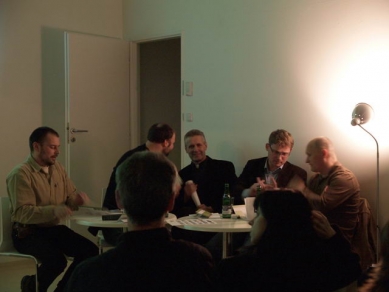
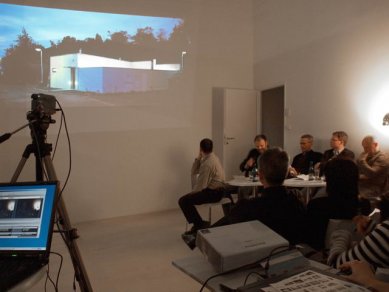
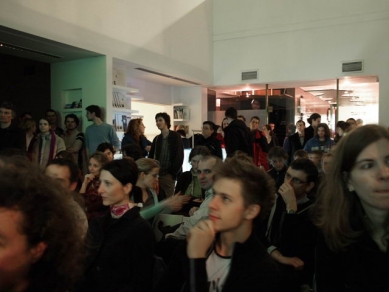
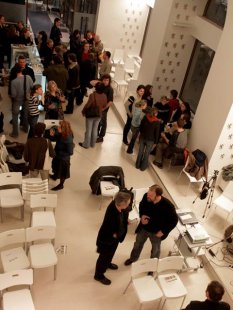
The first March evening hosted another thematic evening at the Czech Center, Versus Architect. The series, dramaturgically prepared by the studio A1Architects, this time focused on the architects' own houses, that is, the interesting situation where the architect is their own client, investor and, as it turned out, often also the builder.
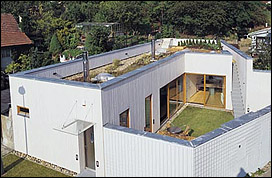
The series of presentations was kicked off by Jan Zelinka from the Opava Atelier 38. The decision to build a own house was prompted by comparable investment costs for purchasing an apartment and a house. The Zelinkas had a garden and chose more comfortable living in a family house. There wasn't much time for the design, thus the house ended up being very simple and straightforward. The budget of 1,000,000 CZK dictated the materials used. Architect Zelinka revealed one aspect of designing his own house, namely the influence of family members on the final formal appearance. Thanks to excellent arguments, Zelinka managed to build the house as intended. The house is still not finished; with the expansion of the family, additional spaces will be built. Zelinka demonstrated that an architect's own house does not necessarily have to represent a groundbreaking manifesto in their work, but rather can be a purposefully useful matter. The Zelinka family's house ultimately serves as a family chronicle, reflecting the current needs of the family. How else should an architect record the fates of their family but structurally in their house?
A different approach was taken in his presentation by Petr Kolář from ADR. It was no secret that he moved from his debut in Dolní Chabry to one of the houses in Na Kozinci, but when he mentioned that he is now designing his sixth house, it was shocking. Unfortunately, this claim was not substantiated by any evidence, leaving the question of whether he was telling the truth. He completed his first house while still studying at VŠUP. He exchanged his apartment for a plot in Dolní Chabry. The rocky terrain caused his father to turn against him, but after the house was completed, forgiveness happened. Architect Kolář's house was somewhat a laboratory, a practical school 1:1. Both during the approval process, where he learned about the power of conservationists and during the construction, which he demonstrated using the example of window openings, as well as during usage when he changed or completely eliminated many proposed solutions. Daily use initiated the removal of the wall between the kitchen and living area, the cancellation of the rooftop garden, changes to stainless steel surfaces in the kitchen, and the choice of a new seating set. The story of the house in Chabry concluded with the architect commenting on the difficult coexistence with non-professional neighbors. The neighbor's recommendation to not spare expenses on the architect next time was significant for the other participants as well.
Another house by Kolář in the Na Kozinci colony can be described as a conventional home. He acquired it from a developer who did not trust the ADR concept and did not want to be a lightning rod for complaints from the new homeowners. It is hard to say why the architect moved from here to a third house. Kozinec belongs among the best living areas in our country, as proven by the photographs. The only hitch turned out to be the column in front of the double garage, where men test the driving skills of their partners. The monotony of forms and materials used is also a cost for the pioneering step into similar housing. Petr Kolář showed himself as an architect striving to test the correctness of his opinion on housing. He enjoys experimenting with various housing forms, from detached houses, through row houses, and now he has reached the reconstruction of a 200-year-old farmhouse on the outskirts of Prague.
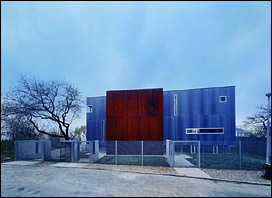
The own house of architect Karel Mrázek and his family in Kobylisy is known by everyone; however, the available authorial report was supplemented during his presentation with a number of significant findings. From the very beginning of the presentation, it was clear that architect Mrázek was aware of all the pitfalls that awaited him on the way to his own house. The difficulty of the task was further intensified by the planned presence of the studio in the house. The plot near their original residence was discovered by the architect's wife. It is located right next to the school, which their daughter attends. The architect conceived his house as a demonstration of his own understanding of architecture. The materials used had already appeared in his previous realizations. The elementary form of the house, which utilizes a strongly artistic composition of cladding and openings on the facade, is not surprising either. The client is thus directly confronted with the architect's personality in the studio and senses what awaits them. The issue of separating the studio from the living space was solved with a sophisticated staircase system. The fascination with the simple form of the house, on which the shadows of trees and the setting sun are cast, was expressed in a series of photographs and snapshots. Karel Mrázek contributed to the discussion with his own axiom, stating that if you move into your own house before it is finished, you will never completely finish it. For this reason, he postponed moving into his own house for a whole year. Very importantly, he also communicated that, on the slope to his left, another architect—Petr Malinský from DaM—has settled with his own house.
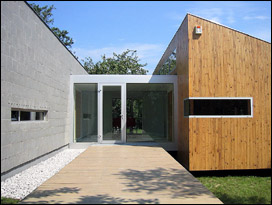
A very interesting contribution was presented by Kamil Mrva from Kopřivnice. The impulse to build the house came from inheriting the land. The house was completed when the author was 28 years old and was one of the first projects that architect Mrva realized. Based on this house, he obtained additional commissions and inscribed himself in the builders' subconscious in the region. Architect Mrva's house also includes a studio; however, unlike Mrázek's vertical layout, Mrva chose a horizontal separation of living and work. Very simple forms serve as a basis for further layering, and the house is variably furnished or reconstructed. Similar to the case of the Zelinka house, an emphasis is placed on maximum integration of the house with the fresh garden environment. Interestingly, neither architect counted on demanding garden work, which resulted in the space for garden tools being built in Kopřivnice.
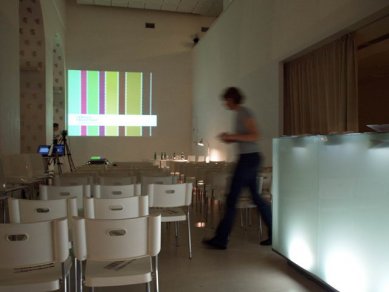
The evening closed with the presentation of architect Zdeněk Fránek, who built his own house with his own hands on Kamenná Street in Brno, but now he only uses it as a studio and remains in his original residence. Fránek pointed out the unpleasant feeling of schizophrenia during the design of the house and generally labeled the role of designing one’s own house as very challenging. The architect advantageously acquired the plot and kept building additional floors of his house. The planned basement expanded to include another underground floor, and the above-ground part also increased in size compared to the project. The operationally austere solution is enriched with sculptural forms in the interior. The interior space of the studio is variable and is modified according to current needs. One of the requirements for the studio was to create a space for irregular meetings of architects, screenings, celebrations, etc.—as documented by photos. During the presentation, architect Fránek admitted to being clearly inspired by Tadaa Anda's studio layout.
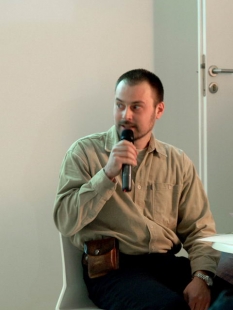
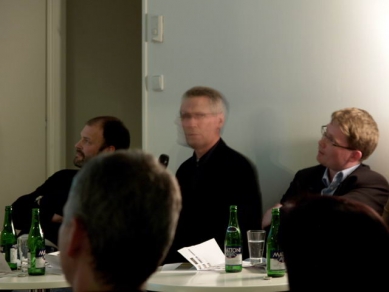
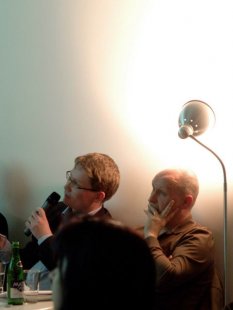
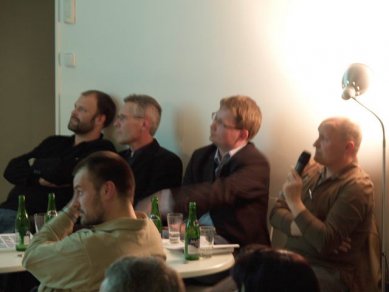
Questions in the subsequent discussion revolved around the relationship between residence and studio, financing of the house, family influence on the final design, and others. Jan Zelinka tries to eliminate his work space from his house, but sometimes he has no other choice but to sit at home at the table and give himself "a second shift." Petr Kolář resigned to the connection of his own residence with the studio, since the ADR team counts nearly 70 people. Conversely, Karel Mrázek finds positioning the studio next to the residence advantageous and argued about the short commute to work. Architect Mrva considers the placement of the studio next to the residence to be invigorating and appropriate, while Zdeněk Fránek is an advocate of separating the studio from the residence. All architects agreed that realizing one's own house is a frustrating matter; however, from their contributions, listeners got the feeling that the result is worth it. The financial question could be summarized with the words that it is advisable to exceed the planned budget in the design because "the money somehow always ends up being found."
Next time, theorists will gather at the Czech Center. The topic for the meeting on Thursday, April 5, 2007, is Theory versus Architect. Selected guests will discuss the relationship between theory and practice in architecture, whether and how to interpret architecture. They will outline what they consider to be the fundamental themes and concepts of contemporary architecture.
 |
 |
 |
 |
 |
 |
Questions in the subsequent discussion revolved around the relationship between residence and studio, financing of the house, family influence on the final design, and others. Jan Zelinka tries to eliminate his work space from his house, but sometimes he has no other choice but to sit at home at the table and give himself "a second shift." Petr Kolář resigned to the connection of his own residence with the studio, since the ADR team counts nearly 70 people. Conversely, Karel Mrázek finds positioning the studio next to the residence advantageous and argued about the short commute to work. Architect Mrva considers the placement of the studio next to the residence to be invigorating and appropriate, while Zdeněk Fránek is an advocate of separating the studio from the residence. All architects agreed that realizing one's own house is a frustrating matter; however, from their contributions, listeners got the feeling that the result is worth it. The financial question could be summarized with the words that it is advisable to exceed the planned budget in the design because "the money somehow always ends up being found."
Next time, theorists will gather at the Czech Center. The topic for the meeting on Thursday, April 5, 2007, is Theory versus Architect. Selected guests will discuss the relationship between theory and practice in architecture, whether and how to interpret architecture. They will outline what they consider to be the fundamental themes and concepts of contemporary architecture.
The English translation is powered by AI tool. Switch to Czech to view the original text source.

0 comments
add comment