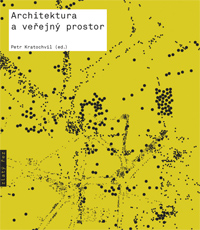
The interview was conducted regarding the latest book by architecture theorist Petr Kratochvíl Architecture and Public Space. The anthology of thirteen texts by authors from various professions demonstrates a wide interest in this topic within society. It is no surprise that public space and its form in contemporary times is a pressing and current issue, as its contemporary content is often complicated to determine. Public spaces are essential for cities; in the introductory text of the anthology, Petr Kratochvíl states: "Without attractive public spaces inviting participation in communal events, a city would not be a city, but merely a cluster of buildings."
Filip Šenk: According to what criteria did you select the authors for the book? Petr Kratochvíl: I tried to choose topics so that the studies covered the entire spectrum of what is hidden under the concept of public space. At least, there is a basic ambiguity here - public space must be physical and at the same time it is a social phenomenon. A physical space without people cannot become a public space. I wanted to include sociologists, political scientists, lawyers, urban planners, and architects. It seems to me that only in the intersection of these perspectives can we talk about public space a little deeper than just as a fashionable topic of “we need to put interesting paving and attractive benches there.” The specific choice of authors is based on previous knowledge. I also tried to balance the anthology territorially, although the fact that I had the opportunity to stay in New York on a Fulbright scholarship influenced the selection. American literature was just flowing toward me there.
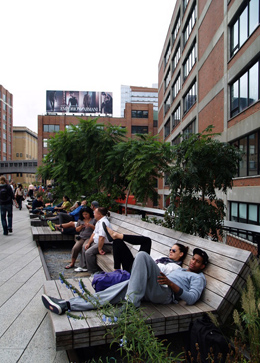
High Line Park in New York (photo: M. Čermáková)
FŠ: I was struck that alongside a number of expert texts, the book includes a punchy essay by Paul Goldberger from The New Yorker. It shows how new digital technologies are transforming public space. A person on the street, when on the phone, is actually not present on the street, i.e., they do not participate in public space. PK: I was thrilled by this essay. Paul Goldberger is a great commentator on architecture, and the fact that his articles appear in The New Yorker does not detract from their seriousness at all. They are often cited in professional literature. In English magazines - but also in newspapers - architectural criticism is at a high level. It is not at all harmful for one to reach for such texts. Besides, my relationship with mobiles has been traumatic since they have existed. When I encountered the essay of a person who sees their harmfulness and the pollution of the world by being mentally elsewhere than where we are physically, I was excited. I wanted to include another author who can write humorously and sharply - Michael Sorkin, who is a creative architect. He mercilessly criticizes the social contexts of architecture. Unfortunately, his essay on the "disneylandization" of public spaces was too extensive.
FŠ: In Klaus Selle's essay, the inconsistency of discussions and the terms used is well demonstrated. At the same time, I appreciated the sobriety of the assessment of the current state. PK: I consider Klaus Selle's contribution to be incredibly important, even though it represents a perspective that may be somewhat distant from me, as I tend to be more critical of the current state. I realized that many authors perceive the current public space as a manifestation of a certain crisis in society. Their expressions about architecture are a way to critically define themselves against the current commercialized society and a culture that is solely consumption-oriented. And this perspective can be one-sided. Klaus Selle is a professor at the university in Aachen, who also participates practically in developing positive programs. He thinks critically and at the same time tries to show how public spaces can be newly formed. In the position he represents, it is crucial that in today's situation of economic crises and a certain weakening of public authority, this usually cannot be done without a partnership between the public and private sectors. One must practically deal with that. It cannot simply be said that everything is privatized and that it automatically leads to the curtailment of public space of freedom. Selle and his group are trying to look for risks and positive responses to face those risks. I found that interesting. I liked the compactness of the text, clearly defined theses and antitheses, and everyone can judge whether the truth lies with the slightly left-leaning ideological critics or the positively seeking pragmatists. Selle's group at the university in Aachen is also engaged in mapping specific cases. They had a fairly long grant for that and worked on the situation in several European countries. They continue to do so, so they have already elaborated on many more nuanced perspectives, but I felt that this text expresses Selle's strategy succinctly.
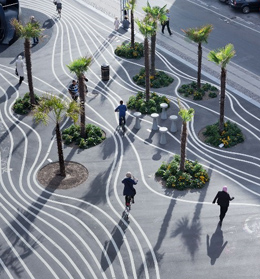
Superkilen Park in Copenhagen (design: B.I.G.)
FŠ: Juhani Pallasmaa is one of those who do not limit themselves to architectural and urban discussion. He deals with the broader cultural situation. Is that close to you? PK: Juhani Pallasmaa is an incredibly close person to me; we always enjoy meeting. We particularly share philosophical favorites. I studied philosophy, and therefore I admire architects like Christian Norberg-Schulz or today Pallasmaa when they dive into such demanding readings of authors like Heidegger or Merleau-Ponty and manage to bring forth something that can orient architecture. Not necessarily in an instrumental sense, but that it deepens understanding of the world. An architect should first understand the world before they start inserting something into it.
FŠ: The discussion about public space arose mainly from a certain feeling of crisis. What are the symptoms of this crisis? Why has this discussion actually emerged? PK: In our environment, there is a certain delay compared to Western countries, where critical views on the public sphere have been ongoing for several decades. There were several main reasons - the first was the problematization of public space by the modern functionalist doctrine of urbanism, which abolished the classical notion of urban space as a place that is inside, that is demarcated, and replaced it with the idea of open space around buildings. That degrades either into hygienic greenery or transportation routes. It seemed to automatically exclude the possibility of being a focal point for public activities, gathering, and defining oneself in relation to others. Residential spaces in many of our cities carry that within them. The second crisis moment was the takeover of streets and squares by cars. The third problematization perhaps lies in the arrival of technologies that transfer us into the virtual world. Our world is becoming wider all the time, and we have a legitimate feeling that the significant things are happening somewhere in the distance. A specific place, whether a square or a street, has lost the role it traditionally had since ancient times or in the Middle Ages. It was a place where we learned how decisions about our destiny are made. Today, we do not need to go to the town hall gates to know what will happen to our city. All information is on the Internet. There are many moments when the relationship to a specific place loses its significance in contemporary civilization. On the other hand, many other motives arise for why we perceive the beauty of public space and enjoy being in it. Jan Gehl in his essay shows that while in the past we had to use public space, today cities compete to make us use it, so that it is worth our while to go there.
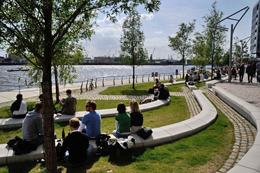
HafenCity in Hamburg
FŠ: What is the situation like here? PK: The perspective on the state of public spaces is quite relevant. We have a lot of historical public spaces, and many cities have recently tidied up these places. But to a large extent, the more beautiful they are, the more they are expropriated for the tourism industry, so we no longer feel them as our own public space. Secondly, after November 1989, the defense of the public interest was significantly weakened, partly due to the preceding experience of “everything belongs to everyone.” Signs that something should change are reflected in urban policies on all sides, and spontaneous initiatives like "City Interventions" in Prague, Brno, Bratislava, etc. show that architects and urban planners are interested in the matter. And there are even positive responses from city halls. But their interest should not be limited to the squares in historical centers, as has often been the case until now. City halls are responsible for what happens in public space, what private entities build around public spaces. Public space is also defined by the shape and use of surrounding buildings, not just the paving in the middle. The interplay of public and private must return to balance again. That has been disrupted - let’s compare Karlín with what I saw in Hamburg - and I was very happy to include an essay in the anthology about what is happening in their port. In Hamburg, the city is capable, in agreement with private investors, of enforcing a concept of public space including social dimensions. In Karlín, freedom is left, there is no guiding idea that the city defends to create a real city with real public spaces. And not to mention places like the Bubny railway station. We still don’t know what a private owner will deign to build on such a piece of the city and what they will leave us as a public space.
FŠ: There are many examples abroad where public spaces are revitalized even in historic neighborhoods and centers - let's mention High Line in New York or Museumsquartier in Vienna. Here, there are actually only exceptions. What do you think is the reason for this? PK: It is the result of the fact that urban policy had other priorities. In some places, this is even logical; it is prompted by economic attitudes. At that moment, the idea that we should focus on public spaces does not have such significance. On the other hand, and it is fundamental to the strategies of many cities, it shows that investment in public space is relatively cheap compared to other urban investments and can have a huge positive impact on the wider area. That was the basis of what Barcelona brought up at the beginning of the 1990s. Back then, it was called the "Barcelona effect," even before the "Bilbao effect." In preparation for the Olympics, there was an effort to rehabilitate neighborhoods with a bad reputation. The city had no chance to reconstruct entire neighborhoods. From public funds, public space was rehabilitated, and suddenly the entire neighborhood improved, inducing positive interventions of private money as well. The same can be seen with the New York High Line. Suddenly, it becomes an attractive axis, and investors start vying to have an address on the High Line because it is fashionable. Caring for public space is not that expensive; it can be done modestly, and the effect can be significant. Unfortunately, here things get started and are not followed through. We actually have our own High Line in Prague; it’s just that nobody knows about it. The disused track from Bulhar along Vítkov fortunately was not destroyed, and there is an asphalt strip for cyclists and rollerbladers. However, what was supposed to be connected to it - starting with someone picking up trash there once a year - is not happening. These are opportunities that can give an impulse to an entire neighborhood.
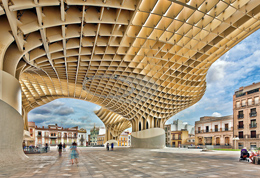
Metropol Parasol in Seville (photo: F. Rodriguez)
FŠ: What is the purpose of public space today? Just for recreation and entertainment? PK: I would not define it functionally like that. One of the authors, I think Sola-Morales, says that when spaces are newly formed, they should not be formed for a specific function. Rather, they should be a certain form that gives an opportunity for life to settle. It is necessary to give it a chance. Overly pre-programmed space can be misleading; it may ultimately prevent what is the most interesting about public spaces – the meeting of one with another in an immediate, surprising, un-staged environment (unlike shopping centers where everything is subordinated to a marketing strategy). Public space should provide the freedom of meeting, including what I might not want to see, but is part of life. I remember a conversation I had with Jiří Střítecký from A 8000. When he expressed himself about Anděl and the small square that was created there, he said, "I even like the homeless people there. They are a part of life, after all. Let everyone see them. Just let them know there is a problem. Let’s not sweep it under the rug." This role of public space is an extreme position, but the fact that I actually meet someone is important. A virtual meeting with a person is simply a diluted version of seeing someone shout, how they look, sing, or just sit. Meeting is still the greatest magic of public space. The most interesting in it are not so much the physical forms and attractions but the others.
FŠ: The book does not contain a significant critique of Corbusier’s concepts of the city. Can a city exist without public spaces? PK: Everything can exist, but will we still call it a city? If we will not call it a settlement or label it with some other technical term. I tried to show what makes a city a city, and that is why I included the now classic sociologist Hans Paul Bahrdt. He deals with the polarity of private and public that has been shaped since the Middle Ages in markets, and that defines what makes a city a city. It is not the quantity of people. There is a specific form of incomplete integration of society, which is different from a village where everyone knows each other in advance. In the city, they do not know each other beforehand, but they must have some ties; they must create elementary rules of coexistence, politeness, just in order to prevent disputes and conflicts in the marketplace. And above all, respect for the other person as a human being was formed on the market - not just because they are a relative, acquaintance, etc. Therefore, Bahrdt argues that the beginnings of democracy were formed in the medieval marketplace. This possibility of social integration - confrontation with others, with differences, and the search for what is common - defines a city as a city. When it disappears, the buildings will still stand there. The spaces will also remain, but they will not be public spaces and it will not be a city.
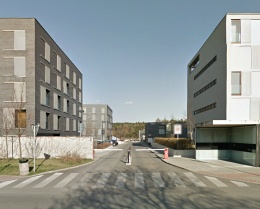
Entrance to the Na Krutci complex (photo: Google Maps)
FŠ: Abroad, and in our country to a significantly lesser extent, communities are emerging that create closed parts of the city within the city. Is this a phenomenon aimed against the city? PK: It seems directly criminal to me. Unfortunately, this phenomenon, which originated in the USA and which I first encountered in London, is something that threatens the city. Society, in order not to disintegrate, must guard against being divided into mutually impermeable ghettos. These can be purely social like castes that do not communicate with each other, do not know each other, and fear each other. It can also have a physical manifestation, clearly defined and socio-economically delineated. They can be real physical fences, but it can also be done invisibly with the same purpose. It is partly a natural tendency. However, as soon as it exceeds a certain threshold where the barriers become very impermeable, then conflict is brewing. Suddenly the situation can explode like a rebellion of those who are at the very bottom. Preventive solutions must be sought that do not allow radical segregation. The fenced housing estate Na Krutci with street names marked in red but blocked by a barrier contains beautiful architecture, but I consider it to be a malignant issue.
The English translation is powered by AI tool. Switch to Czech to view the original text source.