
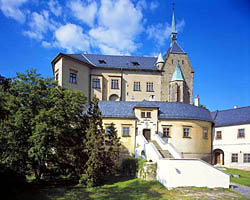
The most prominent monuments on the market are burgher houses and castles
 |
"Sellers are usually from the ranks of restitutors or heirs who cannot utilize the building’s layout or are unable to maintain it for financial reasons," said Miroslav Churánek from RE/MAX Premium. According to Jaroslav Novotný, president of the Association of Real Estate Agencies, people are also disposing of properties who have not succeeded in business ventures in these buildings, or liquidators or bankruptcy administrators of failing companies.
Buyers, on the contrary, often come from banks, other financial institutions, and large corporations. There are also many foreigners and foreign investment companies.
Real estate agencies do include heritage properties in their listings, but they are not the main focus of their interest. "The heritage property market is definitely not a lucrative business for most companies," noted Novotný.
Prices for some heritage properties sold on the real estate market can, according to experts, soar into hundreds of millions of crowns. In the current offer from RE/MAX, for example, a castle in the village of Bezno near Mladá Boleslav approaches this limit, with the seller requesting 75 million crowns. For the house U Zlatého hroznu in Prague's Malá Strana, which previously housed a branch of Komerční banka, the owner is asking 145 million crowns on the sreality.cz website.
In southern Moravia, real estate agencies are currently offering about ten interesting historical properties for sale. Most of them are dilapidated buildings that require multi-million investments for restoration. Primarily, these are crumbling castles, which municipalities do not know how to manage, and for which real estate agents have been searching for buyers for several years.
Many of the sold heritage properties also do not appear in real estate listings, as their owners simply have no interest in advertising. "These properties are usually not offered through classic advertising, but through individual outreach to investors," said Petr Illetško, director of AAAbyty.cz, earlier to ČTK.
Of the heritage properties that pass through the real estate market, they most often become hotels, but they also frequently serve residential purposes. Large companies use these buildings, for example, for representative purposes. However, old industrial properties also appear on the market, which give rise to atypical so-called loft apartments, for example.
Heritage-protected apartment buildings often continue to serve their original function, with Prague leading in this regard. "Historical properties in Prague are highly valued for their uniqueness and surrounding environment," said Ondřej Diblík from the real estate agency Lexxus. According to him, these are apartment buildings or former palaces, especially in the Old Town, Josefov, Kampa, or Malá Strana. In this regard, Churánek also notes that other tourist cities, such as Český Krumlov, Kutná Hora, or Karlovy Vary, are attractive.
In February, the Ministry of Health sold three castles as part of the sale of unnecessary property. Along with 14 other properties, they were acquired for 113 million crowns by the Czech-Cypriot real estate firm Terabet, based in Písek. There were only two interested buyers, and price was the main criterion for the ministry. An expert company estimated the market value of all buildings at 95 million crowns.
April 18th marks International Monuments Day. This year, its main theme is sacred heritage and sacred sites.
Church monuments in the Czech Republic, however, due to the social situation in the second half of the 20th century, are among those that have been largely destroyed or damaged, and have long awaited, or in many cases still await, repairs. Churches and other church buildings were frequent targets of thief attacks, especially in the 1990s, and many sacred monuments were taken abroad, where they became objects of trade on the black market.
Of originally church properties, there is currently for sale the Chapel of Saint Joseph in Zákupek near Česká Lípa from 1782. The owner is asking for nearly 2.5 million crowns through the real estate agency Mexx Reality. In Rokytník near Hronov, the sreality.cz website offers a 19th-century Lutheran church for 1.2 million crowns. The Plzeň Bishopric, as part of the restructuring of church real estate, even established a special website www.fary.cz dedicated exclusively to the sale or rental of some sacred properties.
Daniel Novák
Municipalities or churches sell heritage properties, the state does not
Owning a castle, chateau, or water fortress is a dream for many romantics, but in the last two decades, many Czechs have been able to fulfill it. Up until the 1980s, most heritage properties were state-owned. Due to restitutions and privatization, the ratio of heritage property owners has significantly changed. While before 1989, 60 percent of heritage properties belonged to the state, today, 90 percent of immovable cultural monuments are in non-state ownership. It is now possible to buy heritage properties from municipalities, churches, or private individuals for whom they have become unnecessary. Acquiring a heritage property is not a problem; in fact, the fact that a given object is declared a heritage property can reduce its price. For some buyers, this fact may be a burden, as the owner of a heritage property is legally obliged to care for it. This means that the features for which it was listed as a heritage property should not be changed. And if someone wants to radically redesign an abandoned chateau or perhaps a village cottage, heritage protection will prevent that.
A heritage property thus has limited options for utilization - therefore it may also be unappealing to some solvent buyers. On the other hand, purchasing a heritage property almost always means investing a lot of money. Buildings that are offered for sale have often been uninhabited for years.
Currently, there are about 40,000 immovable cultural monuments registered in the Czech Republic, but heritage properties are not just the embellished castles that people visit during the summer season. Of the 130 castles and chateaux accessible to the public, around 30 were returned to their original owners after 1989. Together with others that the state did not care for, dozens of castles and fortresses now belong to private owners, municipalities, or other entities. The mentioned hundred serves as a showcase representing the state’s care for heritage properties.
Several urban palaces that are heritage-protected and owned by the state, especially in Prague, serve various authorities. The remaining tens of thousands of heritage properties, including structures from entire urban reservations to castle ruins, chateaux, churches, chapels, rectories, village cottages to roadside shrines, are owned by municipalities, regions, churches, or private individuals.
And these owners also sell them; the state, with exceptions, does not. One exception is the sale of the Church of St. Michael in Prague, which was purchased by a private individual, its long-term tenant. According to state representatives, this was only after the state did not exercise its preemptive right, which means that no state institution wanted the historical object in the center of Prague.
Unnecessary or unused heritage properties are sold by churches or municipalities mainly because they say they do not have the funds for their reconstruction. State administrators have also occasionally complained about a lack of funds, which has led to discussions in recent years at the Ministry of Culture and the National Heritage Institute about the possibility of transferring some state properties to regional governments.
Some heritage preservationists are concerned that the regions would later realize that they also do not have the funds for the maintenance of heritage properties and could further sell castles and chateaux, or separate the property from its interior furnishings, which would decrease its artistic-historical value according to them. They are also concerned that heritage properties would only serve as intermediaries for acquiring funds from European funds.
In the early 90s, many heritage properties became collateral in banks - for example, the long-neglected chateau in Buštěhrad, which was purchased by the firm of the current owner of the aforementioned Church of St. Michael. After years of neglect, the municipality repurchased the chateau four years ago, but they are struggling to gather the funds for repairs.
The English translation is powered by AI tool. Switch to Czech to view the original text source.
0 comments
add comment