
From former customs offices, facilities for tourists are being created
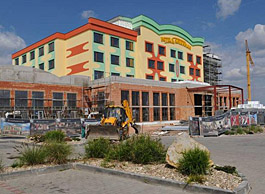 |
| Hotel Savannah in the area of the former border crossing in Hatě near Znojmo |
After being abandoned by members of the foreign police and border guards, the customs offices, along with their land, remained state property, and the state is now disposing of them through the Office for Representation of the State in Property Matters (ÚZSVM). Interest mainly comes from regions and municipalities, but there are also buildings for which no interest has been shown by any state or local authority, so ÚZSVM is offering them for sale to any interested party.
This is the case of the building in Královec in the Hradec Králové region. In the first round, no interested buyer emerged for the price of ten million crowns, and therefore the office will offer it in the second round of sales for a reduced price of 7.5 million crowns.
However, most of the buildings of former customs offices will serve as facilities for tourists, and tourist centers, hostels, and refreshments will be built in their places, often using funds from cross-border programs.
An example is the project of a common square at the site of the former border crossing in Vejprty in the Chomutov region. Representatives of Vejprty, together with the neighboring German town of Bärenstein, have already developed a study and are now preparing a tender for the project. A fountain, new benches, a building with an exhibition hall, and a parking lot are to be created in the common square, said mayor Jitka Gavdunová to ČTK.
The study was financed by grants from the town of Bärenstein, and each municipality will cover the development of specific projects itself. According to preliminary estimates, the entire project should cost around 70 million crowns. Construction could potentially begin next year based on the grant, and the entire construction, divided into phases, could take two to three years.
Similarly, the municipality of Boží Dar in Karlovy Vary has acquired a complex of buildings at the border crossing to Germany. According to the mayor of Boží Dar, Jan Horník, the facilities intend to create an information center for the Central Ore Mountains. Other partners, such as Jáchymov, Loučná pod Klínovcem, the spa Kurort Oberwiesenthal, and the municipality of Breitenbrunn, are also to be involved in the project. "The transfer contract has already been signed, we just need to wait for the confirmation of the transaction from the Ministry of Finance," Horník stated.
Under the Schengen Agreement, it is possible to quickly resume border checks. "We will guarantee that in the event of extraordinary situations, the police and other components of the integrated rescue system will have adequate facilities here," assured Horník.
The Czech Republic joined Schengen last December along with nine other countries. The area allowing travel without passports has expanded to 24 states and now stretches over 4,000 kilometers from Portugal to Estonia.
The English translation is powered by AI tool. Switch to Czech to view the original text source.

0 comments
add comment