
Builders do not use water transport, transport companies complain
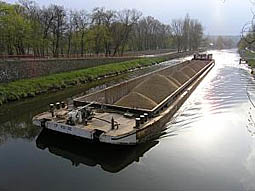 |
Builders generally reject water transport because it is more expensive and the cargo needs to be transferred several times. "We have to make two additional transfers compared to road transport," Kafka stated. The price competitiveness of water transport has also been lost due to the advantage of subsidized diesel. "This has greatly hindered our ability to participate in the transport chain last year and this year," he added. However, shipowners argue that if road repair costs are included, water transport is competitive.
In the past, water transport was utilized in the construction of the Letná Tunnel or the Palladium in Republic Square. Kafka mentioned current projects such as the Blanka Tunnel, the road bypass at Komořany, and the bypass between Lahovice and Slivenec as examples. "Although we provided bids for the majority of current large constructions, whether it is the road bypass at Komořany or the road bypass from Lahovice to Slivenec, we were unsuccessful," Kafka noted.
"The construction of a section of the ring road between Slivenec and Lahovice is high on a slope above Radotín, and there really is no other transport option than road transport," said Alena Čechová, spokeswoman for Hochtief, the company carrying out the construction. Furthermore, if the company wanted to transport materials by boat, it would have to transport them to the water via Radotín, which would burden local residents, Čechová claims.
According to Skanska spokesperson Ondřej Šuch, water transport cannot be chosen even for the construction at Komořany. "We would like to use it, but the navigability of the Vltava does not align with the route where the materials are currently being transported," he said. However, Skanska used boats, for example, during the construction of the D8 highway when it transported sand from Ústí nad Labem. The company is also trying to utilize rail transport, which it incorporated during the construction of the New Connection, where it also built its own railways.
Boats are not used even in the construction of the Blanka Tunnel, where carriers also submitted bids. They are now fighting to at least have water transport utilized at the Letná portal and other connecting sections. According to Metrostav spokesman František Polák, water transport would increase construction costs. "These are public funds, and that would be hard to explain," Polák added. Moreover, according to Polák, loaded trucks would still have to travel to the Vltava. However, Metrostav is considering rail transport because it could use the nearby Dejvice station. Rail transport is also considered more expensive than road transport, according to Polák.
According to shipping companies, construction materials could be transported by water during builds in Libeň, Maniny, or Rohanský Island. Loaded trucks would then not burden the city's transport and would not inconvenience Prague residents. "It is expected that the construction on Rohanský Island will be serviced by water transport," said deputy mayor of Prague Pavel Klega (ODS) to ČTK.
The reconstruction of the treatment plant on Císařský Island looks promising in terms of water transport. Prague 6 and 7 demand the transportation of materials by water. "We will not allow loaded trucks through Vítězné náměstí; if they cannot drive another way, there will be no other choice," stated Jaroslava Trnková, the coordinator for strategic development in Prague 6, to ČTK, emphasizing that the city hall is trying to protect citizens from road traffic.
Shipping companies are capable of transporting three million tons of construction materials by water and could even increase their capacity. Prague has three ports - Holešovice, Smíchov, and Radotín. Other loading points could also be utilized for loading and unloading materials, such as Na Františku, Pelc Tyrolka, Vychovatelna, Maniny, Podhoří in Prague 8, Klecánky, and others. Excavated materials and rubble can then be stored in the excavated quarries and sandpits along the Elbe and Vltava rivers. One
The English translation is powered by AI tool. Switch to Czech to view the original text source.

0 comments
add comment