
Overview of Future National Cultural Monuments
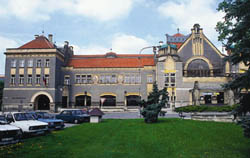 |
| National House, Prostějov |
Central Bohemia Region
- Český Šternberk Castle - one of the best-preserved castles in the Czech Republic. Originally an early Gothic castle from 1214, its construction was essentially completed in the late Gothic style, with later modifications focusing only on the interior spaces.
- St. James Church in Jakub near Kutná Hora - a Romanesque church from 1165 is one of the most significant monuments of 12th-century architecture. It features unique preserved external sculptural decorations with figurative sculptures.
- St. Nicholas Church in Vinci - a late Romanesque church from the second half of the 12th century with rich decoration both inside and outside. Its current appearance dates back to around 1240.
South Bohemia Region:
- Water Mill in Hoslovice - a unique monument documenting the development of folk architecture and the technical equipment of village mills. It likely originates from the second half of the 16th century, and the first mention of the mill dates back to 1654.
- Orlík Castle - the original castle was mentioned as early as the mid-13th century; after a fire in the mid-16th century, it acquired its current layout. The current romantic Gothic reconstruction is from the first half of the 19th century.
- Premonstratensian Monastery in Milevsko - founded in 1184, the Romanesque basilica of the Visitation of the Virgin Mary, and especially the older St. Giles Church, are among the most significant buildings of the last quarter of the 12th century in the Czech Republic.
Pilsen Region
- Farmer's Courtyard in Plzeň-Bolevec - an authentically preserved example of traditional farm courtyards built in the Plzeň region during the period of so-called folk classicism. The courtyard existed in the Middle Ages, and its current form is from the early 19th century.
- Church of the Assumption of the Virgin Mary in Přeštice - one of the outstanding examples of late Baroque architecture in the Czech Republic. It was constructed according to plans by Kilián Ignác Diezenhofer in 1729, and it was restored by architect Bedřich Ohmann in the early 20th century.
Karlovy Vary Region:
- Premonstratensian Monastery in Teplá - founded in the late 12th century. The church consecrated in 1232 is the first hall triple-nave church in the Czech Republic and represents a testament to the transition from Romanesque to early Gothic style. It is also an example of the continuous development of construction, which continued until the 20th century.
- Medieval Jeroným Mine in Čistá - a mining site intended for tin mining dating back to the 15th-16th centuries. Due to its preservation in its original state, it is among the most significant technical monuments in Europe.
- Ore Tower of Death in Ostrov nad Ohří - the ore tower from the 1950s is a testament to the persecution of political prisoners and serves as a reminder of the victims who died as a result of exhaustion and radiation.
Ústí nad Labem Region:
- St. Florian's Church in Krásné Březno - originally a castle chapel built between 1601 and 1603. It represents a unique example of so-called Saxon Renaissance, supported by nobles of the Lutheran faith. The significance of the building in terms of fine arts surpasses the territory of the Czech Republic.
Liberec Region:
- St. Lawrence and Zdislava Church in Jablonné v Podještědí - the church with rich interior decoration was built over the grave of St. Zdislava (canonized in 1995). It is one of the leading examples of Baroque architecture in Central Europe.
- Grabštejn Castle - one of the oldest castles in northern Bohemia. From 1564 to 1569 it was transformed into a Renaissance residence, preserving the large round tower and most of the perimeter walls from the original structure. It has retained its Renaissance form to this day.
Hradec Králové Region:
- Castle in Nové Město nad Metují - the original fortress from the early 16th century was expanded in the Renaissance style in the second half of the same century. It underwent further reconstruction in the second half of the 17th century, and from 1909 to 1911 it was restored in the Baroque style according to plans by Dušan Jurkovič. The interiors were designed by Pavel Janák.
- Kost Castle - founded around the first half of the 14th century, radically rebuilt after 1370, and a Renaissance wing was added in the first half of the 16th century. After a fire in 1635, it was minimally utilized, making it one of the best-preserved castles without later modifications.
- Humprecht Castle - a hunting lodge, an excellent example of a building created for occasional use. It was built in 1667, and its current form was achieved 13 years later after a roof fire and subsequent repair.
- Cemetery Church of the Virgin Mary in Broumov - a wooden church built around 1177, with its current form dating back to after a fire in 1449. The oldest authentically preserved wooden church is an exceptional example of folk architecture.
Pardubice Region
- Town Hall in Polička - a Baroque complex of town hall with two fountains, a plague column, and a statue of St. John of Nepomuk in the square. A uniquely organic ensemble of the town hall and statues rivals the most magnificent noble residences.
Vysočina Region:
- Church of the Assumption of the Virgin Mary in Polná - on the site of a church from the early 13th century, a Baroque building was erected in the early 18th century according to the plans of architect Dominik d'Angeli. The church is one of the most significant structures built outside the circle of leading regional architects.
- St. James the Greater Church in Jihlava - the early Gothic structure was founded concurrently with the city in the 40s of the 13th century and was completed gradually by the end of the 14th century. This monumental structure is an architectural work of Central European significance.
South Moravian Region:
- Slavkov Castle near Brno - a commandery of the Order of the Teutonic Knights stood here since the 13th century. The later Renaissance residence was reconstructed according to the project of Italian architect Domeniko Martinelli at the end of the 17th century. In its Baroque form, the castle represents an important noble residence.
- Pilgrimage Church of the Name of the Virgin Mary in Křtiny - it arose after 1713 on the site of two older churches, which were damaged during the Thirty Years' War. The church was designed by Jan Blažej Santini-Aichel, and it is one of the most prominent Baroque complexes of this type in Moravia.
- Archaeological site of Dolní Věstonice including a collection of the most significant finds from the era of mammoth hunters - among the most significant sites of human life from the Upper Paleolithic in Europe. Remains of dwellings, hunting trophies, and evidence of artistic expression are preserved here.
Olomouc Region:
- National House in Prostějov - built between 1905 and 1907 according to the design of Jan Kotěra. The artistic expression of the house involved painters Jan Preisler, František Kysela, and sculptors František Sucharda and Bohumil Kafka.
- Hydroelectric Power Plant in Třeština - the building is a remarkable work of Czech interwar architecture, with the turbine and accessories from 1932 to 1933 originating from ČKD Prague and ČKD Blansko.
Moravian-Silesian Region:
- Lískova Villa in Ostrava - a villa designed in 1935 by the Šlapeta brothers and built a year later, represents one of the unique examples of organically oriented functionalism in northern Moravia.
Zlín Region:
- Pilgrimage Church of the Assumption of the Virgin Mary in Velehrad - originally an extensive Cistercian monastery completed in the 40s of the 13th century at a pilgrimage site associated with the activities of Cyril and Methodius. The monastery was damaged by the Hussites, and the church was restored at the end of the 16th century. Its current form dates from the turn of the 17th and 18th centuries.
- Evangelical Church in Velká Lhota - a one-story timber church from 1783, the last authentically preserved evangelical church with typical features of poor timber churches of that time. It is an exceptional testament to folk architecture.
The English translation is powered by AI tool. Switch to Czech to view the original text source.
0 comments
add comment