
Experts disagree on why there are few low-energy houses
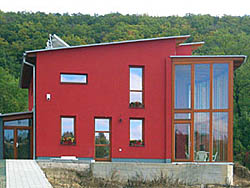 |
| Passive House in Brno |
"Price is only a question of the team's expertise that prepares the project," said František Kulhánek from the Czech Technical University during the discussion. According to him, a low-energy house can be built at standard prices. This is one of the reasons why these buildings have a future in development, Kulhánek believes. "The development towards passive houses will slowly reach maturity, but it won't be easy," he added regarding the second type of ecological housing that is more demanding to realize.
However, other experts believe that the cost of low-energy houses cannot be maintained at a standard level. "I disagree that costs are the same; they will always be higher," stated Martin Svoboda from the company JRD at the discussion. According to him, another cost in these projects is air technology. Greater support from the state for ecological housing could bring improvements, which is currently insufficient, according to Svoboda.
Irena Plocková from the Ministry of Industry sees the main reason for the small number of ecological buildings in the low awareness of their possibilities. "There is a delay in awareness and education of five years, maybe even more," she stated regarding the difference in the spread of these buildings in Western countries and the Czech Republic. At the same time, Plocková rejected the idea that a universal state subsidy could be a solution to support the construction of low-energy houses. "Subsidies are definitely not what would drive it forward," she said.
The existing form of the real estate market could also be a problem for this segment of housing. According to Martin Sladký from the Podlipný/Sladký Architects company, the cause is a significant imbalance between supply and demand. "Developers are not under pressure and only offer standard projects," he added.
The number of low-energy houses is negligible compared to overall construction, according to Kulhánek. According to a previous estimate by architect Josef Smola, there may be around a thousand of them in the Czech Republic.
A low-energy house should be located in the northern or eastern part of the plot so that the southern façade can access solar gains. The shape of the house should be simple, without unnecessary projections. Living rooms should be oriented towards sunlit sides, while the entrance and storage areas should be on the opposite side. The so-called wet rooms are stacked on top of each other. The ratio of windows to floor area should be 1:6. "The best solution in this regard was the Eskimo igloo. Eskimos managed it without computers, so designing a house with these parameters should not be a problem," said Kulhánek. The house must also have sufficient thermal insulation.
A passive house places even higher demands on low energy consumption. The air is heated by forced ventilation with heat recovery from the outgoing air. This utilizes the heat produced by a person, for example, during cooking. Auxiliary heating is used at low outdoor temperatures. The operating costs of the house are then one-fourth compared to a typical house. There are also fewer microorganisms, viruses, molds, and pollen present.
While low-energy houses are relatively rare in the Czech Republic, since January 1st, it has been impossible to build anything other than low-energy new constructions in the federal state of Upper Austria.
The English translation is powered by AI tool. Switch to Czech to view the original text source.
0 comments
add comment