
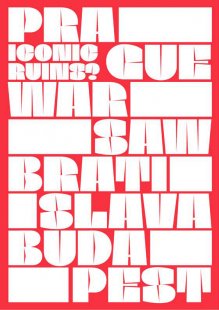
Iconic ruins? - post-war socialist architecture of the V4 countries
The new exhibition titled Iconic Ruins? Post-war Socialist Architecture of the V4 Countries, which will be on display from April 18 to May 15, 2019, at the Gallery of Czech Centres, is an integral part of the project Shared Cities: Creative Momentum (SCCM), co-financed by the European Union Creative Europe program. The exhibition presents the past, the present, and raises questions about the future of the architecture that emerged in the territory of the Visegrad Four during the period of 1948 – 1989. The exhibition was prepared by a group of curators from the Czech Republic, Slovakia, Poland, and Hungary. The main organizer of the exhibition Iconic Ruins? is the Czech Centres.
The exhibition titled Iconic Ruins? Post-war Socialist Architecture of the V4 Countries in the Gallery of Czech Centres represents one of the projects that viewers cannot overlook: it recalls buildings that were created during the period of socialism in the Visegrad countries, characterized by the monumental style of brutalism (ICONIC) and whose current state is unsatisfactory and future uncertain (RUINS). The exhibition provides examples of the most significant architectural projects in the territory of V4 countries and showcases both positive and negative approaches to them. This raises a discussion on the topic of "risks threatening late modernism in European architecture." The content of the exhibition was contributed by four curators: Petr Vorlík (Czech Republic), Henrieta Moravčíková (Slovakia), Anna Cymmer (Poland), Ábel Mészáros (Hungary). The connection of the V4 countries reflects the main theme of the entire project Shared Cities: Creative Momentum, focused on the theme of "sharing" public space in a European context. In the case of this exhibition, it particularly concerns "sharing" in the field of the heritage of the post-war historical and social development of architecture across Central European states.
A PIT OF HISTORY OR A THEMATIC RESTART?
Post-war architecture in former socialist states has recently become a closely watched topic. For many years, the public perceived it with reluctance, often against the backdrop of bleak personal memories and human fates influenced by the communist regime. However, recent scholarly studies and awareness activities reveal a diverse range of forms that architecture of that time adopted, as well as a parallel development that anchors the former Eastern bloc in a broader context of the history of world architecture. The exhibition Iconic Ruins? focuses on the area of politically exposed public investments and seeks connections or conflicts between the ambitions of power and the creative thinking of architects. The rapid demise of "socialist architecture" in recent years, due to radical reconstructions and demolitions, has led to unprecedented engagement from the professional community and academic sphere. The exhibition also tracks the current condition of selected buildings and complements historiographical comparisons according to the methodology of Docomomo International with student visions of future use and transformation of similar buildings, which were created as part of the namesake project at the Academy of Fine Arts in Bratislava (studios of architecture II, III A3, and Virtual Studio).
WHAT ARE ICONIC RUINS?
The term "iconic ruin" originated within the Department of Architecture at VŠVU in Bratislava as a certain type of provocation. The term describes a socialist cultural, commercial, sports, or other "palace" with exceptional architecture in an exceptional location in the city featuring a generously conceived public space. Currently, such buildings often find themselves in a problematic state, both in terms of the building itself and its programmatic content. The financial demands of potential revitalization of the buildings represent another crisis aspect given their monumentality and in many cases, their undeniable architectural quality.
ONDŘEJ ČERNÝ, GENERAL DIRECTOR OF CZECH CENTRES:
"The exhibition seeks to reveal parallels in architecture within the shared socialist past of the Visegrad Four states and to initiate a broader discussion about the near future of critically endangered cultural heritage of late modernism. We want to follow up the exhibition with a moderated discussion on the current relationship of contemporary society to these buildings, how each of the V4 countries is coping with this heritage, and how it is being handled."
The exhibition panels are divided into the typologies of "culture," "media," "education," "commerce," "international representation (hotels)," "sports," "transport," "healthcare," "infrastructure," "administration," and "state administration." Photographs of 132 selected buildings will be presented. The photographic representation is supplemented by information about the current condition and use of the building. The exhibition also includes visions of transformations created by students from the Department of Architectural Creation at VŠVU in Bratislava.
As part of the exhibition's accompanying program, a discussion about the future of these buildings will take place on April 17. The choice of topic stems from the fates of certain buildings: the demolition of the Transgas building in the Czech Republic versus the Slovak Radio building, which has been declared a cultural monument. The debate will also reveal differences in approaches toward these buildings, which are a shared heritage of all four V4 countries.
ICONIC RUINS IN EUROPE The ICONIC RUINS? exhibition was created as part of the Shared Cities: Creative Momentum project. It is an international creative platform at the intersection of architecture, art, urbanism, and the shared economy, which connects eleven partner organizations from seven European cities: Belgrade, Berlin, Bratislava, Budapest, Katowice, Prague, and Warsaw. The goal of the entire project is to show city residents that their participation and collaboration are essential for creating a pleasant and valuable urban environment.
The exhibition is co-financed by the European Union Creative Europe program.
CZECH CENTRES IN THE FIELD OF ARCHITECTURE
The presentation of iconic buildings of Czech architecture is part of the solid program concept throughout the network of Czech Centres. Czech Centres abroad organize public events, discussions, and lectures focused on current developments in architecture. The aim is to facilitate dialogue about quality Czech architecture and architectural creation not only for professionals or architecture students but primarily for the general public. Each year, nearly fifty events related to this area take place in the network of Czech Centres. Lectures and presentations by prominent Czech architects and architecture theorists are held. Successful projects include the past Czech Architectural Phenomena, which were presented in various forms in several countries.
Accompanying program at the Gallery of Czech centres:
Panel discussion SHARED CITIES IDEAS YARD: ICONIC RUINS?
April 17, 2019 (Wednesday) at 6:30 PM. The panel discussion is held as part of the Shared Cities Ideas Yard event series. Experts from European countries are coming to Prague to present new approaches in urban planning, shared management, and long-term engagement within communities. Topic: Iconic ruins, their protection, and future use
Guests: Anna Cymer (PL), Vít Halada (SK), Dániel Kovács (HU), Henrieta Moravčíková (SK), Ján Studený (SK), Petr Vorlík (CZ)
Moderator: Igor Kovačević (CZ)
The discussion is organized by the Goethe-Institut in cooperation with Czech Centres. The panel discussion is part of the SHARED CITIES: CREATIVE MOMENTUM project.
Free entry. The discussion conducted in English will be translated into Czech.
EXHIBITION INFORMATION:
Venue: Gallery of Czech Centres, Rytířská 31, Prague 1 April 18, 2019 – May 15, 2019
Opening hours: Monday–Friday: 11:00 AM – 6:00 PM
Saturday: 11:00 AM – 5:00 PM
Free admission
Curators of the exhibition Iconic Ruins?:
Anna Cymer (PL), architectural historian
Ábel Mészáros (HU), architectural historian
Henrieta Moravčíková (SK), architectural historian
Petr Vorlík (CZ), architectural historian
Partners of the exhibition Iconic Ruins? Post-war architecture of the V4 countries
Goethe-Institut, Academy of Fine Arts in Bratislava, Faculty of Architecture CTU in Prague,
Docomomo International – Czech, Docomomo International - Slovak, Department of Architecture
Institute of History of the Slovak Academy of Sciences, National Heritage Institute, regional expert workplace in Prague, A489.
Partners of the project Shared Cities:
Goethe-Institut (DE)
Czech Centres (CZ)
reSITE (CZ)
Academy of Fine Arts and Design in Bratislava (SK)
Association of Belgrade Architects (RS)
Hungarian Contemporary Architecture Centre – KÉK (HU)
Katowice City of Gardens (PL)
KUNSTrePUBLIK (DE)
Mindspace (HU)
Old Market Hall Alliance (SK)
Res Publica – Cities Magazine (PL)
Co-financed by the European Union Creative Europe program.
More information >
The exhibition titled Iconic Ruins? Post-war Socialist Architecture of the V4 Countries in the Gallery of Czech Centres represents one of the projects that viewers cannot overlook: it recalls buildings that were created during the period of socialism in the Visegrad countries, characterized by the monumental style of brutalism (ICONIC) and whose current state is unsatisfactory and future uncertain (RUINS). The exhibition provides examples of the most significant architectural projects in the territory of V4 countries and showcases both positive and negative approaches to them. This raises a discussion on the topic of "risks threatening late modernism in European architecture." The content of the exhibition was contributed by four curators: Petr Vorlík (Czech Republic), Henrieta Moravčíková (Slovakia), Anna Cymmer (Poland), Ábel Mészáros (Hungary). The connection of the V4 countries reflects the main theme of the entire project Shared Cities: Creative Momentum, focused on the theme of "sharing" public space in a European context. In the case of this exhibition, it particularly concerns "sharing" in the field of the heritage of the post-war historical and social development of architecture across Central European states.
A PIT OF HISTORY OR A THEMATIC RESTART?
Post-war architecture in former socialist states has recently become a closely watched topic. For many years, the public perceived it with reluctance, often against the backdrop of bleak personal memories and human fates influenced by the communist regime. However, recent scholarly studies and awareness activities reveal a diverse range of forms that architecture of that time adopted, as well as a parallel development that anchors the former Eastern bloc in a broader context of the history of world architecture. The exhibition Iconic Ruins? focuses on the area of politically exposed public investments and seeks connections or conflicts between the ambitions of power and the creative thinking of architects. The rapid demise of "socialist architecture" in recent years, due to radical reconstructions and demolitions, has led to unprecedented engagement from the professional community and academic sphere. The exhibition also tracks the current condition of selected buildings and complements historiographical comparisons according to the methodology of Docomomo International with student visions of future use and transformation of similar buildings, which were created as part of the namesake project at the Academy of Fine Arts in Bratislava (studios of architecture II, III A3, and Virtual Studio).
WHAT ARE ICONIC RUINS?
The term "iconic ruin" originated within the Department of Architecture at VŠVU in Bratislava as a certain type of provocation. The term describes a socialist cultural, commercial, sports, or other "palace" with exceptional architecture in an exceptional location in the city featuring a generously conceived public space. Currently, such buildings often find themselves in a problematic state, both in terms of the building itself and its programmatic content. The financial demands of potential revitalization of the buildings represent another crisis aspect given their monumentality and in many cases, their undeniable architectural quality.
ONDŘEJ ČERNÝ, GENERAL DIRECTOR OF CZECH CENTRES:
"The exhibition seeks to reveal parallels in architecture within the shared socialist past of the Visegrad Four states and to initiate a broader discussion about the near future of critically endangered cultural heritage of late modernism. We want to follow up the exhibition with a moderated discussion on the current relationship of contemporary society to these buildings, how each of the V4 countries is coping with this heritage, and how it is being handled."
The exhibition panels are divided into the typologies of "culture," "media," "education," "commerce," "international representation (hotels)," "sports," "transport," "healthcare," "infrastructure," "administration," and "state administration." Photographs of 132 selected buildings will be presented. The photographic representation is supplemented by information about the current condition and use of the building. The exhibition also includes visions of transformations created by students from the Department of Architectural Creation at VŠVU in Bratislava.
As part of the exhibition's accompanying program, a discussion about the future of these buildings will take place on April 17. The choice of topic stems from the fates of certain buildings: the demolition of the Transgas building in the Czech Republic versus the Slovak Radio building, which has been declared a cultural monument. The debate will also reveal differences in approaches toward these buildings, which are a shared heritage of all four V4 countries.
ICONIC RUINS IN EUROPE The ICONIC RUINS? exhibition was created as part of the Shared Cities: Creative Momentum project. It is an international creative platform at the intersection of architecture, art, urbanism, and the shared economy, which connects eleven partner organizations from seven European cities: Belgrade, Berlin, Bratislava, Budapest, Katowice, Prague, and Warsaw. The goal of the entire project is to show city residents that their participation and collaboration are essential for creating a pleasant and valuable urban environment.
The exhibition is co-financed by the European Union Creative Europe program.
CZECH CENTRES IN THE FIELD OF ARCHITECTURE
The presentation of iconic buildings of Czech architecture is part of the solid program concept throughout the network of Czech Centres. Czech Centres abroad organize public events, discussions, and lectures focused on current developments in architecture. The aim is to facilitate dialogue about quality Czech architecture and architectural creation not only for professionals or architecture students but primarily for the general public. Each year, nearly fifty events related to this area take place in the network of Czech Centres. Lectures and presentations by prominent Czech architects and architecture theorists are held. Successful projects include the past Czech Architectural Phenomena, which were presented in various forms in several countries.
Accompanying program at the Gallery of Czech centres:
Panel discussion SHARED CITIES IDEAS YARD: ICONIC RUINS?
April 17, 2019 (Wednesday) at 6:30 PM. The panel discussion is held as part of the Shared Cities Ideas Yard event series. Experts from European countries are coming to Prague to present new approaches in urban planning, shared management, and long-term engagement within communities. Topic: Iconic ruins, their protection, and future use
Guests: Anna Cymer (PL), Vít Halada (SK), Dániel Kovács (HU), Henrieta Moravčíková (SK), Ján Studený (SK), Petr Vorlík (CZ)
Moderator: Igor Kovačević (CZ)
The discussion is organized by the Goethe-Institut in cooperation with Czech Centres. The panel discussion is part of the SHARED CITIES: CREATIVE MOMENTUM project.
Free entry. The discussion conducted in English will be translated into Czech.
EXHIBITION INFORMATION:
Venue: Gallery of Czech Centres, Rytířská 31, Prague 1 April 18, 2019 – May 15, 2019
Opening hours: Monday–Friday: 11:00 AM – 6:00 PM
Saturday: 11:00 AM – 5:00 PM
Free admission
Curators of the exhibition Iconic Ruins?:
Anna Cymer (PL), architectural historian
Ábel Mészáros (HU), architectural historian
Henrieta Moravčíková (SK), architectural historian
Petr Vorlík (CZ), architectural historian
Partners of the exhibition Iconic Ruins? Post-war architecture of the V4 countries
Goethe-Institut, Academy of Fine Arts in Bratislava, Faculty of Architecture CTU in Prague,
Docomomo International – Czech, Docomomo International - Slovak, Department of Architecture
Institute of History of the Slovak Academy of Sciences, National Heritage Institute, regional expert workplace in Prague, A489.
Partners of the project Shared Cities:
Goethe-Institut (DE)
Czech Centres (CZ)
reSITE (CZ)
Academy of Fine Arts and Design in Bratislava (SK)
Association of Belgrade Architects (RS)
Hungarian Contemporary Architecture Centre – KÉK (HU)
Katowice City of Gardens (PL)
KUNSTrePUBLIK (DE)
Mindspace (HU)
Old Market Hall Alliance (SK)
Res Publica – Cities Magazine (PL)
Co-financed by the European Union Creative Europe program.
More information >
The English translation is powered by AI tool. Switch to Czech to view the original text source.

0 comments
add comment