
Musicians agree that Prague needs a new and larger hall
 |
"Saying something against the Rudolfinum in youth would have been heretical. But it is true - it is not sufficient for us," said 71-year-old chief conductor of the Czech Philharmonic, Zdeněk Mácal, to reporters recently. According to him, this beautiful hall is too small for certain works. A larger hall would also be suitable for the Prague Spring festival. The thousand seats in the Dvořák Hall and just slightly more seats in the Smetana Hall in the Municipal House will no longer suffice in terms of necessary revenues.
According to Mácal, ticket prices have a certain ceiling, after which they become inaccessible to some people. "Foreign ensembles are expensive, though - we would need a hall with about 2,200 seats," estimates the conductor. According to him, music circles should join forces to ensure that one day a hall worthy of Prague as a cultural center is built.
The director of the Prague Spring festival, Roman Bělor, is also convinced that the city needs a modern hall with world-class parameters. "Absolutely. A cultural metropolis of a quarter-million people, if it styles itself into an increasingly significant position, cannot do without a modern concert hall," he told reporters.
As he added, there is already competition among European cultural centers. "If there is no such hall in Prague, it will eventually become a competitive disadvantage, and we may find ourselves on the sidelines," he stated.
The editor-in-chief of the music monthly Harmonie, Luboš Stehlík, shares the same opinion. "Prague absolutely urgently needs a multipurpose but acoustically top-notch hall for 1,500 to 2,000 people," he told ČTK. He added, however, that this is merely a pious wish due to a lack of funds.
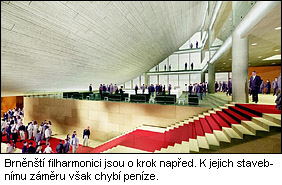
"If the state decides to prioritize the construction of the National Library in Letná, it will not allocate money for the construction of a hall in Brno either," believes Stehlík. The local project is already quite concrete and it is only a matter of political decision whether it will be realized.
In Prague, no hall is planned. According to the councilor for culture, Milan Richter (ODS), a modern hall with greater capacity would be good. However, it is a question of to what extent it would be utilized and what its economics would be, Richter told ČTK today. The current halls in the historic Municipal House and the Rudolfinum have their charm, he added.
The metropolis could have had a new concert hall back in the mid-90s. Japanese investors wanted to gift one to the Czech Philharmonic for its centenary in 1996. The project was prepared, but Czech politicians ultimately rejected the proposal. The hall was to be built in Letná by Špejchar, where the controversial building of the National Library by architect Jan Kaplický is likely to be erected in the future. The then Minister of Culture, Milan Uhde, and Mayor Milan Kondr were not in favor of the concert hall. The preparatory committee was backed by President Václav Havel and Japanese Emperor Akihito.
The hopes and aspirations that Prague might have a concert hall instead of barracks in Republic Square were not fulfilled either. There, another shopping center is now being built.
There are no objections to the acoustics of the Rudolfinum, the seat of the Czech Philharmonic from the 1880s, but the space is too small for large orchestral and vocal-instrumental concerts with their dynamic parameters. According to Stehlík, a thousand seats for a city with over a million people is too few.
In his opinion, the Art Nouveau Municipal House is completely unsuitable for current acoustic demands, for service, for listening conditions, and to make people feel comfortable there. "The Smetana Hall should not be primarily for symphonic concerts, let alone for recitals. You can hear the outside and the ventilation, and in the flat auditorium, you can't see the stage," reminded music critic Stehlík.
Zdeněk Mácal gives other countries as examples. "Every time we come to Spain with the Philharmonic, we play in some new hall. Budapest also has a new hall. And there is now a new auditorium in Madrid, with over 2,000 seats. And I could sing the same tune about Japan; whenever we go there, there is at least one new hall - and what halls they are!" said the chief conductor.
This year’s festival concerts of Pavel Šporcl or Gabriela Beňačková were among those for which tickets disappeared in a very short time. "I hardly need to mention that for some of them, it would have been possible to sell many more tickets; unfortunately, the capacity of Prague's concert halls does not allow that," stated the spokesperson of Prague Spring, Alena Svobodová.
"Prague is getting into a tight spot, but in Brno it is a disaster - and has been for a long time," Bělor reminded the fact that the city has no space at all for orchestral concerts. The Besední Dům is chamber-sized, and the Janáček Theatre is primarily an opera house. Meanwhile, the Philharmonic in Brno originally hoped to play in a new residence next to the Besední Dům in 2006.
The English translation is powered by AI tool. Switch to Czech to view the original text source.
0 comments
add comment