
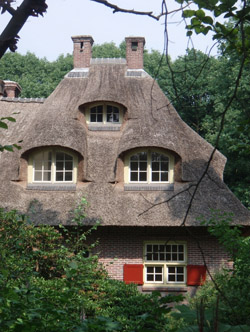
On the roofs of European luxury villas, there is Danube reed
 |
| photo: rakosovestrechy.cz |
Romanian reeds have also served as decorations for films, especially for the reconstruction of a theater in a film about Shakespeare, which was shot in the Babelsberg studios near Berlin.
Thatched roofs, once used by poor villagers for their cottages, are now sought after for the homes of wealthy individuals longing for authenticity.
"Reed is a natural material that also isolates very well acoustically and thermally. With the growing interest in ecological buildings, many people today want a thatched roof," explains Octavian Popa, director of Delta Stuf Production.
This private company is one of only two that have permission to harvest the golden stalks in the Danube Delta in southeastern Romania, in an area that is listed as UNESCO World Heritage due to its exceptional fauna and flora and the largest reed beds in the world.
Almost all of the harvest, 20,000 tons, is exported, primarily to Germany and the Netherlands, but also to Denmark, Britain, and France.
Reeds from the Danube Delta are known for their strength, but they have faced competition from Chinese reeds in recent years.
Before they reach the roofs of villas, farms, or mills in Northern Europe, the reeds are harvested in difficult climatic conditions, in the heart of swampy areas between the sea and the river, which can often only be reached by boat.
"Here we harvest on a floating island," explains seventy-seven-year-old Dan Baltaneanu, who has spent 52 years harvesting reeds.
The soil on the island is only a few dozen centimeters deep. When the wide-wheeled tractor moves forward, the ground ripples like a mattress filled with water.
Half an hour's boat ride along the Black Sea is also harvested mechanically. In the front of the machine, steel jaws cut the stalks. Men collect the resulting bundles and stack them in the back.
"Techniques have advanced a lot to protect the environment," states Baltaneanu, who witnessed intense harvesting under the dictator Nicolae Ceaușescu, when machines on iron belts destroyed the rhizomes. In this way, 300,000 tons of reeds were extracted from the delta.
At Lake Sinoe, reeds are harvested manually with a sickle.
"It's hard work because people often harvest with their feet submerged in icy water," admits Popa.
"Without reeds, we wouldn’t have anything to eat. There is no other work in this area," explains Maria Scarlat, who removes weeds and last year’s gray and lower-quality reeds.
During the harvest season, 500 people work with reeds, around 200 throughout the year.
"This harvest is beneficial for the environment. Reeds need to be cut to grow back healthily," explains Silviu Covaliov, a biologist at the National Institute for the Danube Delta. He notes that people have been harvesting reeds for centuries.
Every family in the delta has the right to harvest up to two tons for fuel, for building stables and barns, for livestock, or for repairing roofs.
However, thatched roofs, which are so desired by wealthy families in Northern Europe, are a sign of poverty in the Danube Delta. Residents often prefer materials they consider to be more modern.
The English translation is powered by AI tool. Switch to Czech to view the original text source.
0 comments
add comment