
Many Pakistani monuments are disappearing without a trace
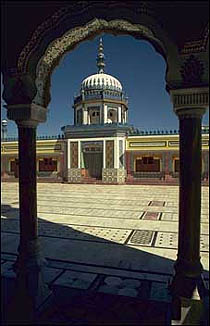 |
As a cradle of ancient civilizations and a crossroads of Greek, Buddhist, Hindu, and Muslim cultures, Pakistan hides a wealth of historical ruins, but many are overshadowed by newer constructions, many have been looted by art thieves or villagers, or have simply crumbled to dust.
Most of the major sites are under the control of the federal government's archaeological department, but provincial officials insist that they should be responsible for the care of local ruins.
For example, Orja Makbúl Jan, who heads the archaeological department of the government in the Punjab province, reminded that this province has long experience in preservation and rescue dating back to the British colonial period of the early last century. "But in the last 50 years, things have been handed back to the federal government, and Punjab has been stripped of responsibility for caring for its own heritage."
The indifference of federal authorities has led to the destruction of 32 sites only in Punjab, Jan states in his office in the provincial capital, Lahore. "People leveled them to the ground and built houses on them. It is a great loss."
Irreparable damage has also been caused by restoration attempts by federal authorities. "The conservation principles set by UNESCO (United Nations Educational, Scientific and Cultural Organization) were not included," he added.
Three years ago, the federal government transferred responsibility for three sites to Jan's department - the Mughal-era Shalimar Gardens in Lahore, the Lahore Fort, and the Hindu temple Katas Raj. Jan managed to achieve repairs at these locations, but as he says, half of the costs went towards correcting mistakes made by federal specialists. And that is why he would like to take care of all monuments in the province.
Archaeological engineer Muhammad Tanvir, representing the federal government, laughs at Jan's demands. "They have not conducted any rescue or restoration work, nor have they spent a penny," he explains, observing schoolchildren in red and blue uniforms playing on the lawn from the window of his office in the sprawling 500-year-old fort.
Pakistan's culture minister Syed Ghazi Gulab Jamal bristles when Jan's criticism comes up. "The provincial government has not done anything significant with what belongs to it." However, if the provinces demonstrated that they were capable of taking care and had greater capacity, then they could be entrusted with more monuments, he noted.
The federal government has a list of 380 registered sites for which it is responsible. However, according to the most prominent Pakistani archaeologist Ahmad Hasan Dani, many more colonial period sites are not recorded and have no protection. "There are so many monuments that have not been included in this document," lamented Dani, who has been working as an archaeologist across South Asia since 1944.
"They do not care about them at all; in fact, they are completely unaware of them," he noted.
Excavations have been conducted at only about a third of the sites across Pakistan.
Villagers often take care of old mosques, but Buddhist and Hindu ruins are looted by thieves, and discovered artifacts are sold on the international black market. Moreover, they are rummaged through by people searching for material to build their homes. "One day they will simply disappear," warns Dani.
Authorities should work together: "If the federal government cannot take care of them, then the provincial government or the district council may," suggests Dani.
Another major problem for anyone responsible for this area are indiscretions. Historical sites should be protected within a 60-meter buffer zone, but uncontrolled construction is engulfing many of them.
The ornate pavilions and fountains of the Shalimar Gardens, built by the Mughal ruler Shah Jahan in 1642, are an oasis of calm in the traffic-choked suburb of Lahore.
To this day, the walls of the gardens have managed to hold back most of the noise and smoke and prevented the spread of concrete and asphalt constructions. However, illegal construction near the thick white walls causes flooding and damage to the artworks within the gardens, experts warn.
106 illegally built structures near the walls are slated for demolition, but their residents claim they will not leave. "We will set ourselves on fire in protest," insists factory worker Muhammad Said, who lives in a small house in the shadow of the wall.
The English translation is powered by AI tool. Switch to Czech to view the original text source.
0 comments
add comment