
The document about Niemeyer's birthday was in production for ten years
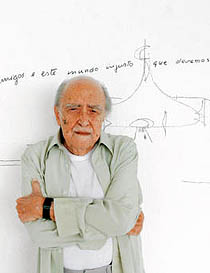 |
In addition to architectural works, which the architect himself reveals how he actually came to them, the film also depicts a human genius who loves women to such an extent that he secretly got married at the age of 98. It shows a man who has a panic fear of airplanes and who has never budged even an inch from his positive stance towards communism.
The title of the film, which has been directed and written by Brazilian documentarian Fabiano Maciel, evokes Niemeyer’s assertion that life is merely a breath, and therefore it is necessary to make use of it.
Maciel relied on the architect's informal notes about his work, politics, friends, women, and Brazil, sketching Niemeyer's profile enriched with testimonies from personalities who know him, such as Portuguese Nobel Prize-winning author José Saramago and Uruguayan writer and journalist Eduardo Galeano.
"It is known that Oscar Niemeyer hates capitalism and hates right angles. Against the right angle, which insults space, he created architecture as light as clouds, free and sensual architecture that closely resembles the mountainous landscape around Rio de Janeiro, with mountains that look like the bodies of lying women drawn by a god on the day he thought he was Niemeyer," said Galeano once.
Opinions about the industrious architect are also expressed in the film by historian Eric Hobsbawm, former Portuguese President Mário Soares, filmmaker Nelson Pereira dos Santos, and famous Brazilian musician Chico Buarque.
Today, the documentary will be presented at a special session of the Brazilian Congress, whose headquarters is also a work by Niemeyer. From Friday onwards, the film will be screened in cinemas not only in Rio but also in São Paulo, Belo Horizonte, Brasília, Porto Alegre, and Curitiba.
The creation of the documentary is connected to the centenary of one of Brazil's greatest geniuses. The entire country is preparing for the birthday celebrations. Maciel began filming the documentary ten years ago to pay tribute to the architect for his then-ninetieth birthday. The filming took him beyond Brazil: to France, Italy, Algeria, the United States, Uruguay, England, and Portugal.
The honoree does not hide his recipe for longevity in the film: it is supposedly women. Those women who brought him to the revolution in architecture when he protested against right angles and replaced them with arches, that is, feminine shapes. Those women who led him to take advantage of all the possibilities of reinforced concrete.
Niemeyer reveals the ideas that inspired him when designing the palaces of modern Brasília, including the presidential residence, Congress, and the Supreme Court, as well as the cathedral and the National Theatre. He also comments on some of his most famous buildings abroad - the headquarters of the French Communists and the Mondadori publishing house in Milan, Italy.
During interviews, Niemeyer took the opportunity to criticize the "bourgeoisie," capitalism, and the media; however, he also noted that he is already tired of constantly explaining what he does or says.
The film, of course, features previously unknown or rare archival footage and mentions the hardships the architect faced during the military regime in Brazil (1964-85) when he identified with communism. Niemeyer even ventures into metaphysics by comparing the insignificance of a person to the universe. And he continually presents his ideal of a fairer society.
"When I am assigned a public building, I try to make it beautiful, different, to evoke surprise. I know that the poorest will enjoy nothing, but they can stop to see it and experience a moment of joy, surprise. And that is precisely how architecture can be useful," Niemeyer explained.
The English translation is powered by AI tool. Switch to Czech to view the original text source.
0 comments
add comment