
Berlin's New Museum is once again a gem of the museum island
 |
After the reopening of the New Museum on October 16, the Berlin museum complex, which is listed as a UNESCO World Heritage Site, will for the first time since 1939 serve the public as a whole. It also includes the famous Pergamon Museum, the Old Museum, the Bode Museum, and the Old National Gallery.
The completion of the reconstruction of the New Museum does not mean the end of construction work on the complex, which has suffered not only from wartime bombings but also from decades of neglect during the time when the eastern part of Berlin was the capital of communist East Germany. The Old Museum has been restored in recent years as the third museum institution on the Spree, while the remaining two – the Pergamon Museum and the Old Museum – are set to undergo extensive renovations by 2026.
According to Minister of Transport and Building Wolfgang Tiefensee, 1.3 billion euros (36.4 billion crowns) have been invested in what is reportedly the largest construction project in Germany to date, of which the New Museum accounted for around 200 million euros.
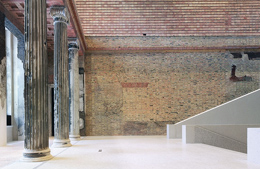
Some scars on the walls of the building remain, deliberately. While British architect David Chipperfield has adapted the interior to his vision – which experts say has been done sensitively – some cracks and bullet holes on the facade have simply been preserved so that traces of history remain visible.
The damaged building from 1843, designed by architect Friedrich Stüler, was fortunate enough to escape insensitive renovations in the 50s and 60s under communism, as happened to neighboring structures. Some experts consider it a miracle that it was not demolished by the communists like the nearby palace.
The New Museum will offer exhibitions on 20,500 square meters, featuring collections from ancient Egypt as well as artifacts from prehistoric times and ancient Greece and Rome, including a Neanderthal skull and a collection of papyrus.
However, the most famous artifact will be the Nefertiti bust, which was first introduced to the general public in this newly restored building in 1924. The Berlin collection of Egyptian art is among the largest in the world, with only Cairo and London boasting larger collections.
The English translation is powered by AI tool. Switch to Czech to view the original text source.
0 comments
add comment