
The Ambrosian Library in Milan has been serving the public for 400 years
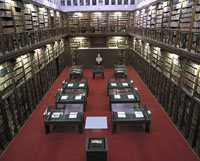 |
The Ambrosian Library (Biblioteca Ambrosiana) was founded by the Archbishop of Milan, Federico Borromeo, who donated 30,000 volumes and 15,000 manuscripts. Following the model of the French Cardinal Richelieu, Borromeo conceived the library as a museum and picture gallery. Construction began in 1603 and was completed six years later.
Borromeo sent many of his agents throughout Europe, as well as to Greece and the Middle East, who sought to bring rare prints to Milan. Later, the famous Picture Gallery Pinacoteca and an academy were also established here.
The library now houses around 400,000 volumes, including 30,000 manuscripts, 60,000 letters and documents, and 12,000 parchment documents in Latin, Greek, Hebrew, Arabic, and Persian. For example, there are fragments of Homer's Iliad, the 15th-century Codex Atlanticus by Leonardo da Vinci, the oldest edition of Dante's Divine Comedy, as well as works by Petrarch, Ariosto, Boccaccio, Galileo Galilei, and others.
A large collection of oriental and Arabic manuscripts was acquired for the museum by Achille Ratti, later Pope Pius XI. Among the Christian and Arabic manuscripts is, for example, a unique collection of 11th-century oriental poetry Dīvān or the oldest copy of the Book of Grammar by the famous Arabic grammarian of Persian origin Sibawayhi from the 8th century. There is also the so-called Muratori fragment, which is a Latin text from the 8th century that contains a list of New Testament books. This was found in the Ambrosian Library in the 18th century by the Italian historian Ludovico Muratori.
The library also houses works on astronomy, medicine, and mathematics - for instance, the work De divina proportione (On the Divine Proportion) by the Franciscan monk and mathematician Luca Pacioli from the 15th century.
In the 24 halls of the Pinacoteca, there are now about 12,000 paintings and drawings by European painters from the 14th to 19th centuries; alongside works by Leonardo (such as Portrait of a Musician), there are also works by Botticelli, Titian, Raphael, Veronese, and Dutch masters.
The library building was seriously damaged during World War II and was restored in 1952. A costly complete reconstruction was carried out between 1990 and 1997.
The English translation is powered by AI tool. Switch to Czech to view the original text source.
0 comments
add comment