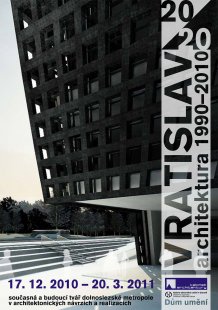
Invitation to the exhibition "Vratislav 20/20 – architecture 1990–2010"
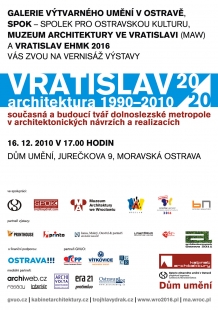
ART GALLERY IN OSTRAVA, SPOK – ASSOCIATION FOR OSTRAVAN CULTURE, MUSEUM OF ARCHITECTURE IN WROCŁAW (MAW) AND THE CITY OF WROCŁAW, candidate for ECoC 2016
INVITE YOU TO THE OPENING OF THE EXHIBITION
INVITE YOU TO THE OPENING OF THE EXHIBITION
Wrocław 20/20 – architecture 1990–2010
the current and future face of the Lower Silesian metropolis
in architectural designs and realizations
the current and future face of the Lower Silesian metropolis
in architectural designs and realizations
December 16, 2010 AT 5:00 PM
Guests of the opening:
Adam Grehl, Deputy Mayor of the City of Wrocław for Architecture and Investment Development
Zbigniew Maćków, architect, author of the reconstruction and extension of the Renoma department store, nominated for the Mies van der Rohe Award 2010
Jerzy Ilkosz, Director of the Museum of Architecture in Wrocław
Wojciech Stefanik, Chief Curator of the Museum of Architecture in Wrocław
Wrocław 20/20 – architecture 1990–2010
the current and future face of the Lower Silesian metropolis
in architectural designs and realizations
Architecture Cabinet | House of Art, Jurečkova 9, Moravian Ostrava
December 17, 2010 – March 20, 2011 | opening on December 16, 2010 at 5:00 PM
http://trojhlavydrak.com/
http://kabinetarchitektury.cz/
http://gvuo.cz/
WROCŁAW 20/20. ARCHITECTURE 1990–2010
The exhibition Wrocław 20/20. Architecture 1990-2010 will be ceremonially inaugurated on Thursday, December 16, 2010 at 5 PM at the Architecture Cabinet of the Ostravian House of Art. The exposition will present the architectural transformation of 20 urban districts of Wrocław. The exhibition will last until March 20, 2011.
The exhibition documents the architectural transformation of Wrocław through 150 projects from 1990 to 2010. Not only completed projects will be presented, but also those that are still in progress. The exhibition will also feature models of some buildings. It will be supplemented with programs for schools and the public.
Over the last 20 years, Wrocław has undergone significant changes. Its development is captured by Michal Duda, the curator of the exhibition. “After 1989, more precisely, at the beginning of the 1990s, Wrocław began to change at an unprecedented pace. New social conditions and a new economic and market system became the main force of transformation. The fate of the city has been taken into the hands of people who perceive the reality of its problems much more sensitively,” says the curator.
Wrocław is where Polish, Czech, and German cultures intersect. One of the buildings that exemplifies this cultural intersection is the Centennial Hall (1913) by Max Berg, which boasts the largest reinforced concrete dome in the world and is on the UNESCO list. The city features not only medieval monuments but also buildings from the early twentieth century and the interwar period. The German architectural avant-garde (Hans Scharoun, Erich Mendelsohn, Hans Poelzig, Adolf Rading) also played a significant role in shaping the city's appearance. During the war, nearly 80% of the city was destroyed and then almost restored to its original form. Contemporary architecture and buildings confidently and dynamically connect the city to its history.
How has Wrocław changed in the last twenty years? What changes will occur in the near future? These questions are addressed in the exhibition, which presents the architectural development of the city through 150 objects found not only in the central part but also on the outskirts of Wrocław. Among other things, the exhibition will showcase the transformation of the post-industrial Wrocław area into a modern center of business, education, and schooling.
Curators of the exhibition in Ostrava: Tadeáš Goryczka and Jaroslav Němec
The exhibition involves SPOK – Association for Ostrava Culture, the Gallery of Fine Arts in Ostrava (GVUO), the Museum of Architecture in Wrocław (MAW), and the city of Wrocław.
The exhibition is taking place with the financial support of the Statutory City of Ostrava.
Wrocław (Wrocław) is a candidate for the European Capital of Culture in 2016. In 2012, it will host the final of the UEFA European Championship, for which a new stadium is being built. The city has "the city of meetings" in its motto. This is reflected in the urban appearance of the city. Wrocław is becoming a more significant Polish cultural and educational center and is referred to as the most European city in Poland.
The English translation is powered by AI tool. Switch to Czech to view the original text source.
0 comments
add comment