
HORROR VACUI: Urban Implosions / The Growth of Cities Inward
Dutch urban implosions
 |
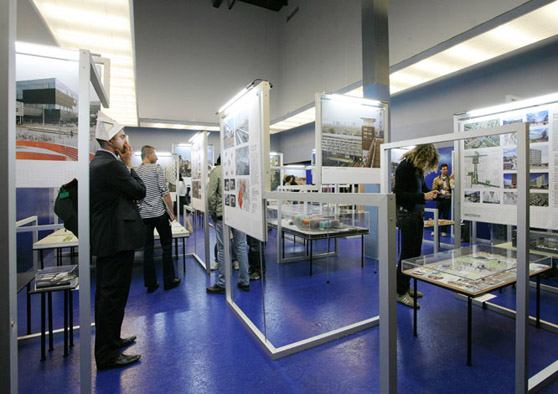
Traveling exhibition NAi (Dutch Institute of Architecture) presents in its project the perspective of eighteen contemporary leading Dutch architectural offices on the issue of urban densification and the development of older urban areas. Among the showcased examples are solutions from the cities of Amsterdam, Arnhem, Eindhoven, Eschede, Groningen, Lelystad, Maastricht, Rotterdam, Tilburg, Utrecht, and Zaanstad, which will present projects ranging from residential, social, and office buildings to university campuses - both on the peripheries and in the original centers of urban agglomerations. The examples demonstrate possibilities for reusing and reorganizing older urban areas in the face of limited building space. The exhibition HORROR VACUI will subsequently be presented at the Jaroslav Fragner Gallery in Prague.
Represented architectural offices: S333 architects, KCAP, OD 205 architectuur bv, De Architecten Cie, Wiel Arets Architects, Rijnboutt Van der Vossen Rijnboutt, JHK, Claus en Kaan Architecten, Benthem Crouwel, Jeroen van Schooten of Meyer & van Schooten, UN Studio, Herman Hertzberger Architects, Jo Coenen, Věra Yanovchinsky, NL Architects, MVRDV, Soeters van Eldonk, OMA, West 8.
Most Dutch cities have been undergoing remarkable transformations, especially in the last two decades. The old lines of cadastres and distinct originally defined residential and economic areas are now often disrupted by unorganized development, where original buildings or entire complexes are replaced by new architecture that is proportionally and form-wise unrelated to the original structures. These unorganized and often organically developing building structures may introduce chaos into the original places, but they also bring new opportunities in the demands for modern urban infrastructure. Old economic and production centers are thus replaced by residential or educational complexes, with administrative or commercial activities emerging in predominantly still residential parts. This kind of suburbanization has its roots in the post-World War II period, when the Dutch government began efforts to decentralize urban planning under the slogan "Centralize where necessary, decentralize where possible," granting Dutch cities and their municipalities the right to decide on development projects.
The issue of developing older urban areas - both on the peripheries and in the original centers of urban agglomerations - also directly affects many Czech and Moravian cities, and we believe that the exhibition will offer an intriguing opportunity for both professionals and the general public here to become acquainted with the results of long-term efforts by Dutch experts in addressing contemporary urban planning challenges.
The day after the opening of the exhibition, an international conference will take place at the Brno Exhibition Center as part of the main accompanying program for the opening of the International Building Fair, where the topic of urban densification will also be one of the discussed issues. The Brno Center for Architecture, in collaboration with NAi, the Embassy of the Kingdom of the Netherlands in Prague, and the Brno Trade Fairs and Exhibition Company, has invited representatives from selected Czech and Dutch studios to exchange their experiences, approaches to urban planning, and discuss ways to meet the demands for urban growth without destructive and irreversible interventions in the landscape. The Netherlands will be represented by the exhibition curator Hans Ibelings, the studios of Jeroen van Schooten of Meyer & van Schooten and Rijnboutt Van der Vossen Rijnboutt, while Czech architects Jan Jehlík, Roman Koucký, and Petr Hlaváček will represent the Czech side.
 |
The English translation is powered by AI tool. Switch to Czech to view the original text source.
1 comment
add comment
Subject
Author
Date
U nás?
x
24.03.09 01:16
show all comments