
Czech architectural cubism travels the world
Zagreb Architecture Museum
April 29 - May 23, 2008
Czech Centre Paris
May 29 - June 21, 2008
curator: Zdeněk Lukeš
concept: Zdeněk Lukeš, Dan Merta
photography: Ester Havlová, Jan Malý
graphic works: Robert Novák, Tomáš Brichcín
exhibition architect: Pavel Fanta
supported by: Ministry of Culture of the Czech Republic, City of Prague, Czech Architecture Foundation, Kubista
The exhibition on Prague's architectural cubism, which was first presented in December 2006 in Prague, in 2007 in Dresden, and this year in Berlin, continues the projects that leading Czech historian and architecture theorist Zdeněk Lukeš prepared for the Jaroslav Fragner Gallery.
Exhibitions Repayment of the Debt - Prague and Its German-speaking Architects 1900-1938 and Emil Králíček - The Forgotten Master of Art Nouveau and Cubism received great interest from both the professional and general public. Publications released for these exhibitions received awards in the competition for the most beautiful book of the year, also due to the fact that leading Czech photographers Pavel Štecha, Karel Cudlín, and especially Ester Havlová contributed to the photographic sections. The graphic design of the exhibitions and catalogs was prepared by the renowned Czech graphic designer Robert Novák. This group of collaborators also contributed to the exhibition on architectural cubism.
It should also be noted that both previous exhibitions presented Prague and Czech architecture abroad (e.g., Berlin, Stockholm, Munich, Darmstadt, Regensburg, Rotterdam, Vienna).
Concept of the Exhibition on Architectural Cubism
Prague constructions dominate, but the exhibition and catalog also present several buildings realized in other cities or locations in the Czech Republic.
Since 1909, Prague became the second most significant center of European cubist art after Paris. The echoes and stimuli of Parisian cubists were responded to not only by Prague sculptors and painters, but also by architects, designers, furniture designers, scenographers, poets, and writers. Prague, at that time an important spiritual and artistic center of Europe, transformed these stimuli into a unique architectural style that emerged during the period of European expressionist architectural modernism.
Czech architectural cubism is now at the center of interest of professionals and amateurs worldwide. It is a bizarre chapter in the development of modern architecture of the 20th century, often referred to as a dead end, but still very inspiring. The basic postulate was created in 1911 by the prominent Czech architect Pavel Janák (1882-1956), who critically responded to the then rational creation in the modern style of Jan Kotěra and his circle. While cubism in architecture did not establish itself as a style in the long term, several buildings were constructed, not only in Prague.
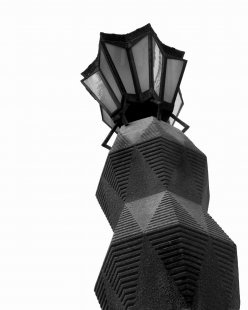
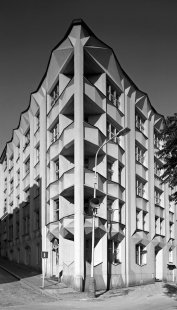
The exhibition focuses on the most significant period from 1911 to 1914 and presents prominent figures of cubism and their works: Pavel Janák, Josef Gočár, Vlastislav Hofman, Josef Chochol, and Emil Králíček. On 33 panels, visitors are also introduced to cubist design, unrealized projects, and further developments after 1918. The author of the black-and-white photographs is the renowned photographer Ester Havlová, and the exhibition and texts were prepared by Zdeněk Lukeš.
A publication in Czech and English was released for the exhibition, which includes a comprehensive catalog of buildings, including maps of realizations in the Czech Republic and Prague, as well as a key essay by Pavel Janák "Prism and Pyramid".
April 29 - May 23, 2008
Czech Centre Paris
May 29 - June 21, 2008
curator: Zdeněk Lukeš
concept: Zdeněk Lukeš, Dan Merta
photography: Ester Havlová, Jan Malý
graphic works: Robert Novák, Tomáš Brichcín
exhibition architect: Pavel Fanta
supported by: Ministry of Culture of the Czech Republic, City of Prague, Czech Architecture Foundation, Kubista
The exhibition on Prague's architectural cubism, which was first presented in December 2006 in Prague, in 2007 in Dresden, and this year in Berlin, continues the projects that leading Czech historian and architecture theorist Zdeněk Lukeš prepared for the Jaroslav Fragner Gallery.
Exhibitions Repayment of the Debt - Prague and Its German-speaking Architects 1900-1938 and Emil Králíček - The Forgotten Master of Art Nouveau and Cubism received great interest from both the professional and general public. Publications released for these exhibitions received awards in the competition for the most beautiful book of the year, also due to the fact that leading Czech photographers Pavel Štecha, Karel Cudlín, and especially Ester Havlová contributed to the photographic sections. The graphic design of the exhibitions and catalogs was prepared by the renowned Czech graphic designer Robert Novák. This group of collaborators also contributed to the exhibition on architectural cubism.
It should also be noted that both previous exhibitions presented Prague and Czech architecture abroad (e.g., Berlin, Stockholm, Munich, Darmstadt, Regensburg, Rotterdam, Vienna).
Concept of the Exhibition on Architectural Cubism
Prague constructions dominate, but the exhibition and catalog also present several buildings realized in other cities or locations in the Czech Republic.
Since 1909, Prague became the second most significant center of European cubist art after Paris. The echoes and stimuli of Parisian cubists were responded to not only by Prague sculptors and painters, but also by architects, designers, furniture designers, scenographers, poets, and writers. Prague, at that time an important spiritual and artistic center of Europe, transformed these stimuli into a unique architectural style that emerged during the period of European expressionist architectural modernism.
Czech architectural cubism is now at the center of interest of professionals and amateurs worldwide. It is a bizarre chapter in the development of modern architecture of the 20th century, often referred to as a dead end, but still very inspiring. The basic postulate was created in 1911 by the prominent Czech architect Pavel Janák (1882-1956), who critically responded to the then rational creation in the modern style of Jan Kotěra and his circle. While cubism in architecture did not establish itself as a style in the long term, several buildings were constructed, not only in Prague.
The exhibition focuses on the most significant period from 1911 to 1914 and presents prominent figures of cubism and their works: Pavel Janák, Josef Gočár, Vlastislav Hofman, Josef Chochol, and Emil Králíček. On 33 panels, visitors are also introduced to cubist design, unrealized projects, and further developments after 1918. The author of the black-and-white photographs is the renowned photographer Ester Havlová, and the exhibition and texts were prepared by Zdeněk Lukeš.
A publication in Czech and English was released for the exhibition, which includes a comprehensive catalog of buildings, including maps of realizations in the Czech Republic and Prague, as well as a key essay by Pavel Janák "Prism and Pyramid".

Czech Architectural Cubism
Zdeněk Lukeš, Ester Havlová
Jaroslav Fragner Gallery, 2006
176 pages, 19x13 cm, paperback, 280g, Czech, English
Regular price:290 CZK
Our price: 260 CZK (shipping time: up to 7 days)
Zdeněk Lukeš, Ester Havlová
Jaroslav Fragner Gallery, 2006
176 pages, 19x13 cm, paperback, 280g, Czech, English
Regular price:
Our price: 260 CZK (shipping time: up to 7 days)
 |
The English translation is powered by AI tool. Switch to Czech to view the original text source.
0 comments
add comment