
Acoustics of Sacred Spaces
 |
In modern history, Otakar Novotný defines the temple space in his publication "On Architecture" from 1959 as follows: "For the creation and understanding of spaces, humans use optical attributes (primary and secondary views with all perspectives, changes in geometry of shapes, and perspectives), acoustic attributes (good or poor audibility in space), movement attributes in various directions (according to communication needs), and finally synthetic outputs flowing from the sense of balance and harmony."
Interior comfort is essentially the harmonization and humanization of the building or its interior in subordination to human feelings. In the case of sacred buildings, it is about creating an atmosphere of interior well-being with the appropriate rational and emotional charge (spirituality) of the inner environment.
Gathering spaces of sacred buildings serving divine service must meet a number of aspects to ensure the interior comfort of believers:
Thermal comfort
Of the most important, it is necessary to mention thermal comfort, both in terms of the thermal regime balance concerning persons present in the gathering space and in the area of energy minimization of the object.
Lighting
Another equally important factor is the illumination of the space by both natural and artificial lighting, which significantly contributes to the spiritualization of both the external and especially the internal space. This factor is generally referred to as light quality of the interior.
Acoustics
Another attribute, especially in relation to historical applicability, can be defined as acoustics of the space. It should be noted that currently, when new church buildings are being constructed in municipalities, cities, and residential areas, the factor of noise loading from the external environment, and secondarily from the interior of surrounding buildings, such as residential establishments, caused by impulsive or stable noise, whether from church services in churches or especially from exterior accompanying manifestations of church services (singing, music, bells) and their duration or overlap, is also equally important. Often, external noise loading, such as from traffic, can influence both the placement and the layout, and potentially even the structural solution of the church building.
These factors can be summarized under the definition of acoustics of the external environment.
From the above, it is clear that the realization of a sacred object is not only an architectural and artistic expression of its time but also a liturgically and humanly shaped space that should provide a guarantee of quality reception of the word of God in a space that meets the attributes of comprehensive comfort.
Spatial acoustics
The design of the shape and geometry of the temple space is one of the most significant factors influencing the sound quality of the liturgical event in terms of both verbal and musical expression. The fact that architects and builders in the past also intensely dealt with these issues is evidenced by the analysis of the quote from the famous Roman builder Marcus Pollius Vitruvius:"… great care must be taken that the object in which the voice is to spread quietly is designed so that the reflections do not return and only bring indistinct hints to the ears. There are indeed many places, which by their natural positioning disturb the sound's movement, such as desonant places (silent), which are called by the Greeks katechúntes, circumsonant places (with sound dispersing around), known to them as periechúntes, also resonant places (sound-emitting), called antiechúntes and consonant (harmonious), known as synechúntes."
Desonant places are those in which the first sound, upon its appearance above, is obstructed and deflected back by solid bodies positioned higher: thus it remains lying low and hinders the ascent of the following sound behind it.
Circumsonant places are those where sound, compelled to wander around, vanishes in the middle, resonates without endings, and gets lost there in indistinct hints of words.
Resonant
Consonant
Therefore, if careful attention is paid to the structure, this carefulness will ensure that the voice sounds in temples and theaters quality for the benefit of the cause. The designs differ from one another in that the gathering spaces usual among the Greeks are based on squares, while the Latin ones are based on equilateral triangles. Anyone who is willing to use these regulations will achieve flawless execution of theatrical buildings."
A perfect architectural work should be the result of harmonious fulfillment of not only artistic but also technical requirements. When creating an architectural object and its environment, the influence of acoustics on the future structure is a very significant component. Acoustics is a relatively young field; scientists began to take an interest in it as a science only in the seventeenth century, but it has been part of constructions since ancient times. Perhaps ancient builders did not know its principles and the possibilities of its calculations as we know them today, yet their buildings were created in accordance with acoustic needs. Often these buildings even today serve as examples of good acoustics and are objects of our interest and admiration. Acoustics as a science developed the most during the functionalism period.
A mere mathematical computation devoid of the current architectural space solution does not guarantee a positive result. Humans perceive events in the space of the architectural work with all their senses; therefore, mere limitation to stark calculations can become an obstacle in the final impact of the work. But conversely, merely solving the space from an artistic standpoint while neglecting the basic technical acoustic requirements does not lead to success. It can thus create a shape-rich space, which is, however, very unsatisfactory from an acoustic perspective. This reduces the value of the entire work.
Criteria for acoustic quality of spaces can be divided according to the nature of the evaluated parameters into:
- temporal
- spatial
- dynamic
- spectral
1. Temporal Criteria
Distinction between direct and reflected sound - subjective criterion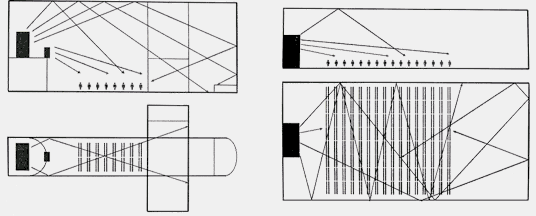 |
| Propagation of sound in a narrow space | Propagation of sound in a wide space |
Although the share of direct sound in the listener's perception in spaces designated for music occupies a maximum of 10% of the total acoustic energy at the listening point, it suffices for a reliable estimate of the direction from which the sound comes. Disruption of this distinction between direct and reflected sound is associated with the creation of an echo, which is a single or multiple clear repetition of the original sound. The presence of an echo not only disturbs but can also cause erroneous localization of the source.
Direct reflections are generally not perceived separately from direct sound and contribute especially to reinforcing the perception of its loudness. With a significant delay in the first reflections (above 30 - 50 msec), characteristic colorations of sound or a perception of roughness of sound may occur.
The detectability or even disturbance of the first reflections is related to the difference in their levels compared to direct sound, to their delay compared to direct sound, and to the direction from which the reflections come. The human ear is, due to binaural perception, more sensitive to reflections from side walls, which cause a greater interaural difference than reflections coming from the ceiling, floor, and rear wall. Therefore, in low and wide spaces, subjective reflections from walls are often associated with a negative impact on the acoustic quality of spaces compared to high and narrow spaces, where the delay of reflections from the ceiling predominates.
intelligibility - subjective criterion
Decreases with increasing reverberation time and the distance between the source and the listener. It also depends on the volume of the space and on the distance of the speech level from the background noise.
Loss of intelligibility of consonants - objective criterion
It is directly related to the overall loss of intelligibility.
Clarity - subjective criterion
We divide it into temporal clarity (horizontal) - distinguishability of the time sequence of tones or sounds and into register clarity (vertical) - distinguishability of sounding instruments.
Clarity decreases with increasing reverberation time, and both the first reflections, their temporal sequence, and intensity at a specific listening point affect it.
Reverberation time - both subjective and objective criterion
One of the most important criteria in assessing the acoustics of sacred spaces.
Reverberation is defined as sound that propagates through space after the source is turned off. It mainly depends on the size (volume) and shape of the space and on the structure and absorbency of its walls. Reverberation time is also dependent on the loudness and color of the sound at the moment the source is turned off, and it is also affected by the initial reverberation time. This is evaluated from the first 10 dB decrease of the reverberation curve, unlike the standard reverberation time, which is determined at the decrease of the curve between -5 to -35 dB. The agreement between these reverberation times ranks among the objective criteria of acoustic quality of musical spaces.
Subjective and objective criteria for the reverberation time relative to the size of the space, together with its purpose, lead to the recommendation of optimal reverberation time.
For speech, values of 0.5 - 1.2 s are cited. Increasing reverberation time supports the masking effect and decreases speech intelligibility. For music, the optimal reverberation time values are 1.6 - 2.1 s, where for organs, the value should not drop below 2 s (in Gothic churches, the reverberation time could be up to 8 s, and in Baroque churches, 5 s). For organs, it is important to realize that they act as a system of resonators that absorb sound intensely across a wide frequency range.
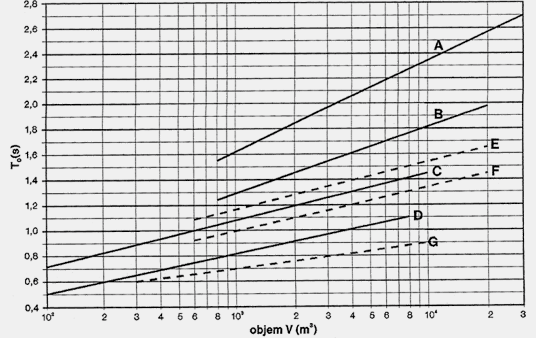 |
The dependence of optimal reverberation time on volume (applies to frequency 1 kHz); A - organ music, B - orchestral music, C - chamber music, D - speech, E - opera, F - multipurpose hall, G - cinema
2. Spatial Criteria
Spaciousness - subjective criterion
Overall perception of space - subjective criterion
Degree of spaciousness - objective criterion
3. Dynamic Criteria
Loudness - subjective criterionBalance - subjective criterion
4. Spectral Criteria
Color of sound - subjective criterionFrequency course of reverberation time - objective criterion
Determines the suitability of the space for the given purpose and the characteristic color of sound in the space. It is given by the geometric design of the space and its interior fittings, where individual elements exhibit frequency dependence of the absorption coefficient and function as sound absorbers only in a certain frequency range. The finely detailed relief of textiles, walls, and flowers absorbs high frequencies, furniture and its cavities, small paintings, and the presence of listeners manifest by absorbing mid frequencies, while large cavities, practice rooms, large surfaces of paintings, and windows absorb low frequencies (see the example of frequency dependence of reverberation time in selected Prague churches).
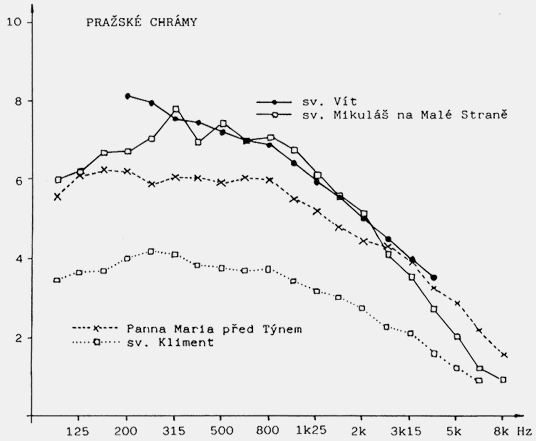 |
Frequency dependence of reverberation time in selected Prague churches.
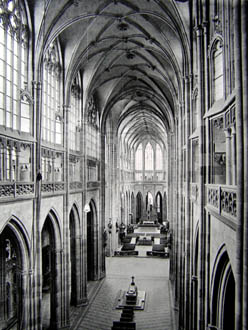
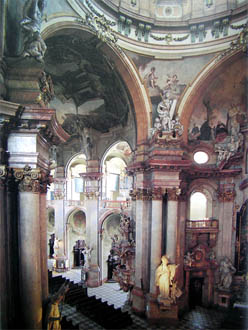
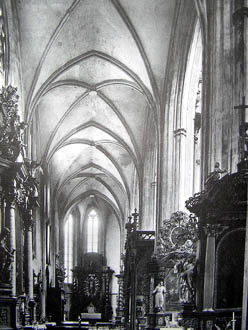
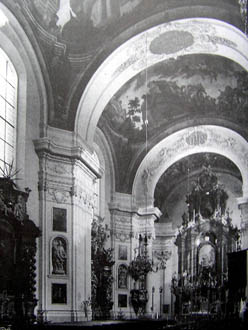
Upon comparing the results of the chart and visual documentation, we can confirm both the dependence of the reverberation time values on the size (volume) of the space and also the frequency dependence of the reverberation time on the division of space and its interior fittings. Common to all churches is the decreasing reverberation time with increasing frequency. In St. Nicholas, the absorption of high-frequency signals corresponds to its spatial articulation with numerous shape models such as the breaking through large niches or the presence of a dome.
|
|
||
| St. Vitus Cathedral |
St. Nicholas Church in Malá Strana
|
||
|
|
||
| Church of Our Lady before Týn |
St. Clement Church |
Among the most successful modern sacred buildings constructed in the Czech Republic since 1990 are especially:
|
|
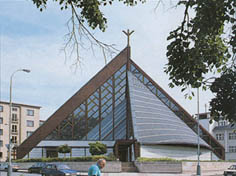
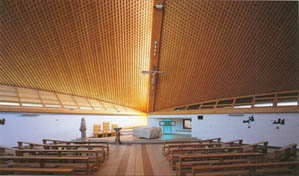
Church of the Immaculate Conception of the Blessed Virgin Mary in Prague-Strašnice
|
|
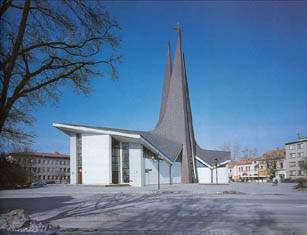
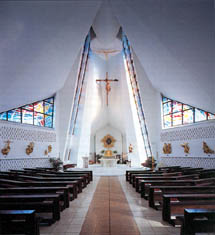
St. Wenceslas Church in Břeclav
|
|
|


Conclusion
This contribution serves to understand the main conditioning factors determining the acoustic quality of spaces.In the context of sacred space, reverberation time, spaciousness, the properties of direct and reflected sound, and intelligibility have a decisive significance.
From these attributes arise the basic principles for choosing the size and shape of sacred space and their acoustic consequences. However, the exact (numerical) characterization of the relationship between the geometric proportions of the space (both plan and section) and the acoustic quality of the space is not apparent from them.
When designing a sacred building, it is important not only to meet the objective criteria of acoustic qualities of the space but also to serve as a basis for prior experiences with the acoustic solutions of these buildings concerning the priorities of purpose, size of the space, shape solution, and materials used.
In practice, this entails collaboration between the architect and the acoustician from the very first proposal of the sacred space.
Most historical churches have a longitudinal layout, which today comes into conflict with the functional requirement for multipurpose sacred space.
For this reason, layouts are increasingly being used where width either predominates over length or is comparable to it, and height is variable. In discussions about the basic criteria for assessing acoustic space, all negative acoustic properties of such a space are known. The advantages, on the other hand, are predominantly functional. People are closer to the altar, better understand the word service, see each other, and thus have a greater feeling of a shared community of believers. Often in modern church spaces, the classical choir is missing, which, together with the vault, significantly aids the emission of sound into the vertical plane. The construction system of these buildings is often conditioned by a multipurpose hall located in the basement below the liturgical space itself.
Literature
1. ČSN 73 0525 Acoustics - Design in the field of spatial acoustics. General principles.2. ČSN 73 0527 Acoustics - Design in the field of spatial acoustics. Spaces for cultural purposes.
3. Kolmer, F., Kyncl, J.: Spatial acoustics. SNTL 1980.
4. Novák, J: Acoustic quality and comfort in construction. SNTL 1981.
5. Vaverka, J. et al.: Building physics 1 - urban, building, and spatial acoustics. VUTIUM Brno, 1998
6. Vaverka et al.: New churches and chapels from the late 20th century in the Czech Republic. Karmelitánské nakladatelství 2000.
7. Vaverka et al.: Modern sacred buildings in the territories of Bohemia, Moravia, and Silesia. Jota Publishing, 2004.
8. Lukášová, M.: Acoustics of Sacred Space, doctoral thesis abstract, 2005.
|
Prof. Ing. JIŘÍ VAVERKA, DrSc. After graduating from the Faculty of Civil Engineering in Brno in 1960, he worked for 15 years in operations as a master, construction manager, and operations supervisor. Since 1975 at Stavoprojekt as the main specialist for building physics. In 1990 he defended his DrSc., after which he was appointed professor. He is a court expert in the field of construction, in the branch of building physics, an authorized engineer in the fields of civil engineering and energy auditing. He leads consulting centers in thermal engineering (EKIS) and the Panel program at the Ministry of Industry and Trade of the Czech Republic. He is the author or co-author of 12 monographs, more than 200 articles, and lectures in reputable domestic journals and conferences, a member of the Scientific Councils at FA TU Liberec and FAST TU Ostrava, where he lectures externally. Currently, an international author team under his leadership is preparing the publication of a technical book (in 2006) - Building Thermal Technology and Energy of Buildings, which is qualitatively set for the time horizon from 2006. |

The English translation is powered by AI tool. Switch to Czech to view the original text source.
1 comment
add comment
Subject
Author
Date
Článek prof. Vaverky Akustika sakrálních prostorů
Prof. Ing. Václav Syrový, CSc.
07.11.07 12:03
show all comments