
Lead Dušan: Irena Machanderová
Holešovice_the future center of the metropolis
 |
studio: Ing. arch. Jan Bočan, Ing. arch. Jan Hladík, Ing. arch. Ondřej Císler, Ing. arch. Jakub Koňata
Judges' evaluation:
Memory of the place - energy of the railway yard from the abolished station.
A suitable combination of block development with a new principle and overall connection to the existing neighborhood while maintaining the surrounding density. A new class is created - new quality.
Logical transport connection. The form has coherence with the spirit of the place.
New development, new heart of the urban organism
The city is a complex structure consisting of many layers that interweave and influence each other. It is a mosaic composed of spaces, their functions, people, and their activities. The city forms a pattern made up of an endless number of parts; it is an organism in which life pulsates. However, no city is perfect and complete. Some parts are missing, or they are disrupted; new elements must be inserted into the incomplete pattern.
The new parts can be independent and self-sufficient, creating their own new environment, but it cannot be overlooked that they are located amidst the old existing structure and must respond to it, rather than distancing themselves from it.
The new parts are bearers of life, a new spirit, but their energy must also be transferred to the old, existing parts, especially if these parts are disrupted. At the same time, their intensity must not engulf the original elements that still have enough strength, function well, and through their tradition and history create the essential phenomenon of place, its character and continuity.
The new parts are the new heart of the existing organism, through which the old blood will flow. However, for the new heart to function well and provide further, richer life to the organism, it must be accepted by that organism.
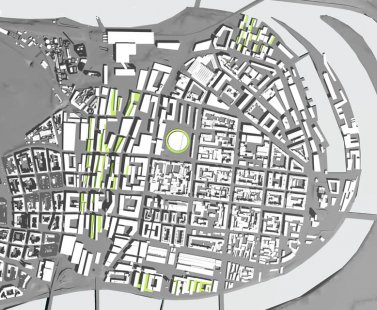
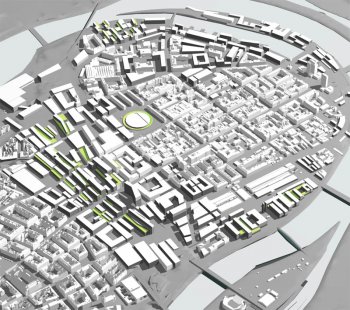
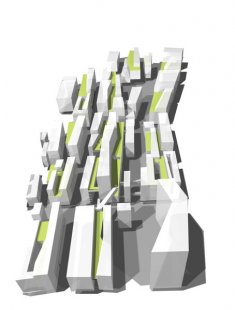
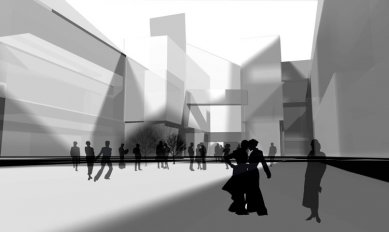
Therefore, a new structure is emerging in the center of Holešovice, which is not clearly and rigidly defined, but which, through its functional and spatial diversity, can interweave with the existing structure. At its core, the new structure is dominant, but at the contact points with the old structure, it approaches and meets it.
New structure, bearer of new life in the metropolis
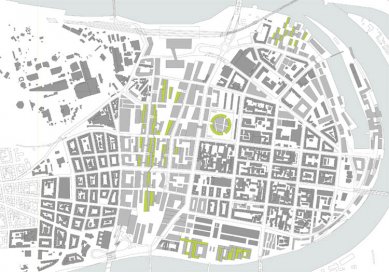
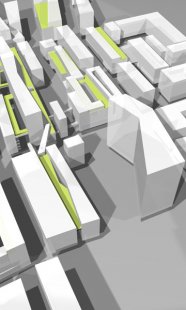
The new structure, future center of the metropolis, forms a flexible spine leading through the entire area from north to south, connecting the metro stops Nádraží Holešovice, Vltavská. The main axis, the central strip of the structure, is pedestrian; at the southern edge of the area it opens onto the viaduct leading to the other bank of the Vltava River.
The main features are:
spatial and functional diversity
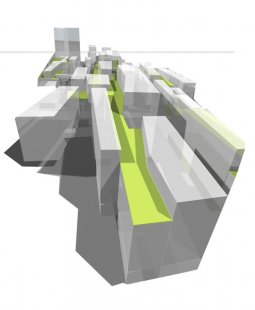
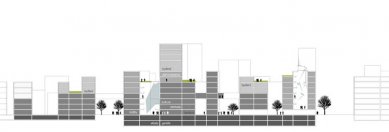
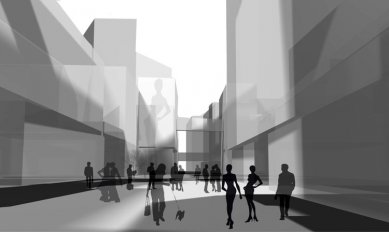
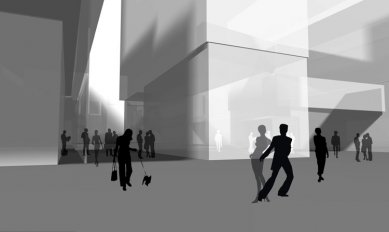
permeability on the ground floor - the street network is connected with a system of passages, corridors, and internal streets
life of the city on multiple levels - connecting pedestrian paths on higher (lower) floors even where they are intersected by streets at ground level
green landscape - at the level of the 5th floor, a system of private and public rooftop gardens is created above the busy city level, interconnected by bridges. From the level of the gardens lead entries to offices and residential spaces located in the uppermost floors of the buildings. Residential spaces are thus protected from the hustle and bustle of the city, with adequate sunlight. Direct access from the ground floor to the gardens is ensured by elevators and stairs located at the intersections of paths in the passages.
The English translation is powered by AI tool. Switch to Czech to view the original text source.
0 comments
add comment