
NG announced a competition for the pavilion exhibition at the biennale
Prague - The National Gallery (NG) in Prague has announced a competition for the exhibition of the Czechoslovak Pavilion at the upcoming Biennale of Visual Arts in Venice. The showcase will take place from May to November next year, and its main theme is inspired by the ancient Chinese curse "May you live in interesting times," which refers to times of unrest and uncertainty. Interested parties can submit their exhibition project proposals by September 17. This was announced by NG spokesperson Tereza Ježková.
The call is intended for curators and authors, and detailed conditions including the application can be found on the profile of the National Gallery https://nen.nipez.cz/profil/profilng. According to the information available, 1.8 million crowns are allocated for the implementation of the selected project. If the proposed budget exceeds 1.8 million crowns, applicants must provide documentation on securing additional funds.
The Venice Biennale is one of the most important global exhibitions of contemporary art and attracts over half a million international visitors each year. It was first held in 1895. After World War II, it was revived in 1948, and its uninterrupted tradition has continued since then. In 1925, Czechoslovakia also built its pavilion in Venice, and after its division, both successor states manage it, alternating in organizing the exhibition.
The call is intended for curators and authors, and detailed conditions including the application can be found on the profile of the National Gallery https://nen.nipez.cz/profil/profilng. According to the information available, 1.8 million crowns are allocated for the implementation of the selected project. If the proposed budget exceeds 1.8 million crowns, applicants must provide documentation on securing additional funds.
The Venice Biennale is one of the most important global exhibitions of contemporary art and attracts over half a million international visitors each year. It was first held in 1895. After World War II, it was revived in 1948, and its uninterrupted tradition has continued since then. In 1925, Czechoslovakia also built its pavilion in Venice, and after its division, both successor states manage it, alternating in organizing the exhibition.
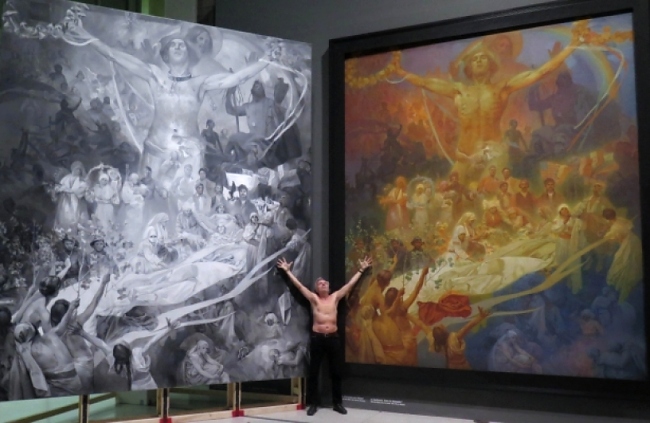
In 2015, Jiří David took care of the exhibition of the Czechoslovak Pavilion at the Venice Biennale of Art, interpreting one of Alphonse Mucha's paintings, with which the famous painter concluded his monumental Slavic Epic. David created an updated version of Mucha's painting Apotheosis - Slavs for Humanity, but the painting was only part of a thoughtful installation through which the artist aimed to debate what a nation is, what the illusion of a nation is, the self-determination of individuals, and entire groups. The curator of David's project was Slovak art historian Katarína Rusnáková.
 |
The English translation is powered by AI tool. Switch to Czech to view the original text source.

0 comments
add comment