
Boršov Rye Mill Residence

Industrial Heritage on the Banks of the Vltava
When we first entered the premises of the former Rye Mill in Boršov nad Vltavou in 2019, we were immediately captivated by the powerful narrative embedded in the site. For nearly two centuries, the energy of the Vltava intertwined here with the scent of grain and the rhythm of industrial machinery. The complex is connected to the river not only physically but historically. The original mill wheel was driven by a water channel, which at the beginning of the 20th century was replaced by two Francis turbines generating electricity. The dominant feature of the entire ensemble is a five-storey brick silo dating from the late 19th century, later complemented by concrete silos and an administrative building. On the opposite side stands a 17th-century Baroque château. The question before us was how to preserve this powerful imprint of the past while opening the site to a new life—housing for the 21st century.
Adaptation of a Brownfield Site for Contemporary Living
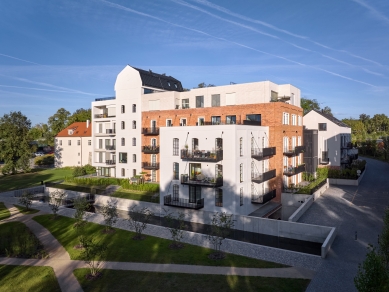
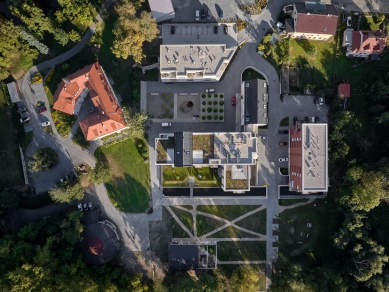
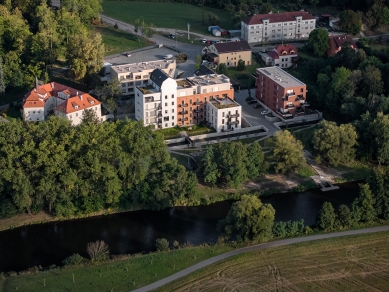
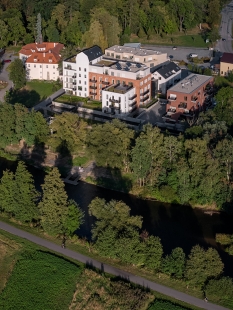
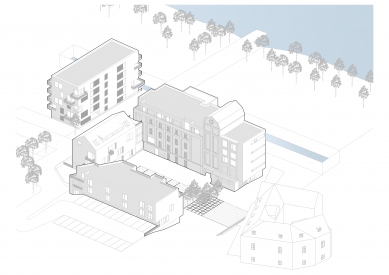
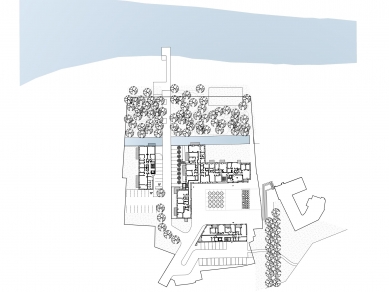
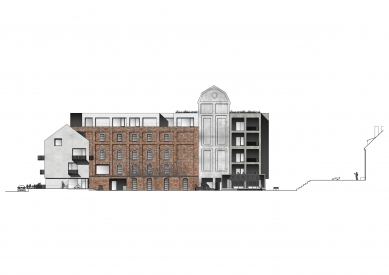
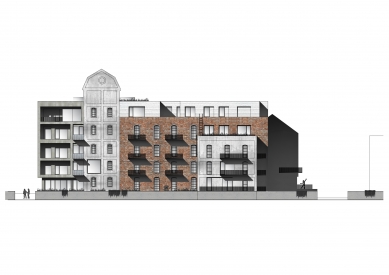
Today, the complex consists of four architectural volumes: two historic structures and two new buildings. In total, 83 residential units have been created, ranging from 45 to 150 m², offering a diverse selection from compact one-bedroom apartments with kitchenette to spacious five-bedroom layouts. Among them is a unique duplex apartment within the original mill building, whose tower-like architecture provides a distinctive atmosphere.
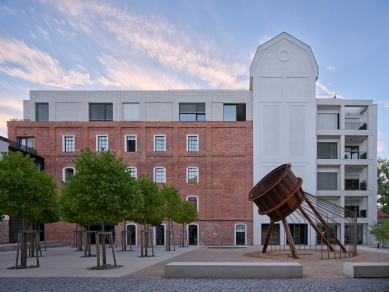
A café has been placed on the ground floor of the main building, activating the square and connecting the site with the public realm. For us, it is a symbolic place where history and the present meet at one table.
A New Square
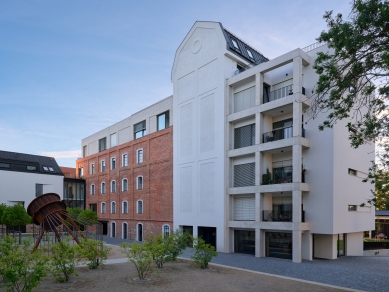
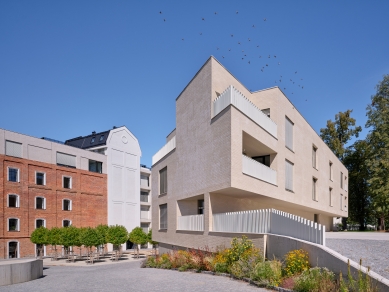
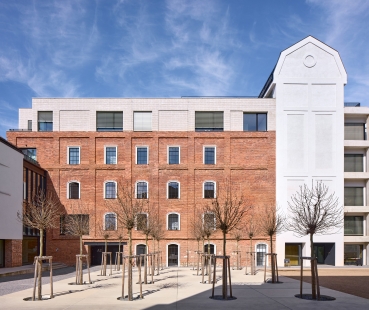
A key urban gesture was the completion of the open side of the “U”-shaped layout with a new three-storey residential building. This intervention created a square lined with trees and defined by a generous staircase oriented toward the château, linking the individual parts of the complex. At its centre, we placed a rediscovered artefact—the original Francis turbine, recovered from the filled-in water channel. The square thus serves not only as a residential courtyard but also as a reminder of the site’s history and as a communal space.
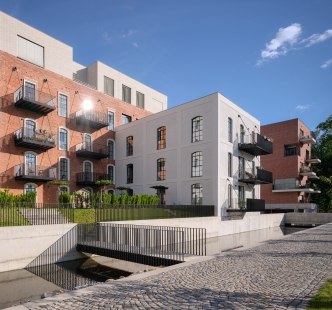
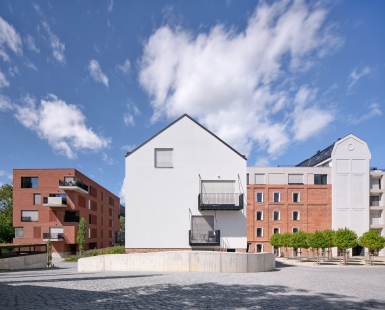
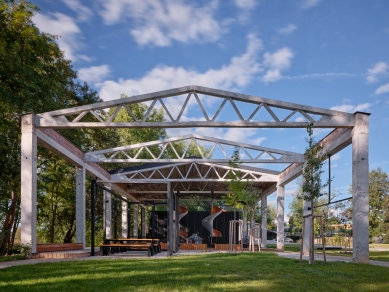
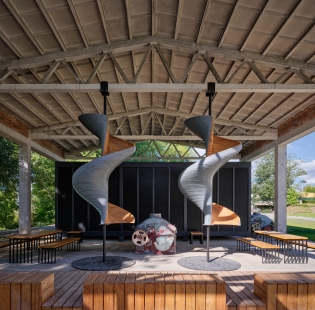
Towards the river, the water channel has been restored and complemented by a new bridge, establishing a natural connection to the riverside park. The preserved remains of the original garage have been repurposed as a gallery space for additional technological artefacts.
Transformation of Historic Buildings
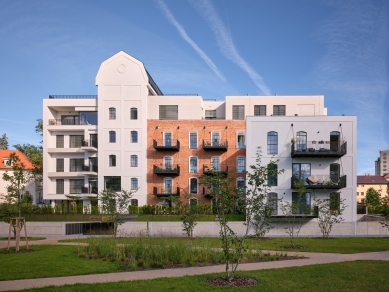
The five-storey silo was stripped back to exposed brick, with later additions and the shed roof removed. A new rooftop extension in light brick is clearly set back from the original mass. The windows replicate industrial steel frames, and black steel balconies were added to the river-facing façade.
The most significant transformation took place in the central tower, where a loft apartment was created. A reinforced concrete shell crowns the tower, forming a space with terraces and views of the surrounding landscape. The roof is designed as a green roof and forms part of the overall ecological concept of the complex.
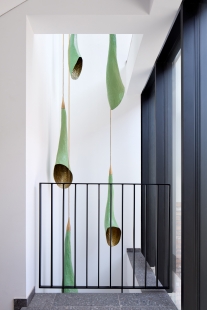
The perpendicular two-storey former administrative building received a new brick plinth and a light plaster finish. The apartments follow a similar layout logic to those in the silo, complemented by balconies. The two historic buildings are connected by a new vertical circulation core made of glass and black metal cladding, serving as both a functional element and a clearly articulated contemporary architectural intervention.
New Buildings
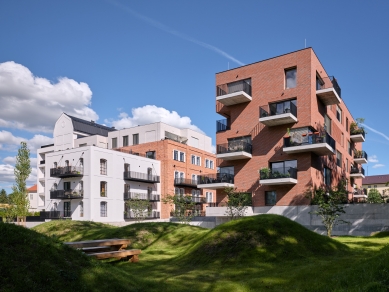
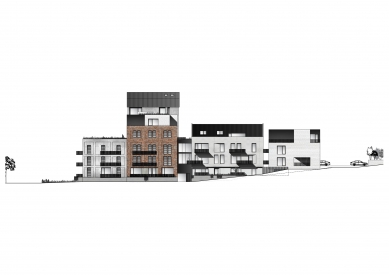
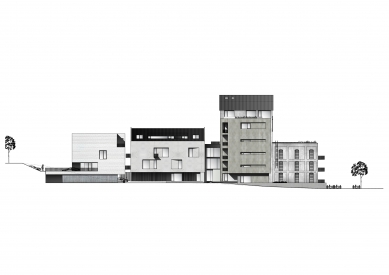
The building enclosing the square is conceived as a three-storey volume in light brick with white metal elements and a flat roof. It intentionally distinguishes itself from the historic structures, its contrast underlining its contemporary character. Instead of balconies, it offers loggias and terraces.
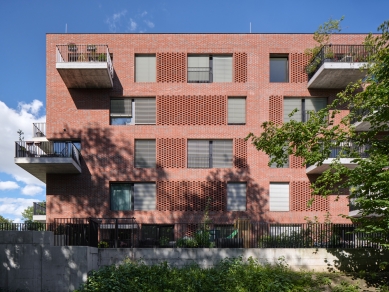
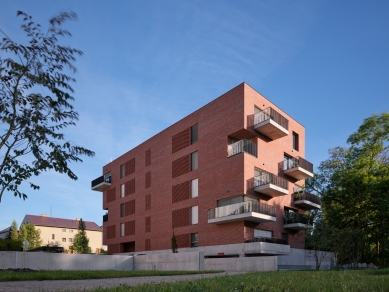
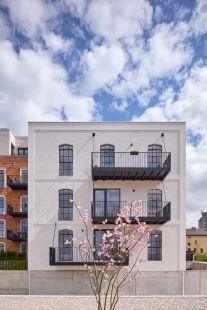
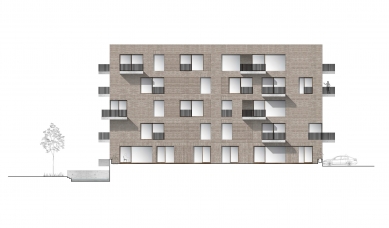
The second new building stands by the water channel and the river. It is a simple five-storey cuboid with a façade of red exposed brick, large French windows, and a combination of loggias and balconies. Its regularity and openness establish a direct relationship with the river.
Technical Solution and Sustainability Features
The conversion of the complex is based on the principle of reuse—maximising the use of existing structures, which we consider the most ecological approach to building resources. The project incorporates green roofs and a rainwater management system that supplies the restored channel.
Structural interventions were demanding: in the oldest building, the original timber silo had to be replaced with reinforced concrete slabs; in the newer section, a system of concrete cellular bins was removed, fragments of which were retained in the interior as a reminder of the past.
Genius Loci
The project evolved in close dialogue with the investor, the family-owned construction company Auböck Bau, which has Austrian roots and a branch directly in Boršov. The owners have a strong affinity for industrial architecture, and our shared ambition was to carry out the conversion sensitively yet confidently.
The entire project is founded on a simple principle: to preserve as many industrial elements as possible, complement them with clearly articulated contemporary interventions, and create a harmonious whole. The château, silo, administrative building, new houses, square, and riverside park now form a single organism—one that retains its memory while offering high-quality living.
For us, the conversion of the Rye Mill complex represented an exceptional opportunity to demonstrate that industrial heritage can become the cornerstone of a new, sustainable, and authentic neighbourhood.
When we first entered the premises of the former Rye Mill in Boršov nad Vltavou in 2019, we were immediately captivated by the powerful narrative embedded in the site. For nearly two centuries, the energy of the Vltava intertwined here with the scent of grain and the rhythm of industrial machinery. The complex is connected to the river not only physically but historically. The original mill wheel was driven by a water channel, which at the beginning of the 20th century was replaced by two Francis turbines generating electricity. The dominant feature of the entire ensemble is a five-storey brick silo dating from the late 19th century, later complemented by concrete silos and an administrative building. On the opposite side stands a 17th-century Baroque château. The question before us was how to preserve this powerful imprint of the past while opening the site to a new life—housing for the 21st century.
Adaptation of a Brownfield Site for Contemporary Living
Today, the complex consists of four architectural volumes: two historic structures and two new buildings. In total, 83 residential units have been created, ranging from 45 to 150 m², offering a diverse selection from compact one-bedroom apartments with kitchenette to spacious five-bedroom layouts. Among them is a unique duplex apartment within the original mill building, whose tower-like architecture provides a distinctive atmosphere.
A café has been placed on the ground floor of the main building, activating the square and connecting the site with the public realm. For us, it is a symbolic place where history and the present meet at one table.
A New Square
A key urban gesture was the completion of the open side of the “U”-shaped layout with a new three-storey residential building. This intervention created a square lined with trees and defined by a generous staircase oriented toward the château, linking the individual parts of the complex. At its centre, we placed a rediscovered artefact—the original Francis turbine, recovered from the filled-in water channel. The square thus serves not only as a residential courtyard but also as a reminder of the site’s history and as a communal space.
Towards the river, the water channel has been restored and complemented by a new bridge, establishing a natural connection to the riverside park. The preserved remains of the original garage have been repurposed as a gallery space for additional technological artefacts.
Transformation of Historic Buildings
The five-storey silo was stripped back to exposed brick, with later additions and the shed roof removed. A new rooftop extension in light brick is clearly set back from the original mass. The windows replicate industrial steel frames, and black steel balconies were added to the river-facing façade.
The most significant transformation took place in the central tower, where a loft apartment was created. A reinforced concrete shell crowns the tower, forming a space with terraces and views of the surrounding landscape. The roof is designed as a green roof and forms part of the overall ecological concept of the complex.
The perpendicular two-storey former administrative building received a new brick plinth and a light plaster finish. The apartments follow a similar layout logic to those in the silo, complemented by balconies. The two historic buildings are connected by a new vertical circulation core made of glass and black metal cladding, serving as both a functional element and a clearly articulated contemporary architectural intervention.
New Buildings
The building enclosing the square is conceived as a three-storey volume in light brick with white metal elements and a flat roof. It intentionally distinguishes itself from the historic structures, its contrast underlining its contemporary character. Instead of balconies, it offers loggias and terraces.
The second new building stands by the water channel and the river. It is a simple five-storey cuboid with a façade of red exposed brick, large French windows, and a combination of loggias and balconies. Its regularity and openness establish a direct relationship with the river.
Technical Solution and Sustainability Features
The conversion of the complex is based on the principle of reuse—maximising the use of existing structures, which we consider the most ecological approach to building resources. The project incorporates green roofs and a rainwater management system that supplies the restored channel.
Structural interventions were demanding: in the oldest building, the original timber silo had to be replaced with reinforced concrete slabs; in the newer section, a system of concrete cellular bins was removed, fragments of which were retained in the interior as a reminder of the past.
Genius Loci
The project evolved in close dialogue with the investor, the family-owned construction company Auböck Bau, which has Austrian roots and a branch directly in Boršov. The owners have a strong affinity for industrial architecture, and our shared ambition was to carry out the conversion sensitively yet confidently.
The entire project is founded on a simple principle: to preserve as many industrial elements as possible, complement them with clearly articulated contemporary interventions, and create a harmonious whole. The château, silo, administrative building, new houses, square, and riverside park now form a single organism—one that retains its memory while offering high-quality living.
For us, the conversion of the Rye Mill complex represented an exceptional opportunity to demonstrate that industrial heritage can become the cornerstone of a new, sustainable, and authentic neighbourhood.
mar.s architects












0 comments
add comment