
Extension to Laurenskerk
Aanbouw Sint-Laurenskerk

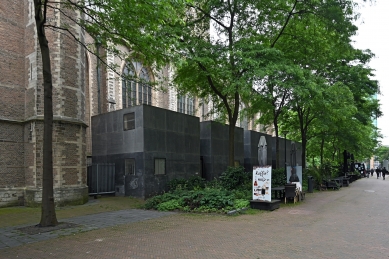
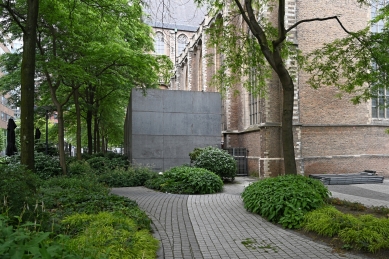
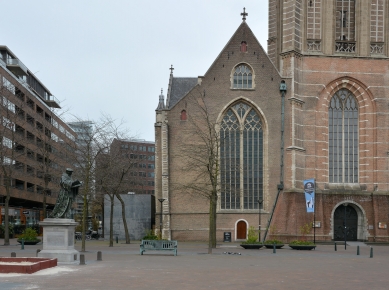
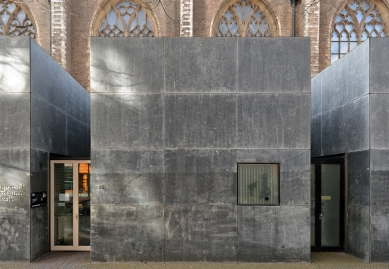
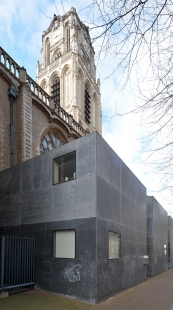
The Laurenskerk annex is perhaps the most forceful demonstration of Quist's design methods of the seventies, namely incorporating the program-me in a form that is 'alien' —that can be interpreted in different ways. The programme here called for a building to house supplementary church activities; a second reason for a modest solution was that the Laurenskerk is a time-honoured monument. Quist subordinated his building to the Gothic main mass by dividing it amongst five cubes and taking their dimensions from the church bays. The five cubes themselves are free-standing, and are joined to one another and to the church by glass corridors. The annex keeps its distance, in humility; it waits obediently at the side of the old church, or rather, it does in theory. In reality these properties can be demonstrated easily enough, and yet they also seem to have become reversed. Keeping at a distance implies not only more deference but independence too; adapting to the dimensions of the lateral facade means subservience but also impasses the difference between the two. The annex is small when compared with the church, but five of these black freestone cubes in the street look enormous. They are open to the church wall; if Quist had had his way they would have been sealed off from the open space they overlook. In their dark privacy they could not contrast more with the finely detailed Gothic skeletal structure. It is no wonder that this work raised a storm of protest; indeed the last thing it seemed to evoke was the idea of a church annex. Many critics saw only five rubbish 'skips' that desecrated the monument, other pointed once again to Quist's 'formalism'. But even those favourably disposed managed to miss the mark. Leanings towards the sculptural had long been a characteristic of Quist's work: here they showed through more vividly than ever before. Everyone got excited, but nobody bothered to look.
AvdW





1 comment
add comment
Subject
Author
Date
Přístavba ke kostelu
Jiri Macku
05.03.26 07:47
show all comments