
Conversion of Pípal's Painting

The original workshop of a painter and lacquerer has been a family property for over 150 years. Now, this object in the Vysočina region has undergone a comprehensive transformation that will allow it to be used for community and cultural activities, complemented by wellness and a wine bar. The realization was carried out by architects from MA Studia under the leadership of Dan Merta.
The author team approached the reconstruction with respect for the long-standing history of this unique place. The pair of buildings, courtyard, and garden create a compact yet richly layered whole. The main building is accessible from the street through a new gable that has replaced the original hipped roof.
The building originally served as a workshop; now it houses a newly built gallery with a bar and an open gallery.
"This space is conceived as the heart of the entire complex: the high ceiling, visible trusses, glimpses into the mezzanine, and industrial lighting create a scene that allows for exhibitions, social events, and the usual daily functioning of the space. The bar is made from recycled steel from the Prague Point Gallery, which brings a striking technical element with its own history into the interior," describes architect Dan Merta from MA Studia.
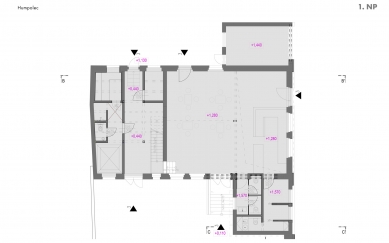
The layout is divided into two main zones. The front part facing the street includes the gallery, bar, mezzanine, and toilets with kitchen facilities. An essential element is also the industrial lighting.
The back part, accessible from both the interior and directly from the courtyard, hides a smaller wellness area with a sauna. Here, a two-story steel structure with a wooden slat filling has been inserted into the space.
From the central hall, there is direct access to the courtyard, which connects all parts of the complex. Thanks to the granite paving and facades draped in vines, it forms a quiet outdoor space that acts as a natural extension of the interior. From this space, it is possible to descend to the garden with a terrace oriented towards the tranquil part of the property, which serves as outdoor seating for gallery visitors and a private area for the family during the summer months.
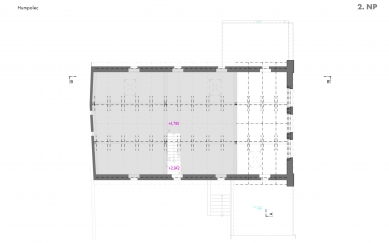
The staircase along the side wall of the gallery leads to the mezzanine area, which opens into the truss. "The original truss structure was cleaned and left exposed, allowing visitors to perceive the space in its full height and rawness," explains Merta. The mezzanine then serves as a second exhibition level, but also as a quieter zone during cultural events.
The second building serves the family and will be expanded in the future to include apartments for accommodating visitors. Unlike the gallery, which is open and passageway, the residential building was conceived by the architects as a more enclosed and tranquil space. The reconstruction of the second facility focused primarily on the facades to harmonize with the main building.
The entire complex can be controlled using the KNX Smart Home system, which allows for controlling lighting, heating, and security. The conversion emphasizes the industrial character, exposed structures, work with light, and preservation of original elements.
The entire project was conceived by MA Studio as a family collaboration under the leadership of Dan Merta, involving Matyáš Merta, Mgr. Dan Merta, Anna Mertová, and Irena Mertová. The goal was to preserve the legacy of more than a century-long history of the place, and thus all participants approached the reconstruction with a measure of sensitivity, respect for history, family continuity, and the atmosphere of the place. The result is a space that can function as a vibrant cultural and social center, naturally connected with the family life of the owners and the context of the locality.
The author team approached the reconstruction with respect for the long-standing history of this unique place. The pair of buildings, courtyard, and garden create a compact yet richly layered whole. The main building is accessible from the street through a new gable that has replaced the original hipped roof.
The building originally served as a workshop; now it houses a newly built gallery with a bar and an open gallery.
"This space is conceived as the heart of the entire complex: the high ceiling, visible trusses, glimpses into the mezzanine, and industrial lighting create a scene that allows for exhibitions, social events, and the usual daily functioning of the space. The bar is made from recycled steel from the Prague Point Gallery, which brings a striking technical element with its own history into the interior," describes architect Dan Merta from MA Studia.
The layout is divided into two main zones. The front part facing the street includes the gallery, bar, mezzanine, and toilets with kitchen facilities. An essential element is also the industrial lighting.
The back part, accessible from both the interior and directly from the courtyard, hides a smaller wellness area with a sauna. Here, a two-story steel structure with a wooden slat filling has been inserted into the space.
From the central hall, there is direct access to the courtyard, which connects all parts of the complex. Thanks to the granite paving and facades draped in vines, it forms a quiet outdoor space that acts as a natural extension of the interior. From this space, it is possible to descend to the garden with a terrace oriented towards the tranquil part of the property, which serves as outdoor seating for gallery visitors and a private area for the family during the summer months.
The staircase along the side wall of the gallery leads to the mezzanine area, which opens into the truss. "The original truss structure was cleaned and left exposed, allowing visitors to perceive the space in its full height and rawness," explains Merta. The mezzanine then serves as a second exhibition level, but also as a quieter zone during cultural events.
The second building serves the family and will be expanded in the future to include apartments for accommodating visitors. Unlike the gallery, which is open and passageway, the residential building was conceived by the architects as a more enclosed and tranquil space. The reconstruction of the second facility focused primarily on the facades to harmonize with the main building.
The entire complex can be controlled using the KNX Smart Home system, which allows for controlling lighting, heating, and security. The conversion emphasizes the industrial character, exposed structures, work with light, and preservation of original elements.
The entire project was conceived by MA Studio as a family collaboration under the leadership of Dan Merta, involving Matyáš Merta, Mgr. Dan Merta, Anna Mertová, and Irena Mertová. The goal was to preserve the legacy of more than a century-long history of the place, and thus all participants approached the reconstruction with a measure of sensitivity, respect for history, family continuity, and the atmosphere of the place. The result is a space that can function as a vibrant cultural and social center, naturally connected with the family life of the owners and the context of the locality.
The English translation is powered by AI tool. Switch to Czech to view the original text source.


0 comments
add comment