
Internalities - Architecture of Spatial Balance
<span>Spanish National Pavilion at the 19th International Architecture Biennale in Venice</span>

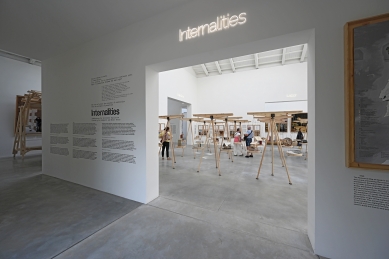
The Spanish pavilion at the 19th International Architecture Biennale in Venice presents a shift in perspective on long-term sustainability in construction under the title "Internalities." Curators Roi Salgueiro Barrio and Manuel Bouzas Barcala argue that decarbonization is not just about technology, but about changing the geography of our resources. Instead of exporting its problems (externalities) elsewhere, architecture must pull these processes back "inside" (internalities) and resolve them at their source. The entire project thus aims to find a new territorial balance where architecture does not burden its surroundings more than the region can bear.
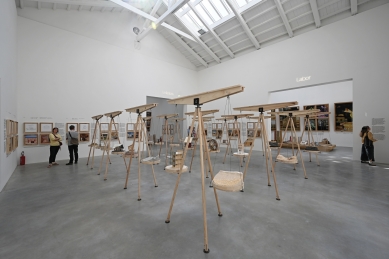
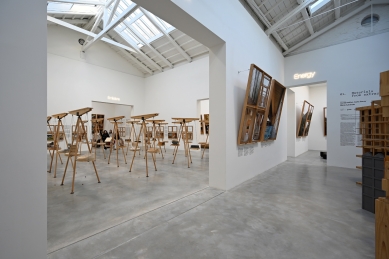
The central theme of the exhibition is, therefore, the search for territorial balance. The exhibition weighs every architectural decision against its environmental and material cost. In the main hall, there are 16 scales, with 16 selected architectural projects by Spanish architects on one side of the scale, and the resources required for these buildings—wood, stone, labor, and energy—on the other. The goal is to show the state when these scales are balanced, and architecture does not burden its surroundings more than is bearable.
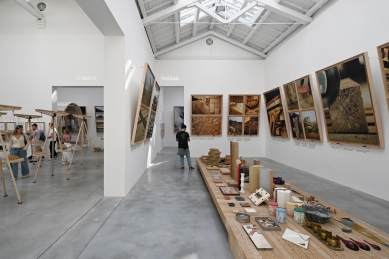
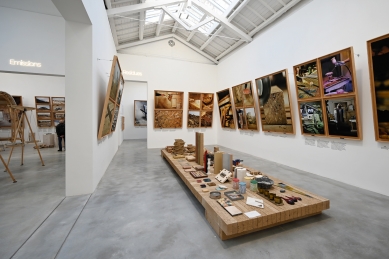
The second key element is large-format photographs. These do not only serve an illustrative role. They do not just show completed buildings. They focus on the scenes of action—quarries, forests, factories, and workshops in five regions of Spain. These images aim to connect architecture with the landscape from which it emerged. They show that a brick is not just a product but a piece of fired earth from a specific place.
Furthermore, the exhibition is structured into five axes around the main room with scales. These axes aim to define a new Spanish architecture:
Materials: A return to natural local resources and how modern technology can utilize these old materials for contemporary needs. A tangible element is three totems in the center, which serve as proof that these materials can function as modern vertical structures.
Energy: The exhibited projects showcase homes that can cool themselves thanks to thick walls, thoughtful shading, or the chimney effect. It is architecture that fights against climate through shape and orientation.
Labor: The exhibition suggests that true sustainability is also social—when you give work to a local stonemason or carpenter, the money and skills remain "inside" the region (internalities) and do not flow away.
Waste: In the logic of "Internalities," there is no consideration for discarding any material. The projects in this room demonstrate absolute circularity—how rubble from an old building becomes the foundation for a new one, how old bricks are recycled, or how a house is designed to be dismantled in 50 years rather than demolished. This logic is illustrated in the room by a column made of crushed bricks, concrete, tiles, and ceramics. A cross-section of various reused materials as a new foundation.
Emissions: Focused on drastically shortening supply chains. The graphics and photographs here map the absurdity of global transportation and present a local approach in contrast. In the middle stands an arched wooden structure, which, due to its shape and material, is low-emission.
I chose the Internalities project because it is not just an exhibition; it is a kind of map of resources and guidelines for future generations. It shows a different way of building that is not an unattainable vision but a reality that a new generation of Spanish architects is already living.
The central theme of the exhibition is, therefore, the search for territorial balance. The exhibition weighs every architectural decision against its environmental and material cost. In the main hall, there are 16 scales, with 16 selected architectural projects by Spanish architects on one side of the scale, and the resources required for these buildings—wood, stone, labor, and energy—on the other. The goal is to show the state when these scales are balanced, and architecture does not burden its surroundings more than is bearable.
The second key element is large-format photographs. These do not only serve an illustrative role. They do not just show completed buildings. They focus on the scenes of action—quarries, forests, factories, and workshops in five regions of Spain. These images aim to connect architecture with the landscape from which it emerged. They show that a brick is not just a product but a piece of fired earth from a specific place.
Furthermore, the exhibition is structured into five axes around the main room with scales. These axes aim to define a new Spanish architecture:
Materials: A return to natural local resources and how modern technology can utilize these old materials for contemporary needs. A tangible element is three totems in the center, which serve as proof that these materials can function as modern vertical structures.
Energy: The exhibited projects showcase homes that can cool themselves thanks to thick walls, thoughtful shading, or the chimney effect. It is architecture that fights against climate through shape and orientation.
Labor: The exhibition suggests that true sustainability is also social—when you give work to a local stonemason or carpenter, the money and skills remain "inside" the region (internalities) and do not flow away.
Waste: In the logic of "Internalities," there is no consideration for discarding any material. The projects in this room demonstrate absolute circularity—how rubble from an old building becomes the foundation for a new one, how old bricks are recycled, or how a house is designed to be dismantled in 50 years rather than demolished. This logic is illustrated in the room by a column made of crushed bricks, concrete, tiles, and ceramics. A cross-section of various reused materials as a new foundation.
Emissions: Focused on drastically shortening supply chains. The graphics and photographs here map the absurdity of global transportation and present a local approach in contrast. In the middle stands an arched wooden structure, which, due to its shape and material, is low-emission.
I chose the Internalities project because it is not just an exhibition; it is a kind of map of resources and guidelines for future generations. It shows a different way of building that is not an unattainable vision but a reality that a new generation of Spanish architects is already living.
Tadeáš Gryc, FA VUT
The English translation is powered by AI tool. Switch to Czech to view the original text source.
0 comments
add comment