
Fresh air indoors

Publisher
Ing. Martin Bžoch, technik STIEBEL ELTRON
02.06.2021 09:35
Ing. Martin Bžoch, technik STIEBEL ELTRON
02.06.2021 09:35
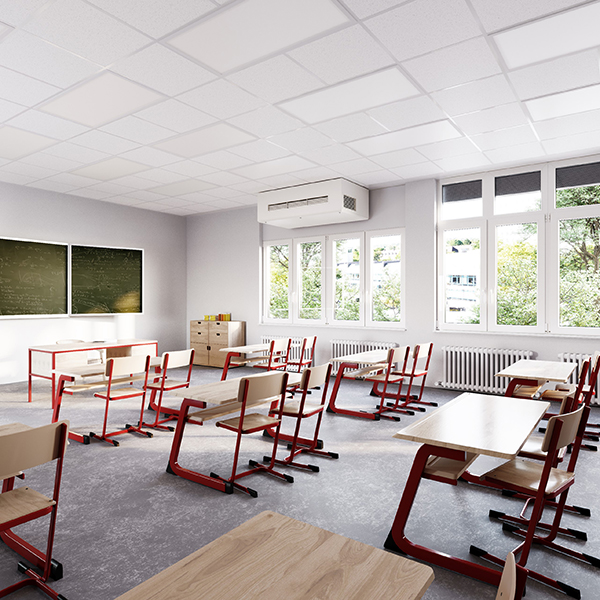 |
A lack of fresh air causes uncomfortable conditions such as headaches or fatigue, which also decreases our ability to concentrate. A typical example of buildings where inadequate focus and fatigue have a direct impact on overall productivity is schools. Older school buildings often undergo renovations to the façade, with old windows being replaced by new, better-sealing ones, causing the natural air exchange in classrooms to cease functioning. Ventilating through windows is, of course, possible, but for most of the school year – in autumn and winter – the cold air from outside is not ideal. In spring, however, noise from the street enters the classrooms through open windows, disrupting the teaching process.
Ventilation without heat loss
However, this issue does not apply only to schools but to all public buildings that have undergone the "sealing" process. This includes offices, restaurants, fitness centers, gyms, lecture halls, meeting rooms, and other public spaces.The solution that helps prevent a lack of fresh air in these types of buildings without heat energy loss is the decentralized ventilation unit VRL-C from the German manufacturer STIEBEL ELTRON. This compact device, designed for ceiling installation, takes up no floor space while fully satisfying the demand for ventilation with heat recovery, available in three versions: 325/625/870 m³/h.


Solutions without extensive construction modifications
If the ventilation system was overlooked during the renovation of a building and needs to be installed subsequently, the unit VRL-C in G version with an integrated supply and exhaust grille, which requires no ductwork, can be a solution, thus not necessitating any significant construction intervention such as the installation of air ducting. However, for planned renovations or new constructions, we can consider using the unit VRL-C in D version with connections for ductwork. This variant is ideally implemented in the ceiling of the room.The decentralized concept of individual units for each space ensures independently controllable ventilated units, meaning, for example, that each classroom is ventilated with the exact amount of air currently needed as measured by a CO2 concentration sensor. When the room has been ventilated and no one is moving in it, the unit automatically reduces its output, thereby saving operational costs. However, all units in the building can be connected into one system, which can be centrally managed, for example, via the Modbus protocol or the internet.
Modern duct system
Nowadays, adequate ventilation of indoor spaces is a current topic in connection with the coronavirus pandemic. "In everyday life, we should focus more on ventilation and less on constantly disinfecting our hands and surfaces," advises virologist Christian Drosten from the Robert Koch Institute in Berlin. The VRL-C ventilation unit is more than a suitable solution, especially for existing public buildings.At STIEBEL ELTRON, as manufacturers of ventilation systems with more than 20 years of development, we can offer a complete ventilation solution for residential buildings, not only through ventilation units but also thanks to the correct and modern duct system. STIEBEL ELTRON is not just synonymous with heat pumps, electric heating products, and hot water heating but also with comprehensive ventilation systems.
For more information about the complete range of STIEBEL ELTRON ventilation units, visit www.stiebel-eltron.cz/vetrani
STIEBEL ELTRON spol. s r. o., Dopraváků 749/3, 184 00 Prague 8
T: 251 116 111, E: info@stiebel-eltron.cz, www.stiebel-eltron.cz
The English translation is powered by AI tool. Switch to Czech to view the original text source.
0 comments
add comment