
In Brno, statues are rising like mushrooms after rain, attracting criticism
 |
Four of the newly unveiled installations are part of the plan "Sculptures for Brno" from 2006, which aimed to install ten new sculptures in Brno within a decade. The original idea was to bring reminders of significant personalities associated with the metropolis to Brno (the Brno Vegetable Market has thus been adorned for some time with a statue of Wolfgang Amadeus Mozart by Kurt Gebauer), but the installations have gradually deviated from this original plan.
The image of the city's center is therefore newly shaped in recent weeks by the statue of Justice in the form of a man lifting a block from the ground, a fountain with a stone edging (allegory of temperance), a bronze model depicting Brno during the unsuccessful Swedish siege in 1645 (allegory of foresight), or a statue of light bulbs reminding of inventor Thomas Alva Edison.
The fifth statue, which does not belong to the plan, is the extravagant granite astronomical clock in Liberty Square.
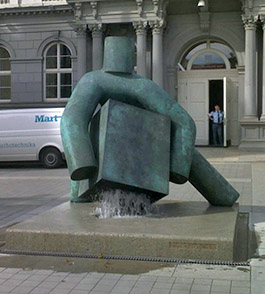
In the statue of a man lifting a heavy block by sculptor Marius Kotrba, which according to the creator's imagination represents justice, and symbolically stands in front of the building of the Supreme Administrative Court, some Brno residents with a more vivid imagination see, for example... an executor confiscating a bidet.
"Some see a bidet, others see a confiscated television," said Kateřina, who has not lived in Brno for ten years and only returns for short visits. "The problem with the statue is that it is unclear whether it is lifting the burden or placing it down," noted architect Jan Březina, who works in Brno.
 |
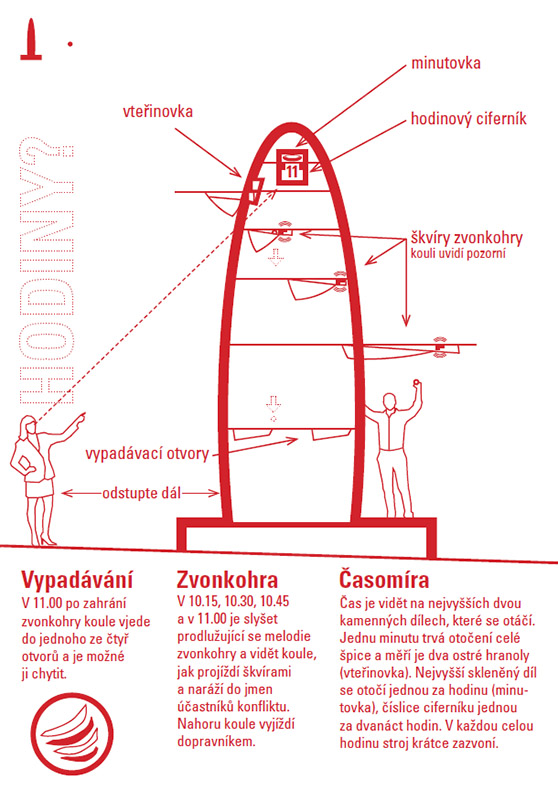
Even more turmoil among Brno's emotions is caused by a multifunctional clock monument worth almost 12 million crowns, which according to its creators - architects Oldřich Rujbr and Petr Kameník - is supposed to represent a cartridge referencing historical events when Brno successfully defended itself against the Swedish siege. "The cherry on top" of the work is that it drops glass balls at 11 o'clock, triggering a special carillon. The symbolism of the glass ball refers to the legend that only a glass bullet could kill General Torstenson, commanding the Swedes.
"Probably the only two positive aspects of the unveiling (of the clock) were the removal of some scaffolding from the city center plus the creation of a source of entertainment for passing tourists," remarked the Brno university lecturer David dryly regarding the ceremony. Other critics accuse the clocks of being overpriced and that it is not even possible to properly tell the time on them. They did not impress Daniel Rychnovský either. "I have a reserved stance toward them. There was a lack of preparation and discussion with the citizens of Brno," he noted, adding that "architecture should evoke positive emotions, which does not happen in this case." Architect Kameník defends his creation, stating that while it is good that there is a discussion about the artifact, many people apparently did not understand the philosophical concept behind it. "When art and architecture are simplified to just whether they are liked or disliked, it is very bad," Kameník stated.
Less controversial emotions and more praise is evoked by the three-meter statue of light bulbs made from a network of intertwined wires by Tomáš Medek, which near the Centrum department store reminds of the inventor Edison. He stopped in Brno during his journey through Europe in 1911. According to architect Březina, it is an imaginative statue, which perhaps only raises concerns about how it will be maintained: leaves could easily fall inside the statue or people might throw trash in it.
After all, the nightmares of artists and police that public artworks might be damaged by people have already been partially fulfilled. Vandals in September made off with part of the controversial granite astronomical clock, but fortunately did not cause any serious damage.
 |
The English translation is powered by AI tool. Switch to Czech to view the original text source.
35 comments
add comment
Subject
Author
Date
...no tak určitě...líbí / nelíbí
arch. Jindřich Bukovina
03.10.10 11:46
Konečně
gallina-scripsit
04.10.10 02:06
týpek
Vích
04.10.10 04:53
tedy ti architekti
Jan Sommer
04.10.10 06:08
V Brně rostou sochy jako houby po dešti, sklízejí kritiku
DeRon
04.10.10 06:31
show all comments