
The book reveals the secrets of the old Prague house signs
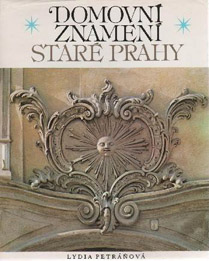 |
The core part of the book is a colorful gallery of picturesque house signs. The Prague pedestrian today perceives them more as decorative elements of historical Prague architecture. Once, however, they served a practical purpose for orientation in the city. They were born from the medieval urban culture at a time when, given the number of streets and buildings, it became difficult to navigate, and this aid became a necessity.
Among the more active ones is the house "At the Stone Mermaid" in Karlova Street, "At the White Unicorn" in Old Town Square, where there is also the house "At the Stone Bell." Almost everyone knows the pub "At the Three Ostriches" on U Lužického Semináře Street under Charles Bridge. A beautiful story is associated with the house "At the Three Wild Men" in Řetězová Street. They were actually con artists thrown out of service, who under the leadership of an English impresario pretended to be savages and devoured raw chickens.
House signs spoke to the medieval people in the same language that today’s orientation and traffic signs speak to modernman. Along with them and the houses they denote, there are also legends, which the author dedicates a separate chapter to.
Color photographs, most of which were taken by photographer Pavel Štecha, are arranged with regard to the period of their creation and taking into account the evolution of artistic styles. The publication is supplemented by a catalog of house signs from historical Prague towns, which contains about 2000 entries. It includes not only signs that still exist in Prague's streets but also those that have long disappeared or are only seen in museum collections. The catalog is supplemented with an alphabetical index.
"When you walk through old Prague, lift your eyes from the daily hustle and bustle of today’s streets and look above the portals of ancient houses. You will discover much of the charm of human imagination and creativity," the author advises readers.
Petráňová works at the Ethnological Institute of the Academy of Sciences. She is the author of numerous studies and three history textbooks. She has contributed authorship to publications such as "The History of Material Culture" (1985, 1987), "The Farmer in European Culture" (2000), and the collective work "Folk Culture. Ethnographic Encyclopedia of Bohemia, Moravia and Silesia" (2007).
The English translation is powered by AI tool. Switch to Czech to view the original text source.
0 comments
add comment