
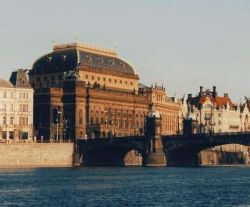
The reconstruction of the façade of the National Theatre will begin in 2009, the roof is already being repaired
 |
"We expect that (with the first phase of repairs) we will finish by the middle of next year. It should be secure for 50 years," Černý said at today’s press conference in Prague. The restoration of the building's facade will start on the northern side near Národní třída. A tender process must first be conducted, and the project needs to be registered with the Ministry of Culture.
While the gilded cast-iron railing weighing 10.5 tons will be removed from the roof and, after repairs, covered with two kilograms of the highest purity gold leaf, a bronze copy of Schnirch's sculpture of rearing horses, the original of which was destroyed in the fire of the “golden chapel” in 1881, will be repaired on the roof. In 1940, the horse's legs were cast in concrete, and water leakage and condensation have contributed to their poor condition. The total weight of the sculpture group is around 6000 kilograms.
Miroslav Růžička from the technical-economic administration of the Czech first stage pointed out the project for utilizing waste heat energy in ND facilities. "It will cost about 40 million crowns, which will be recouped in energy savings over ten years," he stated. The interior decoration of the "golden chapel", including frescoes and gilding, is also continuously being repaired. Hynais's curtain awaits restoration, which will be cleaned and retouched.
In the next part of the press conference, Černý commented on speculations about a possible merger of the National Theatre with Laterna magika. "In my concept, with which I applied for the director position, I considered this," he noted. According to him, the return of the former New Stage to the stage will be particularly important for drama, which needs an intermediate space for 400 spectators to present contemporary drama. "It could present titles that are risky and provocative," Černý added. He considers the Ministry of Culture's thoughts about a possible merger to be legitimate, as this has been the case in the past.
"The transformation ministerial committee is discussing it, and we do not reject any model for connection with ND," Černý added, according to whom ballet and opera productions could also be presented at the New Stage. "But these are just speculations; we have not yet started official negotiations," said the ND director. He expects that the options for possible relationships could be known within two to three months.
LM Director Petr Tošovský wants to transform the ensemble's dramaturgy; thus, he welcomes this intention. "It should return to its original purpose, namely to the image and stage action, abandon the form of dance theatre, and revive dramatic performances. We want to offer space for talented artists and seek co-production possibilities, even with ND ensembles," Tošovský told ČTK.
The English translation is powered by AI tool. Switch to Czech to view the original text source.
0 comments
add comment