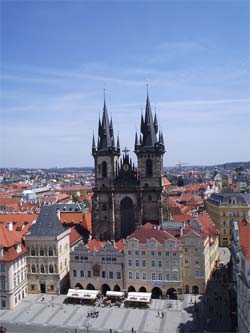
Praha will approve a plan this year that aims to protect the heritage reserve
 |
According to Votava, UNESCO requires such a plan from all cities listed as World Cultural Heritage sites. ÚRM is currently finalizing the plan and intends to send it at the beginning of February.
The document should specify how the city will protect the reserve, where high-rise buildings cannot be built, or where there are development sites in the metropolis where construction can be anticipated. Among the development areas, the plan includes some spaces in the city center, such as Masaryk Station, the surrounding area of Vyšehrad Station, the gap at the corner of Mikulandská and Národní třída, Nový Svět, or Albertov.
This does not please the president of the Czech section of the International Council on Monuments and Sites (ICOMOS), Josef Štulc, who has prepared comments on the document. "I do not consider it wise management for the city to continue to proceed as it has over the last twenty years. That is, heedlessly filling all available free spaces predominantly with commercial buildings and not leaving much-needed spatial reserves for the future," said Štulc. According to him, designating areas as development sites only increases the pressure for their accelerated and irreversible construction.
According to Votava, the material should protect not only the center but also other significant monuments, such as the Břevnov Monastery, and important landscape features, such as the Vyšehrad Rock and the relief of the Vltava River.
Among other things, the plan includes a methodology for assessing the construction of high-rise buildings, according to which such buildings cannot be built in the historical center and the adjacent protective zone. Outside these areas, it will be assessed whether the construction poses a threat to the heritage reserve or whether it will change traditional historical views. The decisive factor will be the view from selected 36 points in various parts of Prague, including Vítkov, Vyšehrad, Nebozízek, the Petřín lookout tower, the restaurant Brussels, Bulovka, or Dobeška.
"For example, it has been confirmed that in Bohdalec - Slatiny, an eighty-meter building can be built and will not be visible from anywhere except the immediate vicinity," Votava stated, adding that each construction must also be assessed in terms of transport or infrastructure.
Štulc finds a guarantee lacking in this methodology that UNESCO will be informed in advance about projects that will influence the city's panorama. "The city and the Czech state would thus avoid repeating the unpleasant case of high-rise buildings on the Pankrácká Plain, which damaged our prestige and credibility," Štulc noted.
A so-called World Heritage Council will express its opinion on possible high-rise buildings and the development of development areas. Its establishment is likely to be anchored in the heritage law. According to the material, the council will consist of representatives of the capital city, significant monument owners, scientific institutions, and universities, as well as representatives of the most important entrepreneurs operating in the area of the heritage reserve.
Štulc sees a conflict of interest in the membership of entrepreneurs. "In an advisory body meant to protect cultural values, representatives of those entities whose activities may threaten these values would thus be incorporated in the form of a Trojan horse," stated the president of the Czech section of ICOMOS. According to him, members of civic associations should rather be invited to the council. However, the plan does not account for them.
If the material is approved by Prague city councilors, it will become a binding document according to which authorities and institutions should behave. The plan will be revised every ten to 15 years.
List of development areas according to the management plan:
in the historical core of Prague
- the location behind the Tesco department store
- Albertov
- Hořejší waterfront
- Wenceslas Square - tunnel behind the museum
- Main train station and its surroundings
- former printing houses between Na Poříčí and Na Florenci streets
- gap at the corner of Mikulandská and Národní třída
- Vyšehrad station and its surroundings
- Masaryk Station
in the protective zone of the historical core of Prague
- Strahov
- Letná
- Prašný bridge
- Maniny, lower Libeň, Invalidovna
- Holešovice, Bubny, Zátory
- Holešovice port
- Vysočany - Ocelářská
- Pankrác prison
- Smíchov station
- Dejvice - Victory Square
in a more distant location from the historical core
- Bohdalec - Slatiny
- Žižkov freight station
- Jinonice
- Velká Chuchle
- Modřany
- Chodov
- Prosek, Střížkov residential areas
- Letňany - exhibition grounds
- Vokovice - Evropská
Source: Management plan for the historical core of Prague (working version)
The English translation is powered by AI tool. Switch to Czech to view the original text source.

0 comments
add comment